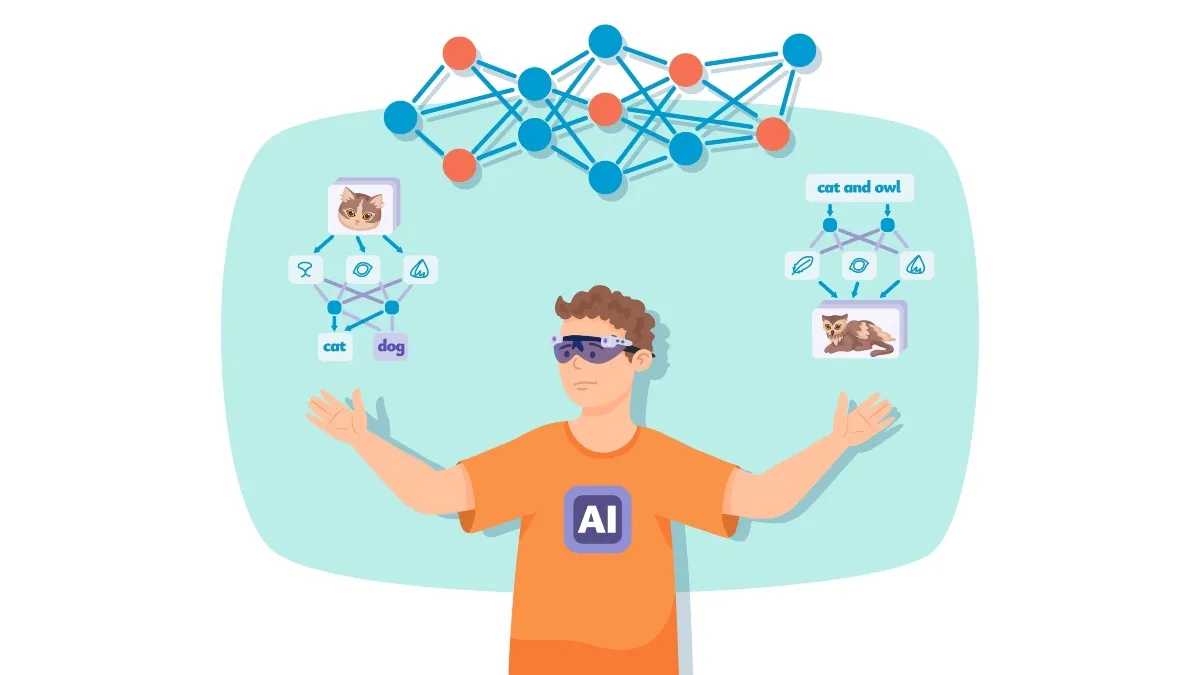
Have you ever marveled at how Google Photos can instantly group your images based on faces? This sophisticated process is powered by Convolutional Neural Networks (CNNs), a pivotal technology in artificial intelligence that classifies images by identifying similar features. If you’re curious about how CNNs enhance our understanding of visual data, dive into our comprehensive guide.
What is CNN in Deep Learning?
CNN, or Convolutional Neural Network, is specifically tailored for processing grid-like data such as images. Unlike traditional neural networks that treat each pixel in isolation, making it computationally intense to analyze images, CNNs recognize patterns much more efficiently. They work similarly to the human brain, recognizing edges, shapes, and textures, which enables us to identify complete objects like faces or vehicles. In essence, CNNs utilize a hierarchical approach to interpret visual information.
How CNNs Actually Work
The architecture of CNNs consists of multiple layers, each extracting intricate features from images. The journey begins with the Convolutional layer—this critical component employs small filters that traverse the image to seek out specific patterns, such as edges or lines.
As the network delves deeper, these filters identify increasingly complex patterns, including curves and textures. Imagine using a magnifying glass to analyze a painting; similarly, the Convolutional layer slides across the image, performing mathematical operations to determine the presence of certain features.
Next, pooling layers condense the information gathered, retaining only the strongest signals and streamlining data processing. Subsequently, fully connected layers classify the overall image based on the features extracted. For instance, if the CNN is trained to identify animals, it can conclude that “this image contains a dog” by evaluating the recognized characteristics.
The Origin Story of CNN
The evolution of CNNs is fascinating. Yann LeCun is often credited as the father of modern CNNs, creating a network capable of recognizing handwritten digits back in 1989. But the groundwork was laid much earlier, in the 1980s, when Japanese computer scientist Kunihiko Fukushima introduced the “Neocognitron,” which outlined how layered networks could process visual input.
Fukushima’s early work was revolutionary, introducing key concepts still utilized in CNNs today. Ultimately, LeCun’s innovation with backpropagation enabled CNNs to learn from data autonomously, essentially popularizing their use.
A pivotal moment in CNN history arrived in 2012 when Alex Krizhevsky, Ilya Sutskever, and Geoffrey Hinton unveiled AlexNet, a CNN that triumphed in the ImageNet competition, significantly outperforming traditional methods. This victory illustrated that with enough data and computational power, CNNs can surpass older approaches for visual analysis.
How CNNs are Trained
Training a CNN requires a vast amount of labeled data. Millions of images, each accurately described, provide the foundation for the network’s learning process. The CNN makes predictions, which are then compared to the correct labels, allowing it to fine-tune its parameters for better accuracy through a process called backpropagation. This iterative method repeats countless times until the network effectively learns to recognize various patterns in images.
The Future of CNNs
While CNNs have revolutionized the field of artificial intelligence, emerging technologies like Vision Transformers (ViT) are demonstrating superior performance. These models, based on Transformer architecture, analyze images in sequences of patches rather than employing traditional convolutional filters. Although ViTs offer heightened accuracy, they demand more computational resources.
In contrast, CNNs remain efficient and can be deployed on edge devices, including mobile phones with limited computational power. Regardless, CNNs have drastically enhanced our ability to process and comprehend visual information, setting a solid foundation for future advancements.
Why are CNNs important for image recognition?
CNNs are crucial because they automate the recognition of patterns in images, making them essential for applications like facial recognition and object detection.
What are the main components of a CNN?
The main components include the Convolutional layer for feature detection, pooling layers for data reduction, and fully connected layers for classification.
How does backpropagation improve CNN performance?
Backpropagation adjusts the parameters of the network based on prediction errors, enhancing its ability to recognize patterns accurately over time.
Are CNNs still relevant in the age of advanced AI models?
Absolutely, CNNs are still highly relevant due to their efficiency and effectiveness in processing visual data, especially on devices with constrained resources.
If you’re intrigued by the technicalities of CNNs, continue exploring related content to expand your knowledge. Visit Moyens I/O for more insights and updates in the world of technology.