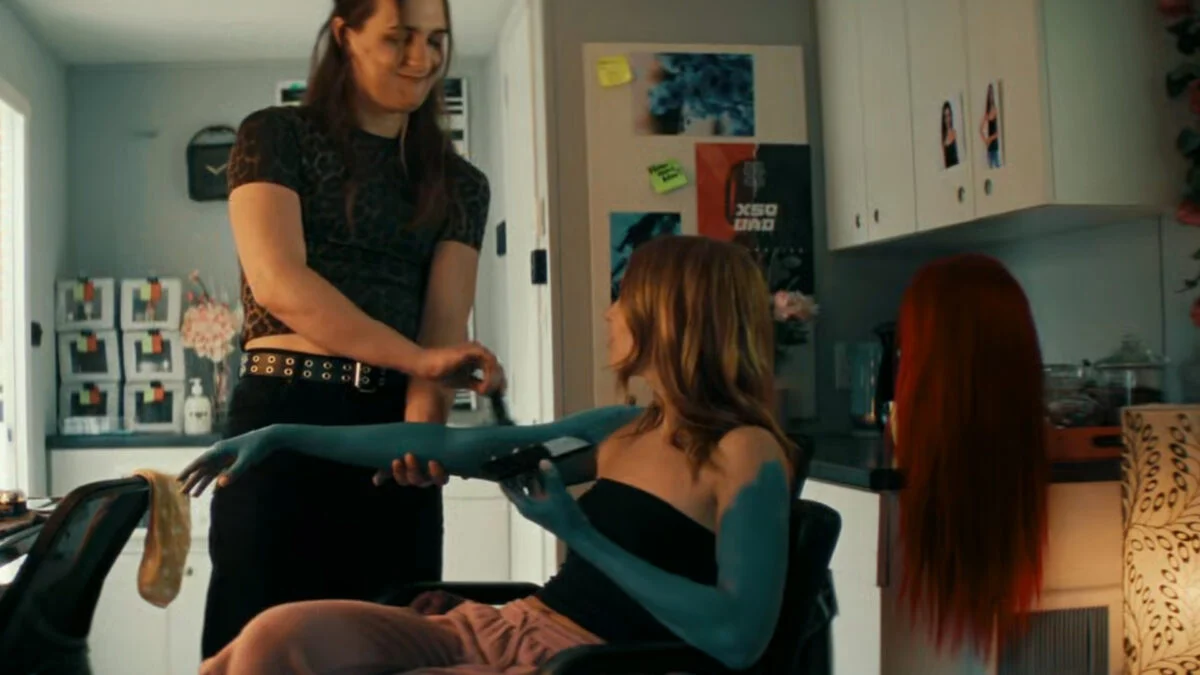
It’s not every day that a gay hockey romance series captures the spotlight alongside sci-fi and fantasy, but Heated Rivalry is doing just that. As I watched one of the standout episodes of this 2025 hit, I found myself drawn not only to the passionate love story of Shane Hollander and Ilya Rozanov but also to a delightful pop culture reference that pays homage to Canada’s superhero legacy.
In episode five, a phone conversation between Shane and his former girlfriend Rose Landry unfolds in a makeup trailer where Rose, dressed in blue body paint, jokes about her superhero role. “I miss being kidnapped,” she sighs, a clear wink at Mystique from the X-Men films. This clever nod isn’t just amusing; it’s woven into the very fabric of the Marvel cinematic universe and its Canadian connections, as confirmed by showrunner Jacob Tierney.
Rose’s lament serves as lighthearted commentary on the film industry, echoing comments made by the original Mystique actress Rebecca Romijn, who recently shared her experiences filming Avengers: Doomsday with an unfinished script. It brings to mind the creative quirks of superhero cinema and how heroes often grapple with narratives that mirror real-world complexities.
Rachel Reid’s Game Changers book series, the inspiration for Heated Rivalry, has its own ties to this broader superhero mythology, showcasing the way fan fiction can evolve into mainstream content. The choice to include Mystique as Rose’s character is fitting. Mystique herself has a rich history as a queer icon within the Marvel universe, her relationship with the precognitive mutant Destiny representing a long-standing bond often left unspoken.
Originally introduced in the late 1970s, Mystique’s ties to the LGBTQ+ community became more visible when her relationship with Destiny was subtly depicted in the comic world. They shared a deep, familial love, raising Rogue together as adoptive mothers. Even though their bond was clouded by the conservative ideologies of earlier comic book eras, it became a beacon for queer representation long before it was explicitly stated in Marvel canon.

Chris Claremont, who crafted many of Mystique’s early narratives, often hinted at her relationship with Destiny until it was explicitly addressed in the present-day comics. Their love, which has spanned years, recently culminated in Marvel’s first same-sex female wedding, renewing their vows and solidifying their bond within the superhero community.
This backdrop enriches Heated Rivalry, where Rose’s portrayal of Mystique becomes more than just a playful reference. As one of the few people Shane confides in about his own identity as a gay man, Rose’s character subtly encourages him to embrace who he is. What could have just been a humorous nod now adds depth to the show’s messaging around acceptance and identity.
Why does Mystique resonate as a queer symbol in comics?
Mystique’s character embodies the struggles and triumphs of queer identity, making her a relatable figure for many fans. Her journey reflects the challenges of self-acceptance in a world that often seeks to define us by rigid categories.
What makes Heated Rivalry a standout series?
This series combines romance, sports, and cultural references, creating a unique narrative that appeals to diverse audiences. Its complex characters and genuine moments of connection have resonated widely.
Are there other examples of LGBTQ+ roles in superhero series?
Many recent superhero series are stepping up to portray LGBTQ+ characters authentically, such as in shows like Legends of Tomorrow and Harley Quinn. These characters often explore themes of love and identity akin to those seen with Mystique and Destiny.
How has comic representation evolved over the years?
Comic representation has progressed significantly, shifting from subtle hints of queerness and character relationships to explicit portrayals of LGBTQ+ heroes. This evolution reflects broader societal changes around acceptance and visibility.
This small nod to Mystique in Heated Rivalry shows a deep appreciation for the history of LGBTQ+ representation within the comics world. It beautifully merges Shane’s own journey with the complexities of a character who has long navigated her identity in a world that often misunderstands her. So, as you catch the next episode, keep an eye out for these layered connections. What do you think about the references to queer identities in mainstream media? Feel free to share your thoughts in the comments below!