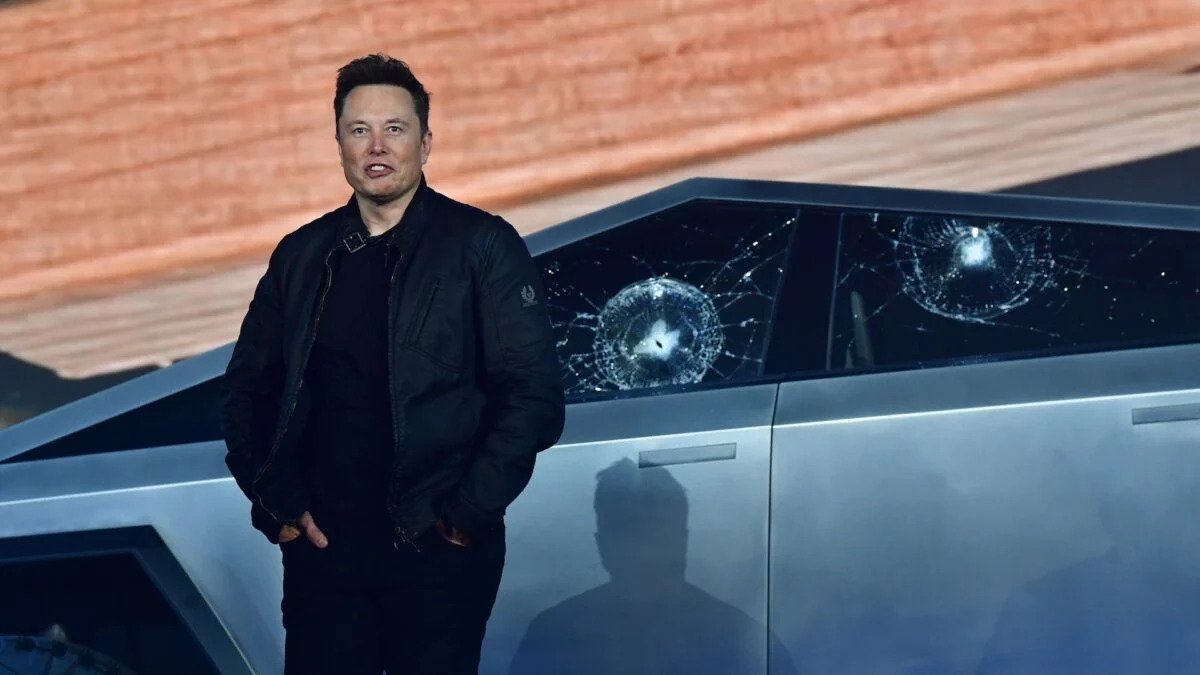
The sun beat down on the cracked asphalt as the test vehicle sped past, its bizarre angles catching the light like a distorted mirror. A knot formed in my stomach – was this the future of automotive design, or a vehicular fever dream backed by petrodollars? If you want a Cybertruck of any kind, you’re going to have to support a monster.
The Tesla Cybertruck certainly made an impact, though maybe not the one its champions expected. Regardless of whether you love or hate the design, it has spawned a series of imitators. Now, a startup from Saudi Arabia is throwing its hat into the ring with a vehicle that seems heavily “inspired” by Tesla’s polarizing creation – but with a few twists that might make even the most ardent Cybertruck critic shudder.
Spy photos recently surfaced, offering a glimpse of CEER Motors‘ prototype undergoing testing. Despite the heavy camouflage, the vehicle’s basic shape and, more notably, its gullwing doors are visible. It’s pretty clear this model, backed by the Saudi Arabia Public Investment Fund, borrows heavily from the Cybertruck’s design language, with a dash of the Model X thrown in for good measure.
Based on images from @ResponseJP, CEER’s EV sports a tall, flat front and an expansive windshield reminiscent of the Cybertruck, which extends slightly over the driver’s seat. The driver appears to sit far back from the vehicle’s nose. Unlike the Cybertruck, the CEER is an SUV, with the rear ending abruptly instead of extending into a truck bed.
こんな形のクルマ、アリ!? ガルウィングと世界最大のフロントガラス、サウジアラビア発「CEER」が始動https://t.co/DY4y0Vs5M1#新型車 #電気自動車 pic.twitter.com/bboKc3YmHu
— レスポンス (@responsejp) January 11, 2026
Gullwing Doors on an SUV: A Practical Choice?
I remember the first time I saw gullwing doors on a DeLorean; it was a pure spectacle. Now, CEER is integrating gullwing doors. Once a sports car novelty, the Model X (in)famously adopted the design for its rear doors. While they might offer some visual flair, anyone who’s used them in a crowded parking lot, a garage, or to access the rear seats of an SUV knows they’re often more trouble than they’re worth.
What companies are involved in the CEER Motors project?
From the get-go, CEER has highlighted its partnerships with established players in automotive manufacturing and EV tech. Foxconn, aiming to expand into automotive production, has been involved from the beginning for development and manufacturing logistics.
Last November, CEER announced that Rimac, a Croatian firm known for its work with Aston Martin on battery tech and its own high-performance vehicles, would supply the electric drive powertrain. They’ve also partnered with Hyundai Transys for additional drive systems. The whole project, from the outside, seems to be mimicking Lucid motors, which is also funded by the Public Investment Fund.
Saudi Vision 2030: Driving the Electric Vehicle Push
I watched a documentary recently that highlighted the scope and ambition of Saudi Vision 2030. The CEER vehicle is part of Saudi Vision 2030, so it will be a battery electric vehicle. Government officials and the Crown Prince launched the program in 2016 to promote economic diversification, which included the production of an electric car, not one powered by gasoline. There have been criticisms about the large-scale displacement of residents and businesses to accommodate certain companies. It’s a gamble – betting on a future that may or may not align with the needs and desires of the people it’s supposed to serve. The entire project is something of a house of cards.
How is the CEER project funded?
The Public Investment Fund, which funds Saudi Vision 2030, has invested in Saudi-based companies and ventures like Lucid Motors, Uber, and Newcastle United F.C.
Production Timeline and Remaining Questions
According to a press release issued this past Tuesday, the still-unnamed EV is scheduled to begin production in the fourth quarter of this year. The CEER is shaping up to be an interesting – if somewhat derivative – addition to the EV landscape. But with its unusual design choices and the backing of a controversial investment fund, one has to wonder: is this a glimpse into the future of sustainable transportation, or just another gaudy symbol of shifting geopolitical power?