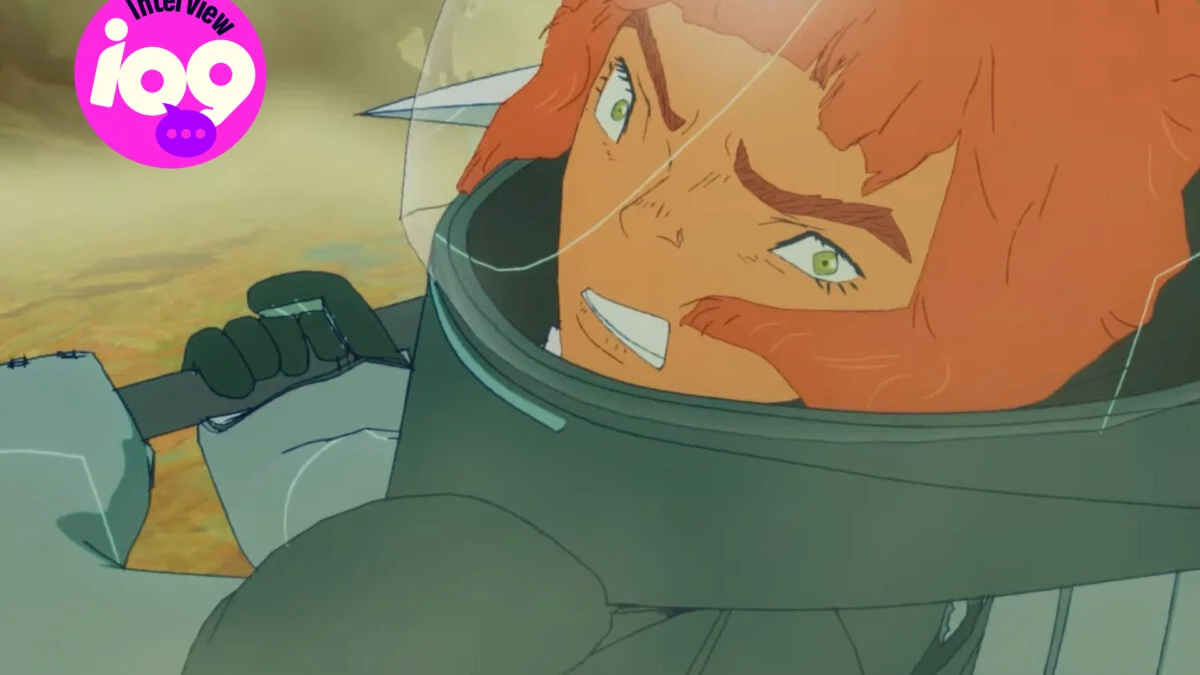
The moment the mech suit locked into place, Keiji knew it was different. A surge of power, a clarity of purpose—this wasn’t just another deployment against the alien Mimics. This time, something felt destined, a convergence he couldn’t explain, but trusted with every fiber of his being.
All You Need Is Kill may initially register as a new anime title acquired for U.S. distribution by GKids. However, it’s actually the latest adaptation of a story with a surprisingly expansive history.
The best-known version might be Tom Cruise and Emily Blunt’s sci-fi actioner Live Die Repeat, better known as Edge of Tomorrow. But the origins trace further back. The source material is a 2003 novel by Hiroshi Sakurazaka, which then became a manga, adapted by Ryosuke Takeuchi with illustrations from Death Note artist Takeshi Obata. This anime adaptation moves in reverse of the usual anime industry trajectory.
The plot centers on Keiji, a soldier fighting invading aliens using powerful mech suits. After dying in battle, Keiji finds himself trapped in a time loop, forced to relive the same day repeatedly. His only hope lies in finding a way to break the cycle. He’s joined by Rita, humanity’s most formidable warrior, also stuck in the loop. Armed with a giant cyber axe, she fights alongside Keiji to escape their endless purgatory and win the war.
Anytime a work is labeled an “adaptation,” there’s cause for trepidation. But fans are reacting with cautious optimism to this new animated interpretation by Studio 4°C (Children of the Sea). Director Kenichiro Akimoto spoke with io9 about why he felt driven to breathe new life into this celebrated series.
Although All You Need Is Kill marks Akimoto’s directorial debut—he previously worked as a CG artist on the Berserk: The Golden Age Arc trilogy and as a CGI director for Netflix’s Children of the Sea—he attributes his taking on the project to serendipity and timing.
“I was in discussions with our president, [Eiko] Tanaka, about potentially directing a project. Simultaneously, Warner Bros. proposed an All You Need Is Kill animation project,” Akimoto said. “Everything aligned perfectly.”
Time-loop stories examine trauma, memory, and identity. This series’ fandom has experienced its own version of this cycle, divided between those who prize the original and those who accept the tale’s multiple adaptations. This reimagining will face challenges appealing to both pessimistic and cautiously optimistic fans, wondering how the story will change.
Akimoto acknowledges the quality and completeness of the source novel and calls the live-action film “very entertaining,” even though it diverges from the source. The most significant change in Studio 4°C’s film is its focus on Rita’s perspective rather than Keiji’s, which adds depth to her character beyond her tough exterior.
“When I was assigned to the animation, I saw it as an opportunity to infuse originality into the project. As a fan, I understand the desire for fidelity. However, I also wanted to create something distinct. That’s why we took this approach.”
Given that this is the third adaptation of All You Need Is Kill, Akimoto anticipated comparisons. However, he hopes the movie will stay true to the title, both thematically and in its 3DCG action, and also highlight the beauty of its dystopian sci-fi setting through animation.
“I wanted to showcase something beautiful within the story,” he said, emphasizing the importance of Keiji and Rita’s connection despite their initial circumstances. “Even though the story and the concept are the same, I wanted to provide everyone with a different experience.”
The film’s distinctive, psychedelic art style sets it apart. In contrast to the gritty aesthetic of the manga and the familiar sci-fi visuals of films like Elysium and District 9, Studio 4°C’s style is mesmerizing, a blend of pastel, precise, clean character models and rough-hewn, scribbly backgrounds. It’s as if the kinetic energy of ’90s anime Crayon Shin-chan was combined with a 2D-meets-3DCG sci-fi thriller.
“All You Need Is Kill” movie + artbook (Studio 4°C) are coming this friday in Japan.
Artworks >> https://t.co/MaxxjQApGl https://t.co/mLiqu14D6B pic.twitter.com/aZJoHhmzM8— Catsuka (@catsuka) January 7, 2026
Akimoto commends character designer Izumi Murakami for cultivating the anime film’s unique aesthetic. This project was also Murakami’s first time as a character designer. Akimoto provided initial ideas for Rita’s design, the visuals the audience will experience in theaters are considerably different from his starting suggestions—for the better, he says.
“Murakami drew inspiration from movie characters and created numerous concept art pieces. Initially, Rita’s character design was very photorealistic,” he said. “But as she refined it, it became flatter. I appreciate that aspect of the design. As Murakami worked on the sketches, she began to internalize the essence of Rita. That’s how her character design came to life.”

Akimoto says he didn’t need to make many changes once Murakami’s vision for Rita began to influence the rest of All You Need Is Kill. The tonal choice was essential in blending Studio 4°C’s skill in 3D animation. CG is often criticized within the anime community.
“The flatness of the character design is important in my film, because these flat characters are set against this 3DCG animation background. If the characters are too realistic, the contrast would be too jarring. So, I challenged myself to create this flat animation style, and that’s how it evolved.”
All You Need Is Kill arrives in theaters on January 16.
Want more io9 news? Check out when to expect the latest Marvel, Star Wars, and Star Trek releases, what’s next for the DC Universe on film and TV, and everything you need to know about the future of Doctor Who.
Director’s First Time
Think about it. The weight of expectation on a director’s debut. To Akimoto, taking on All You Need Is Kill was a stroke of fate.
“I had already been talking with our president, [Eiko] Tanaka, about possibly helming a project. And at the same time, Warner Bros. put together a proposal for an All You Need Is Kill animation project,” Akimoto said. “It just happened to all work together as perfect timing.”
What makes this adaptation of ‘All You Need Is Kill’ unique?
The most obvious, by Akimoto’s reckoning, lies in the switch from Keiji’s viewpoint to Rita’s—a first for the series. This shift adds new layers to the character, enriching her backstory beyond the hardened soldier.
“When I was put in charge of the animation, I wanted to approach it as a challenge to have our own originality into the project itself. And I know as a fan, I would have felt the same, like, ‘Wait, please don’t change it.’ But at the same time, I also wanted to create something that was different. That’s why this is the approach we took.”
The Perfect Novel
Imagine you’re tasked with remaking perfection. Akimoto openly admits the original novel is “complete and very perfect,” a sentiment that must have weighed heavily on him.
How does the director balance honoring the original with adding something new?
Akimoto understood the assignment; the film would invite comparisons. His hope is that the movie isn’t just truer to the title thematically and in its 3DCG action but that it captures the dystopian beauty in a way only animation can. The new movie’s style is a vibrant splash of color against the grim tones of earlier adaptations.
“I wanted to showcase something beautiful within the story,” he said, pointing out how important Keiji and Rita become despite their doomed first meeting. “Even though the story and the concept are the same, I wanted to have everybody experience a different form of entertainment.”
What is the art style of Studio 4°C’s ‘All You Need Is Kill’ anime?
It’s a trip. It’s a mind-bending mix. While the manga is dark and gritty, and the live action version maintains a 2010s-era sci-fi vibe reminiscent of Elysium and District 9, the new anime is a contradiction.
The character models and backgrounds are precise, clean, and pastel but also rough-hewn and intriguingly scribbly. Think of a sci-fi action thriller where the fluid action of a ’90s anime meets 2D-meets-3DCG animation.
The Character Designer
Character design is where the magic happens. According to Akimoto, character designer Izumi Murakami slowly cooked the anime film’s look to perfection.
“Murakami took a lot of inspiration from movie characters, and she drew a lot of different concept art for us. Initially, the character design for Rita was very photorealistic,” he said. “But as she brushed it up, it’s like it started to become more and more flat. That’s what I really like about the design. As Murakami was working on the sketches on her own, she started to get the concept of Rita in her mind. So that’s how her character design came to life.”
From there, Akimoto didn’t have to make many requests or changes to Murakami’s output as her style rippled into the rest of All You Need Is Kill. This visual tone was paramount in meshing Studio 4°C’s penchant for appealing 3D animation.
“The flatness of the character design is really important in my film, because these flat characters are going to be dropped into this 3DCG animation background. If the characters are too realistic, then the contrast would be too abrupt. So I wanted to challenge myself into creating this very flat sort of animation style, and so that’s how this came to be.”
The entire adaptation exists as a sort of paradox, and its success hinges on Studio 4°C’s ability to harmonize the original story’s themes with its unique style. Studio 4°C seems to be gambling on a bold vision, where the grit of war meets the dreamlike quality of anime. Will this gamble pay off, or will the fans reject this new, unexpected version?