The notification blinked on my screen: a manga artist I followed had gotten a like from James Gunn. My mind raced – what masterpiece of fan art had earned such high praise? Turns out, it was Hawk Girl and Supergirl grabbing coffee, rendered in that unmistakable manga style. And that’s how I discovered Manabu Yashiro’s work.
During last summer’s Superman rollout, one delight manga fans got the pleasure of witnessing on X/Twitter was fan art from mangaka Manabu Yashiro. On a pretty regular basis, he’d upload fan art of Hawk Girl and Supergirl hanging out whenever he wasn’t posting fan art of other pop culture icons like Hellboy, Wolverine, and Godzilla, to name a few. It even caught James Gunn’s attention in a cute moment on social media.
James Gunn commented on my fan art
OMG
#Superman pic.twitter.com/WVqUiEzGVC— やしろ学/Manabu YASHIRO (@yashiro_manabu) July 18, 2025
Beyond the Fan Art: Discovering Tank Chair
Have you ever been browsing for one thing and stumbled upon something far more interesting? That’s how I found Tank Chair. The title alone, echoing the same visceral punch as Chainsaw Man, was enough to warrant a closer inspection. What did Yashiro’s original work actually look like?
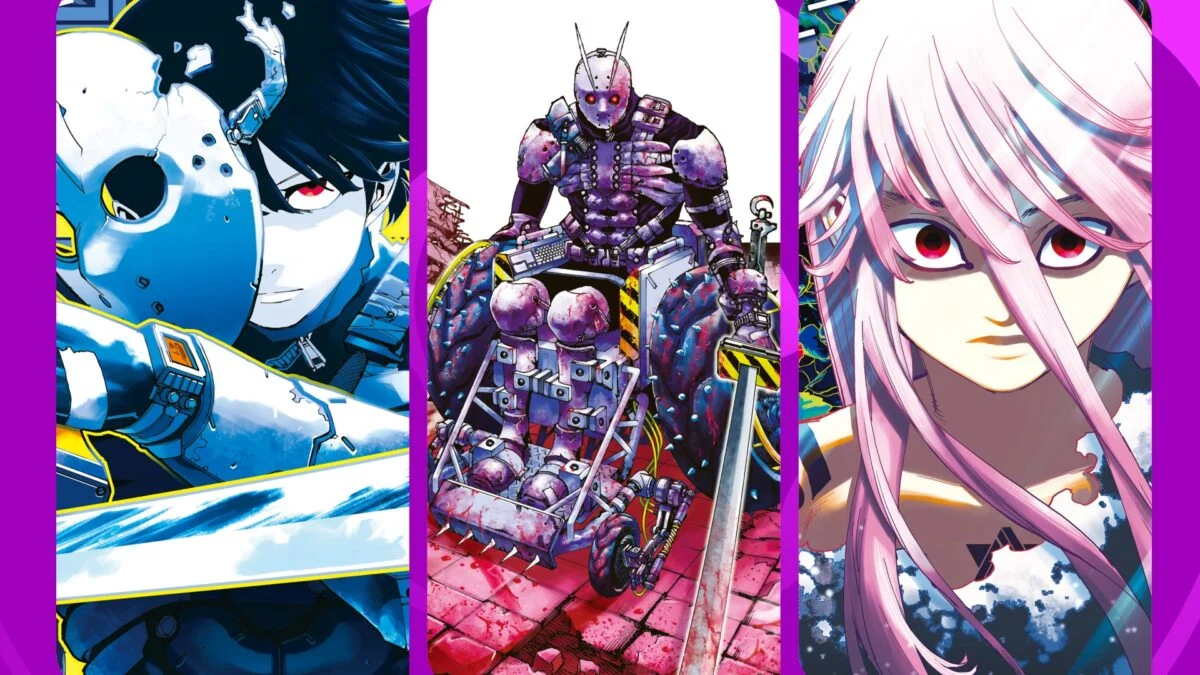
What I got was a manga as advertised on the tin: some pretty kick-ass brutal action whose hero feels like a fusion dance of Kamen Rider and Jason Voorhees placed smack dab in the middle of Dorohedoro’s wild dystopian world. But what kept me motivated to catch up on the series was the surprising amount of heart Yashiro wove into outcasts who felt in line with Gunn’s lovable low-tier heroes.

The Premise: Sci-Fi Action with Heart
I have a soft spot for manga that isn’t afraid to get weird. Tank Chair delivers on that front. It’s a sci-fi action shonen series focused on siblings Nagi and Shizuka. Nagi, once a feared assassin, is left comatose and a wheelchair user after protecting Shizuka. But when he senses killing intent, Nagi briefly awakens, becoming Tank Chair, a vigilante in a souped-up, mech-filled wheelchair.
Tank Chair is a sci-fi action shonen series that follows two siblings, Nagi and his little sister, Shizuka. Nagi was once feared as the best assassin of all time until he was shot in the head while protecting Shizuka, the weakest assassin ever. Thankfully, Nagi has a healing factor, so he survives, albeit in a comatose state. He’s also a wheelchair user. Still, Nagi is just as capable a fighter as Tank Chair, a vigilante seated in a souped-up chair with an increasing number of mech-like configurations as the series progresses. That’s because whenever he senses the killing intent from a strong opponent, he awakens from his stupor for a limited time. It’s a cool ongoing visual that feels like the Sekiro: Shadows Die Twice death prompt.

Shizuka sees these violent awakenings as “rehab therapy,” a way to bring her brother back. He faces everything from assassin swarms to talking gorilla men and kaiju – all while his former guild tries to exploit Tank Chair’s abilities. It’s an insane premise, but it absolutely works.
How does Tank Chair handle representation?
What typically follows is a pretty ultraviolent manga panel of Tank Chair completely annihilating everything, from a swarm of assassins to talking gorilla men to kaiju to all sorts of supernaturally gifted assassins. To Shizuka, pitting her brother against tough opponents to bring him back for a brief moment acts as his “rehab therapy” as they search for a way to bring him back to full-time consciousness. Though the former assassins’ guild he used to run with wants to use Tank Chair for different ends.

Punk Rock Representation
The manga features a range of characters with visible physical disabilities, both heroes and villains. Their disabilities aren’t depicted as weaknesses, but as integral parts of who they are. This emphasis aligns with the spirit of the Cripple Punk movement, defying conventions and celebrating visibility.
By far, the coolest aspect of Tank Chair is that it prominently features characters—heroes and villains alike—with visible physical disabilities, without treating those disabilities as a hindrance or weakness. While likely not a conscious decision on Yashiro’s part, having Tank Chair‘s cast be pretty punk rock, defiantly chasing their goals as brashly and visibly as in the manga, feels like rekindled embers of the Cripple Punk movement made mainstream. It also sets itself apart from other series that tend to use disabilities as a nerf for their heroes and instead makes them a part of who they are, a pretty cool bit of representation for a manga that leads with ultraviolence and heart, primarily from its characters with disabilities.

What makes Tank Chair stand out from other violent manga?
While the fights and art are phenomenal, the story takes a bit to get going. It’s like watching a Saturday morning cartoon such as Kamen Rider; the narrative threads slowly weave together, revealing a broader scope.
But, to keep things a buck, one caveat to getting into the series is that Tank Chair‘s story takes some warming up to beyond its stunning fights and panel work. Though to give Yashiro his flowers on that front, he expertly showcases the scale of its set pieces and where its characters are situated, highlighting its pretty impressive background art. On the whole, the manga especially smacks of the build-as-we-go Saturday morning fare that Kamen Rider would have with its growing ensemble of wacky villains and the allies Tank Chair acquires along the way, painting the full tapestry of where its story is headed.
It’s a stretch that’s not necessarily frustrating, but it does leave a reader flying from the seams of their pants, given how the start of the manga feels like a march toward its end, with its quick pacing, only for that to be the prologue to the story. All of which have a shotgun spread from a distance, a chance of landing as characters you’ll like beyond their neat designs. It’s pretty comparable to Undead Unluck in that regard.

A Touching Story About Family
Once the initial setup concludes, the story gains momentum. What begins as a thin premise evolves into a resonant exploration of family—both the one you’re born into and the one you create. It echoes the magic James Gunn created in Guardians of the Galaxy and Peacemaker: turning outcasts into characters you genuinely care about.
But after that prologue ends and a timeskip ensues, Tank Chair really gets moving, and the inertia it built from points that felt a bit thin starts to bloom in pretty resonant ways to match the visual spectacle the manga’s been nailing thus far. And what lies at the center of its uninhibitedly weird tale is a pretty touching story about family—be it found or otherwise. And it’s there where the series really shines, adding texture to side characters who’ve got just as much going on as its main duo as well as adding dimension to its monster-of-the-week-looking villain troupe, creating the same kind of magic Gunn flourished in Guardians of the Galaxy and Peacemaker, turning outcasts into endearing characters you want to root for even if as a reader you aren’t entirely sure you’re vibing with the grander scale of the story as it’s being built.
If Tank Chair piques your curiosity, you can read the manga on K Manga.
Want more Movies & TV news? Check out when to expect the latest Marvel, Star Wars, and Star Trek releases, what’s next for the DC Universe on film and TV, and everything you need to know about the future of Doctor Who.
So, with its unusual blend of ultra-violence, disability representation, and heartfelt storytelling, does Tank Chair have the potential to reshape our expectations of manga?