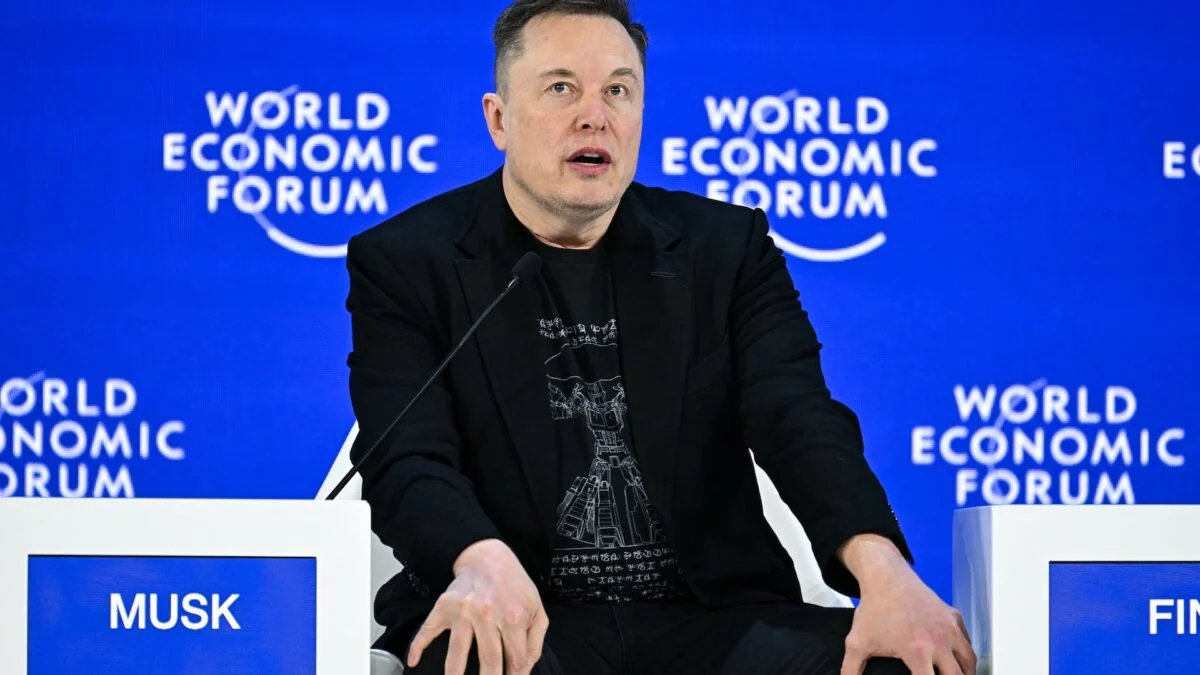
The air in Davos crackled with anticipation as Elon Musk took the stage. He spoke of futures so bright, so bold, they felt ripped from the pages of a sci-fi novel. But as the applause faded, a nagging question lingered: was it vision, or salesmanship?
“I would encourage everyone to be optimistic and excited about the future,” Musk declared, “And generally, I think for quality of life, it is actually better to err on the side of being an optimist and wrong rather than a pessimist and right.”
It’s a sentiment that sounds good on the surface. But scratch a little deeper, and a different story emerges.
Think back to summer 2024. Musk’s public support for President Trump started a trend of rhetoric that’s hard to reconcile with sunny optimism.
In recent years, Musk has warned of a dark future, claiming illegal immigration contributes to “civilizational suicide” and the “woke mind virus” is destroying the country. He even suggested humanity needs to become multiplanetary to avoid an “extinction event.”
“Western Civilization is doomed, unless the core weakness of suicidal empathy is recognized and actions are taken that are hard, but necessary for survival,” Musk wrote in Nov. 2025.
He spent years sounding the alarm about AI, only to launch his own AI company, xAI, in 2023. At Davos, he painted a dystopian Terminator-esque future.
“We need to be very careful with robotics,” said Musk. “We don’t want to find ourselves in a James Cameron movie, you know, Terminator. He’s got great movies, love his movies, but we don’t want to be in Terminator, obviously.”
Remember when Musk signed a letter calling for a pause on AI research? It turned out he was using that time to build xAI, aiming to catch up with competitors like OpenAI. Now, his chatbot is embedded in Pentagon systems. It’s a paradox wrapped in a riddle, isn’t it?
His bleakest pronouncements often veer into racism. “Whites are a rapidly dying minority,” Musk tweeted before his Davos appearance. He also wrote, “If this continues, entire cultures will be erased,” in response to a claim about a rise in the number of Black people living in the UK.
Then there’s the transphobia. He disowned his own daughter, misgendering her publicly. After buying Twitter in 2022, he removed protections for trans users, welcoming back anti-trans bigots, conspiracy theorists, and Nazis.
Musk’s scorn is especially reserved for liberal democracies. He conjured apocalyptic visions of England with mass murder in the streets.
“I really think there’s got to be a change of government in Britain. And you can’t… we don’t have another four years or whatever the next election is. It’s too long,” Musk said, speaking with far-right activist Tommy Robinson this past September. “Something’s got to be done. There’s got to be a dissolution of parliament and a new vote held.”
“I really think there’s got to be a change of government in Britain. And you can’t… we don’t have another four years or whatever the next election is. It’s too long.
Something’s got to be done. There’s got to be a dissolution of parliament and a new vote held.”
— Matt Novak (@paleofuture.bsky.social) September 13, 2025 at 11:55 AM
Bringing down the British government might be “optimistic” in Musk’s view. To most, it sounds like a desire for revolution. It’s a vision consistently framed in apocalyptic terms.
The Price of Optimism: Musk’s Climate Change U-Turn
Remember the outrage over Musk’s stance on climate change, or rather, his lack thereof? He rarely mentions it, despite frequent warnings of civilizational collapse. When President Obama was in office, he touted his environmentalist credentials. But when Trump arrived, the winds shifted. Suddenly, environmental concerns weren’t so important, now that fascism was on the rise. His companies, like Tesla, profited from government subsidies, and then it was time to pull up the ladder.
Following the Money: Is Musk Bankrolling a Certain Future?
Musk, worth $787 billion (€732 billion) according to Forbes, donated over a quarter of a billion dollars to install Trump and his Republican allies into government. He bragged about dissolving USAID, an agency created by Congress. But Musk did it anyway, moving on to countless government programs he alone decided should not be funded. Notably, none of Musk’s lucrative contracts for SpaceX were cut.

Musk is selling something. Everything he says, even if it sounds “optimistic,” is salesmanship. His closing line at Davos rationalizes his tactics. Arguing that “it is actually better to err on the side of being an optimist and wrong rather than a pessimist and right” takes on a different tone when you remember that he’s been over-promising on countless technologies—from full self-driving to visiting Mars to flying cars—and angering investors in the process. He isn’t failing to deliver; he’s just an “optimist,” you see?
Beyond Mars: Is Musk’s Vision Rooted in Nostalgia?
Have you ever wondered about Musk’s fascination with Mars? He might genuinely want to go, like many others. But his way of talking about it feels less optimistic and more like a child’s fantasy, helping him sell himself as a dreamer. His attitude towards space mirrors a comic strip from the 1950s and 60s, the golden age of futurism. The August 16, 1959, edition of “Closer Than We Think,” by Arthur Radebaugh, depicted smiling people leaving Earth due to overpopulation.
“If the earth should ever become overpopulated, emigration to outer space may become a commonplace. Bands of colonists might settle on distant planets, traveling there at lightning speeds in rockets of unbelievable size,” the comic strip explained.

Musk is obsessed with 20th-century futurism. But from the vantage point of 2026, something like the “Space Mayflower” feels less like optimism and more like a distant echo.
What Real-World Problems Should We Focus on Instead?
Today, it feels utopian to imagine a world where masked federal agents aren’t abducting preschoolers and shipping them across the country. We don’t need Musk promising that his Optimus robot will deliver a post-scarcity world where money doesn’t even need to exist. We need universal healthcare and cheaper housing, the kinds of things that Musk undermined while taking a chainsaw to the federal government.
How Can We Distinguish Vision From Salesmanship?
If anything, a post-scarcity world should inspire hope. But when Elon Musk is the one selling it, can we afford to be optimistic?
How Can We Critically Evaluate Musk’s Promises?
Ultimately, Musk’s “optimism” seems less like a genuine belief and more like a carefully constructed brand. He’s not an innovator; he’s a showman. His visions aren’t revolutionary; they are recycled dreams, repackaged and sold for a premium. The question remains: are we buying what he’s selling, or are we investing in a mirage?