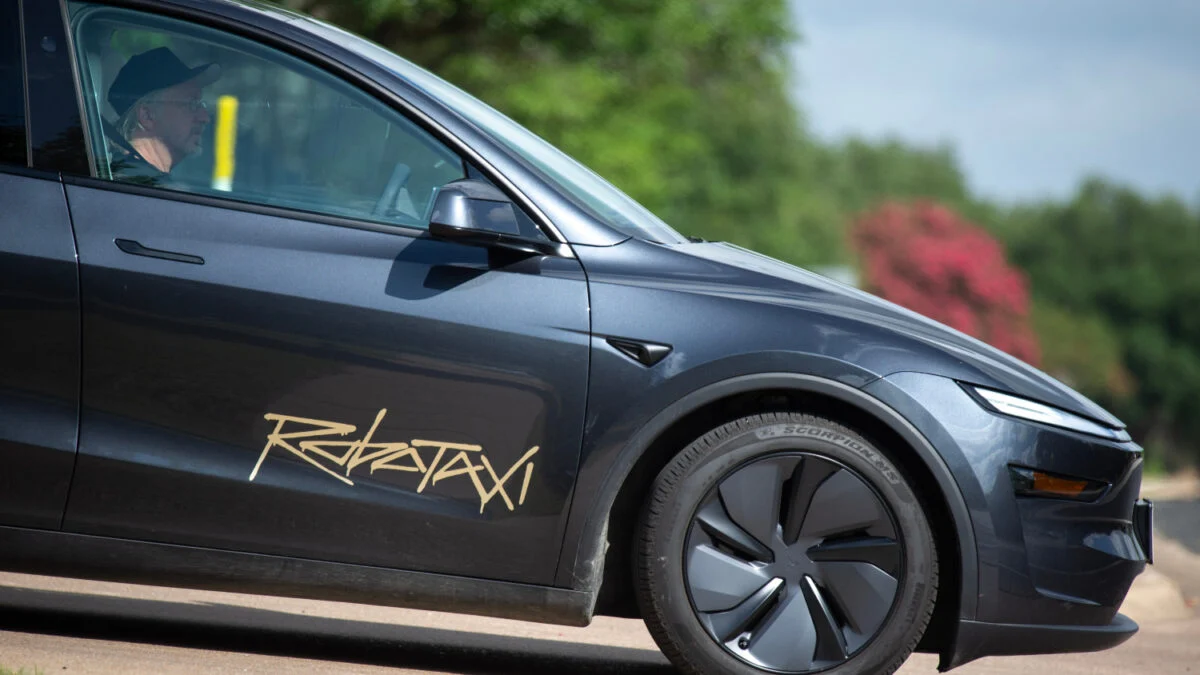
Imagine hailing a Robotaxi in Austin, expecting a driverless experience. Instead, you notice something odd: a second Tesla following close behind. Is it a coincidence, or is there more to Tesla’s autonomous tech than meets the eye?
Tesla’s self-driving Robotaxis have been operating in Austin, Texas, with a safety monitor – a trained person who can intervene –riding shotgun. Last Thursday, CEO Elon Musk announced the monitor would be vacated from the car, which was positioned as a major step forward in the company’s capabilities to operate autonomously without human intervention.
Turns out, it’s not quite that simple. Electrek reported that, based on social media videos, it appears that Tesla hasn’t actually gotten rid of the safety monitor. Instead, the company has seemingly simply moved the person into a trail car that follows the Robotaxi for the duration of its journey. Multiple videos show Robotaxis being tailed by Tesla vehicles, suggesting that Tesla’s autonomous driving may not be as advanced as the company would like it to appear. Tesla, it should be noted, hasn’t confirmed whether or not it is operating trail cars. The company did not respond to a request for comment at the time of publication, but it also hasn’t had an operating public relations department in many years.
My first unsupervised @robotaxi ride here in Austin! Come along with me on this 1st experience of driving around Austin with just me in the car and in the back seat!
Congrats to the @Tesla_AI team! pic.twitter.com/YVJ19zp2qZ
— Joe Tegtmeyer (@JoeTegtmeyer) January 22, 2026
In a video uploaded by Tesla enthusiast Joe Tegtmeyer, he can be heard identifying the “chase car” that is following his ride in what he identifies as his “first unsupervised Robotaxi ride.” Tegtmeyer suggests the car is there for “validation,” which seems like a nice way of saying “being on scene in case anything goes horribly wrong.”
In a vacuum, there’s nothing necessarily wrong with the idea of a trail car for safety purposes—though it does seem like a very inefficient way to operate when you are trying to offer rides at scale. But it’s the weaselly way that Musk has presented this change that gives it such a bad taste. Musk said that the Robotaxis are driving “with no safety monitor in the car.” That’s technically correct. But the knowledge that the safety monitor is still involved and in a position to potentially intervene in every single ride undermines the idea that Tesla has achieved some new, meaningful level of autonomy.
The fact that safety monitors are still involved at such a granular level suggests Tesla is still lightyears behind Waymo, which is currently operating a fleet of around 2,500 cars without a human around to intervene physically (though they do still have remote operators who can take over at any point). Tesla, meanwhile, is reportedly operating about 80ish Robotaxis in total, and usually only a handful at the same time.
Despite this, Musk went on stage in Davos, Switzerland, at the World Economic Forum and claimed that Tesla has solved autonomy. “I think self-driving cars is essentially a solved problem at this point,” he said before claiming that Tesla’s Robotaxis will be “very widespread by the end of this year within the U.S.” If that’s true, get ready for some major traffic jams considering every Tesla Robotaxi ride actually puts two cars on the road: the one getting you to your destination and the one that makes sure you don’t burst into flames.
Spotting the Shadow Fleet
Imagine you’re scrolling through social media and notice a video: a Tesla Robotaxi, followed *very* closely by… another Tesla. This isn’t a bug; it’s a feature, allegedly. Social media is now buzzing with videos showing Tesla Robotaxis accompanied by what appear to be safety monitor “escort” vehicles.
This raises a simple question: is Tesla truly achieving full autonomy, or are they simply shifting the location of human oversight? It is like a magician distracting the audience with one hand while the other performs the trick.
What Level of Autonomy Do Tesla Robotaxis Currently Offer?
The Society of Automotive Engineers (SAE) defines six levels of driving automation, from 0 (no automation) to 5 (full automation). Current reports suggest Tesla’s Robotaxis, even with the trailing safety car, may not yet reach Level 5. They seem to hover somewhere in Level 4, requiring human intervention in certain situations, albeit from a distance. The distance does nothing to negate the need. As long as intervention is still required, Level 5 is still some ways off for Tesla.
Elon’s Davos Declaration
The World Economic Forum in Davos, Switzerland, is usually reserved for discussions of trade deficits, policy reform, and the future of finance. Yet it seems the Robotaxi had its own moment in the sun. Musk boldly claimed that Tesla had “solved” self-driving, forecasting widespread Robotaxi availability within the U.S. by the end of the year. If this is true, then what’s with the second car?
These declarations seem at odds with the “chase car” strategy, potentially misleading investors and the public alike.
How Many Robotaxis Does Tesla Actually Have in Operation?
Reports vary, but estimates suggest Tesla operates a relatively small fleet of Robotaxis. Robotaxi Tracker puts the number at around 80 vehicles, often with only a handful running concurrently. Compared to Waymo’s larger fleet, Tesla’s operation appears more like a limited pilot program than a full-scale deployment. These small numbers suggest that perhaps Tesla’s claims are a little too bullish. The reality on the ground does not fully match up to the narrative.
The Waymo Comparison
Waymo, a competitor in the autonomous vehicle space, takes a different approach. While they still employ remote operators for assistance, their vehicles operate without a physical safety driver inside the car. This is a critical distinction, reflecting a greater level of confidence (or at least a different risk tolerance) in their technology.
Tesla’s reliance on trailing safety monitors suggests they haven’t reached the same level of autonomous capability as Waymo. If Tesla were a rocket company, they’d be launching a rocket attached to a really long tether.
Are Remote Operators a Safe Alternative to On-Site Safety Monitors?
Both remote operators and on-site safety monitors come with their own set of pros and cons. Remote operators can potentially oversee multiple vehicles, improving efficiency. However, they may face challenges in reacting quickly to unexpected situations due to the distance. On-site monitors offer immediate intervention but are more expensive and defeat the purpose of full autonomy. Ultimately, the “safest” approach depends on the specific technology and operational context. It will likely be a source of debate until the technology reaches maturity.
The question remains: is Tesla’s “shadow fleet” a temporary measure, a necessary precaution, or a clever illusion designed to mask the limitations of its self-driving technology?