The air in the room was thick with anticipation as Elon Musk took the stage, investors leaning forward, ready to hear about Tesla’s next leap. But as the presentation continued, a subtle unease began to ripple through the crowd. The reality on the slides didn’t quite match the visionary promises being made, and the tension was palpable.
Tesla’s recent investor call painted a picture of a company at a crossroads. While Musk spoke optimistically about robots and fully autonomous vehicles by 2026, the financials revealed a more sobering truth. A 46% drop in profits to $3.8 billion (€3.54 billion), coupled with a 3% year-over-year revenue decline—the first since 2020—had investors murmuring. The golden goose, it seemed, wasn’t laying quite as many eggs.
Car sales alone slumped by 10%, marking the worst performance since 2021.
Adding to the sense of change, Musk announced the end of production for the Model S and Model X in Fremont, California, to repurpose the factory for robot production, aiming for a million units per year.
Delivery figures already pointed to trouble, with 1,636,129 vehicles delivered in 2025—a 9% decrease from the previous year, and a 16% drop in the fourth quarter alone. Sales of the Model 3 and Model Y fell 7%, while other models, including the Cybertruck and soon-to-be-discontinued Model S and Model X, plummeted by 40%.
But Musk pivoted quickly. With the finesse of a seasoned performer, he transitioned to a vision of “high universal income,” safety, environmental harmony, and “amazing medical care.”
“There’s going to be a lot of change along the way, but that is what I see is the most likely outcome and it makes sense to update Tesla’s mission to that goal,” he stated, steering the conversation toward brighter horizons.
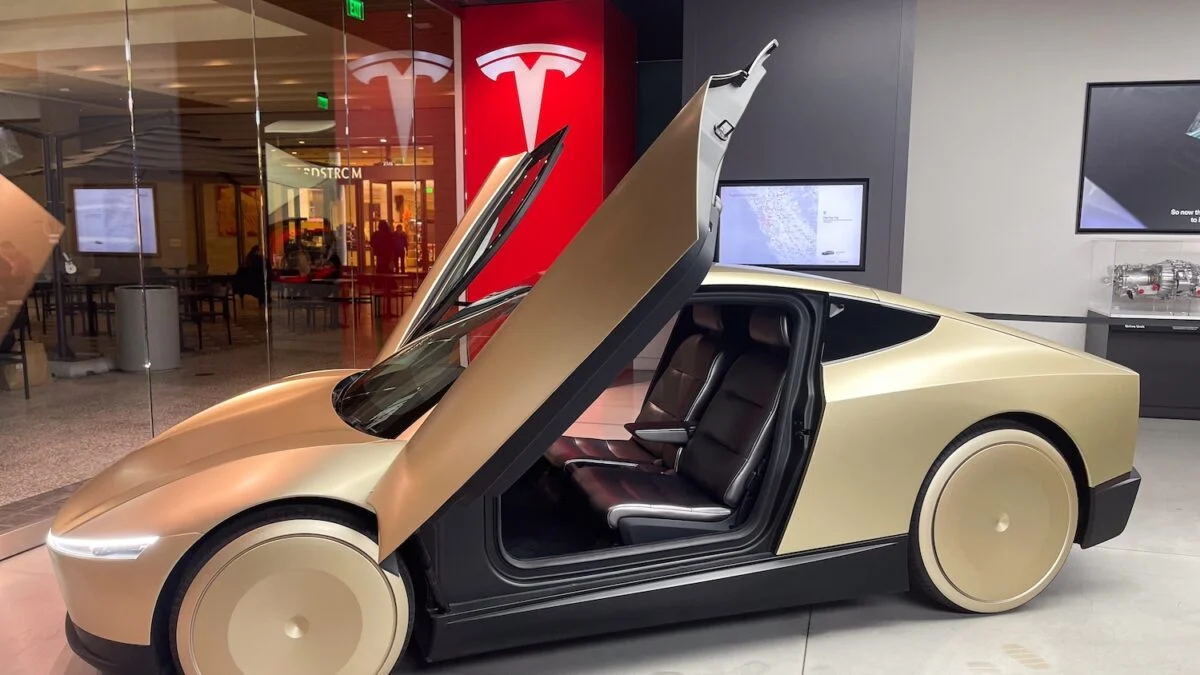
After phasing out older models and adopting a subscription-based “Full Self-Driving (Supervised)” system, Tesla bets its future on autonomy, with the Cybercab planned for deployment in “dozens of cities” by 2026, according to Musk. The next-generation Roadster, slated for an April reveal, remains the only non-autonomous vehicle in the pipeline. A prototype was presented back in 2017.
Tesla’s investor letter stated: “In 2026, we will further invest in the infrastructure needed to support clean energy and transport and autonomous robots, including the ramp of six new production lines across vehicle, robots, energy storage and battery manufacturing, while further leveraging our existing factory, charging and service center footprint to support future growth.”
What factors contributed to Tesla’s revenue decline in 2025?
Last year, Tesla faced a gauntlet of challenges. Musk’s perceived alignment with certain political figures stirred immediate backlash. The expiration of the $7,500 (€7,000) federal EV tax credit in July 2025—a consequence of the One Big Beautiful Bill Act—hit Tesla particularly hard, creating a sales surge in the third quarter followed by a significant drop.
The shift in policy, as well as public sentiment, created headwinds for Tesla. It’s like watching a surfer expertly ride a wave, only to have the tide suddenly pull back.
In response, Tesla introduced lower-priced Model 3 and Model Y variants. However, these models were essentially stripped-down versions of their predecessors. Tesla also mirrored other automakers by turning supervised full self-driving into a $99 (€92) monthly subscription, while discontinuing the standard Autopilot system.
Executives remained tight-lipped about when Full Self-Driving (FSD) would operate without supervision. Musk emphasized ongoing testing in cities with unique traffic patterns, highlighting the Model 3 and Model X’s safety ratings in crash tests.
“We’re actually just being paranoid about safety,” he quipped.
How is Tesla addressing safety concerns about its Full Self-Driving technology?
During the call, Tesla revealed a $2 billion (€1.86 billion) investment in Musk’s xAI platform. Shareholders also approved a compensation plan for Musk, potentially making him a trillionaire if Tesla achieves a $2 trillion market capitalization. This moonshot is fueled by promises of self-driving cars and robots.
Tesla isn’t alone in facing challenges in the EV market. Many automakers overestimated the growth of global EV sales and underestimated the competition from China.
How is anti-Musk sentiment affecting Tesla sales in key markets?
A change in policy regarding electric vehicles and fuel economy, coupled with negative sentiment in some regions, has put extra pressure on Tesla’s primary revenue source: car manufacturing.
The reality is that the road ahead for Tesla may not be as smooth as Musk envisions. Consider it like this: Musk is the captain of a ship navigating uncharted waters. His confidence inspires, but it is the ship’s engineering that will determine whether it survives the storm.
What is Tesla’s plan to revitalize sales growth and revenue?
The core question remains: Can Tesla maintain its dominance in an increasingly competitive landscape, or will it need to drastically transform its business model to accommodate a new reality?