The holodeck flickered to life, and suddenly, I was standing on the promenade of Deep Space Nine. A wave of nostalgia washed over me as I watched holographic versions of Sisko and Kira argue about Bajoran politics, their voices echoing with the familiar passion of the original series. Then, the scene dissolved, replaced by the clean, bright corridors of Starfleet Academy, leaving me wondering: Could this new show truly honor the legacy of such a beloved series?
Whatever your feelings about Starfleet Academy, it’s a series with serious ambition. From the outset, the show has been clear about its intentions to shake up how a Star Trek show presents itself. This playful rebellion suits its young cast and has been unafraid of playfully teasing sections of old-school Trek fandom who were already approaching the new series with some apprehension.
And then it had the audacity to turn around and say, “Actually, we’re going to touch one of the holy grails of classic Star Trek, Deep Space Nine,” and tie its transgressive aims to the legacy of a show that has spent the past 30-plus years being re-evaluated. For some audiences, it started as an outside provocateur that “disrespects” what Star Trek ought to be, but is now considered some of the truest and most beloved Trek around.
But by god, whether those skeptics are willing to see it or not, Starfleet Academy made something beautiful: a fitting revisitation to the life, love, and legacy of Captain Benjamin Sisko.

Star Trek fans have spent half of Trek‘s entire lifetime building up the pillar of Who Ben Sisko Should Be Remembered As. He’s the not-Picard, the doer, the man willing to get his hands dirty (but still in a respectably Star Trek-y way, of course). He is the captain of the Dominion War, the human, imperfect face of a dark heart that questioned what parts of itself the Federation and Star Trek alike were willing to carve off of themselves when facing an existential crisis.
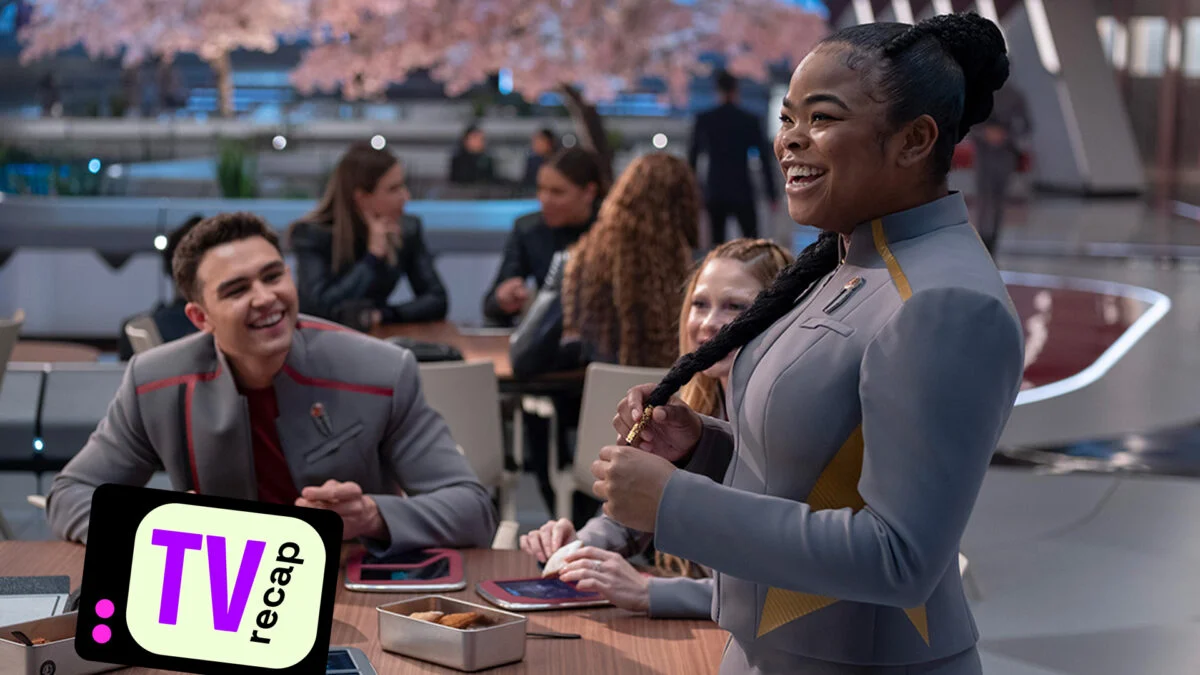
“Series Accilimation Mil,” named for Kerrice Brooks’ holographic student Sam, serves as the episode’s anchor. It takes a different track. We’ve had plenty of time to canonize Sisko as one of the great captains of the franchise among his peers, recognizing his role in the moral grays of Star Trek‘s darkest hour. The episode sees Sam tasked by her photonic masters on Kasq. They feel she is not taking her role as an Emissary seriously enough. As such, she needs to help them decide if organic life can be trusted again after they were made to be enthralled to their biological creators. Instead, she is told the best way to prove herself is to solve the unsolvable (and in that, answer the fate of her fellow Emissary) and take a remarkable at Sisko’s true legacy in what he left behind.
Those skeptics will perhaps shudder a bit about how Starfleet Academy spends much of this episode presenting this . “Series Acclimation Mil” manifests Sam’s own particular brand of quirkiness through heavy-handed editing choices, from graphics covering the screen in a child-like scrawl (Sam is programmed to be a young adult but is only a few months into her entire existence; I would think she would have better handwriting) to lots of slow-mo and freezes as the show zooms in tight on her perspective. We’re given a rundown of how she’s a) a unique cadet as both a photonic and an the Emissary of her unknowing, alien people, and b), made a lot of progress in making friends and exploring the vast, contradictory, and—especially in the case of a gaggle of screwy young kids still figuring themselves out—occasionally very silly complexities of the human condition.

Her holographic masters back on Kasq, much like those skeptics, immediately call Sam out and tell her to stop faffing around with things like “having fun” and “making friends” or, most egregiously to them, taking a music elective. The role of Emissary is a serious diplomatic mantle, and if Sam doesn’t do it right, she threatens isolating her entire people from the rest of the galaxy. So they challenge her: the academy has a course on challenging the unknowable they demand she take instead. And although initially reluctant, Sam finds a hook visiting the class of Professor Illa (hello to our first major 32nd-century Cardassian, played by Lower Decks‘ Tawny Newsome, who also co-wrote this episode with Kirsten Beyer) that she believes will solve her superior’s problems—she will be the one to solve what actually happened to Captain Sisko, a fellow Emissary, at the end of Deep Space Nine, a question untouched by onscreen Star Trek for almost 30 years, if only because no one has dared to yet.
But again, Starfleet Academy is going to make you work for this juice. “Series Acclimation Mil” is an episode about Deep Space Nine and about Ben Sisko’s legacy, but it is not an episode of Deep Space Nine; it is an episode of Starfleet Academy. That means in Sam’s explorations of the evidence, she has to answer the question of whether or not Sisko really transcended reality and joined the Prophets in the Bajoran wormhole. What remained when he did so is rooted in her perspective and her growing bond with her friends at the academy.
That includes, on her part, making a terribly silly faux pas by showing up at the student body’s Bajoran extracurricular group and essentially asking them, “So hey, is your god real?” or having Caleb figure out a way to alter her programming subroutines so she can replicate getting absolutely smashed at the local cadet-friendly bar, built on the grounds of a similar haunt Sisko himself visited during his time at the academy. This is Starfleet Academy‘s well-established comfort zone at this point, brimming with youthful energy and humor. But it’s also paired with the first of this episode’s huge shocks, when Sam, on Chancellor Ake’s advice, calls up the archives of an entire museum dedicated to Sisko’s legacy.

And finds herself face-to-face with that legacy made flesh: a hologram of Jake Sisko, played by the returning Cirroc Lofton for the first time since Deep Space Nine ended.
It’s a remarkable moment, if not just for the metatextual shock that most Star Trek fans are going to be confronted with the fact that our memories of both Lofton and this character are almost entirely of him as a child, and that to see him as an adult stirs something deeply moving within. It gives us a chance in the moment to feel something similar to Sam, as we realize we’re hearing the words of Captain Sisko’s own son reflect on the man—not the captain, not the Emissary, but his father. In seeing that bond, Sam’s curiosity about Sisko’s fate, and her own if she fails to sufficiently achieve the unyielding standards of her masters, turns maudlin: being an Emissary means giving this up, this profound love and connection, and if that sacrifice is necessary, then maybe being an Emissary and having your fate decided for you—Sisko as the predestined arm of the Prophets, herself a literally created tool of Kasq’s photonic society—is worth nothing at all.
Time and time again, we see Sam return to the idea of exploring who Sisko was and what happened to him through the bonds she has forged in her time at the academy, and it’s clear that she begins to become enamored with the humanity of the man, more so than his galactic, spiritual status. Her initial explorations see her prioritize the thoughts of her friends over her own because she values them; we see her bring them food based on recipes from the Sisko family’s restaurant because they can bond with it in a way she cannot. The reason she wants to go to the cadet bar is both because Darem tells her Sisko hung out at a similar one and because it is also an act of teenage defiance in the face of her creators forcefully reminding her that time is running out to comply with their demands or lose these bonds she has already come to cherish—just as Sisko did when he traded his life with Kasidy and Jake, with his colleagues on DS9, to defeat the Pah-wraiths.
That is the lesson that Sam initially takes back to Professor Illa: the answer to the mystery of Sisko is that whatever happened, it sucked, because he left behind his wife, son, and friends, and that she’s probably going to have to do that too. But Illa decides to show her something—a copy of Anslem, a book Jake wrote but never published about his life. Reading it, Sam conjures up Jake again, not a holographic archive this time, but her imagining of the man and author as she over his work and mourns for this figure she’s come to find kinship with.

But Jake turns a page for her and gets her to reflect on something: Sisko lived his life as an emissary doing the work of the Prophets his own way, centering the bonds with his family and friends, pushing back, and defying them to accept his lived experience on his own terms. That is what Benjamin Sisko left behind: a love that carried on in his son, that was passed down through the ages to now impact itself upon a young woman almost a thousand years later. Not a Starfleet officer. Not the representation of compromises made in dark times. A man who defined and strengthened his life through connection in the wake of almost being broken by the loss of one and endured through it all and beyond it because of it.
One last legacy of that connection is made manifest when Sam returns Anslem to Professor Illa, who reveals that she is not just Illa but Illa Dax (so part Trill, part Cardassian, another of Starfleet Academy‘s interesting commentaries on future hybridization), keeping the spirit of her very best friend alive one further bond at a time. Sam that Sisko helped her find the courage to stand up to her own arbiters and tell them she will teach them about what it means to be human in her own way, in her own time. As she walks away to do exactly that, we hear the voice of Sisko himself, Avery Brooks, echoing out:
Divine laws are simpler than human ones, which is why it takes a lifetime to be able to understand them. Only love can understand them. Only love can interpret these words as they were meant to be interpreted.
Again, it’s more than just the emotion of a voice not heard in Star Trek for decades, something that felt impossible given Brooks’ broad exit from the public spotlight. But it’s that Starfleet Academy rose to the biggest potential of its far future setting and of its place as the Star Trek show leading the series’ 60th anniversary to what one generation of Starfleet heroes can mean to another, across eons. The impact of time is felt by its audience reflected in its characters. Only Starfleet Academy could’ve pulled a tribute like this off, and Star Trek is better for the fact that it was brave enough to defy fate and do so.
The brilliance of this episode is that it doesn’t merely rehash old storylines. It uses the past as a foundation to explore new perspectives, much like an artist using classic techniques to create something entirely new. It’s not just a tribute; it’s a conversation across time.
Why is ‘Deep Space Nine’ still relevant?
I remember watching ‘Deep Space Nine’ as a kid and feeling like it was a different kind of ‘Trek’. It wasn’t just about exploring new worlds; it was about the messy, complicated relationships between people, cultures, and even religions. That complexity is something that resonates even more today.
’Deep Space Nine’ distinguished itself with its complex, serialized storytelling, moral ambiguities, and exploration of faith, war, and political intrigue. Set on a space station near a strategically important wormhole, the series veered away from the optimistic outlook typical of Star Trek, instead tackling darker, more nuanced themes. This willingness to challenge the established formula made it a standout show, influencing later series in the franchise and beyond.
How did ‘Deep Space Nine’ influence later ‘Star Trek’ series?
The DNA of Deep Space Nine is all over modern Trek. Its serialized nature paved the way for shows like ‘Discovery’ and ‘Picard,’ which embraced longer, interconnected storylines. Even the focus on character development and moral complexity can be traced back to DS9’s influence.
‘Deep Space Nine’’s impact can be seen in the darker, more complex narratives of later Star Trek series like ‘Enterprise’, ‘Discovery’, and ‘Picard.’ The emphasis on character arcs, political intrigue, and moral dilemmas set a precedent for these shows to explore similar themes with greater depth. Additionally, the serialized storytelling format pioneered by DS9 has become more common in modern television, including within the Star Trek franchise.
Tawny Newsome’s Touch
I’ve always admired Tawny Newsome’s work, especially her comedic timing on ‘Lower Decks’. But her contribution to ‘Starfleet Academy’ goes beyond just acting. Co-writing this episode with Kirsten Beyer shows her deep understanding of the ‘Trek’ universe and her ability to add fresh, exciting layers.
Newsome, known for her role in ‘Lower Decks’, brings her comedic sensibilities and sharp writing skills to ‘Starfleet Academy’. Her involvement the episode an extra layer of depth, blending humor with insightful commentary on the legacy of ‘Deep Space Nine’. Kirsten Beyer, a veteran writer in the Star Trek universe, also co-wrote the episode.
How does ‘Starfleet Academy’ balance humor with serious themes?
‘Starfleet Academy’ manages to walk a tightrope, blending lighthearted moments with profound discussions about identity, legacy, and the meaning of connection. Like a skilled comedian using humor to tackle tough subjects, the show uses its youthful energy to make these themes accessible and engaging.
‘Starfleet Academy’ balances humor and serious themes through character-driven storytelling and self-aware writing. The show uses its setting at Starfleet Academy to explore themes of identity, belonging, and duty, while also incorporating comedic elements and lighthearted moments. By grounding these themes in the experiences of young cadets, ‘Starfleet Academy’ makes these bigger questions relatable.
Want more io9 news? Check out when to expect the latest Marvel, Star Wars, and Star Trek releases, what’s next for the DC Universe on film and TV, and everything you need to know about the future of Doctor Who.
“Series Acclimation Mil” is a reminder that the past is never truly gone; it echoes through the generations, shaping our present and influencing our future. What other classic ‘Trek’ stories deserve this kind of reexamination?