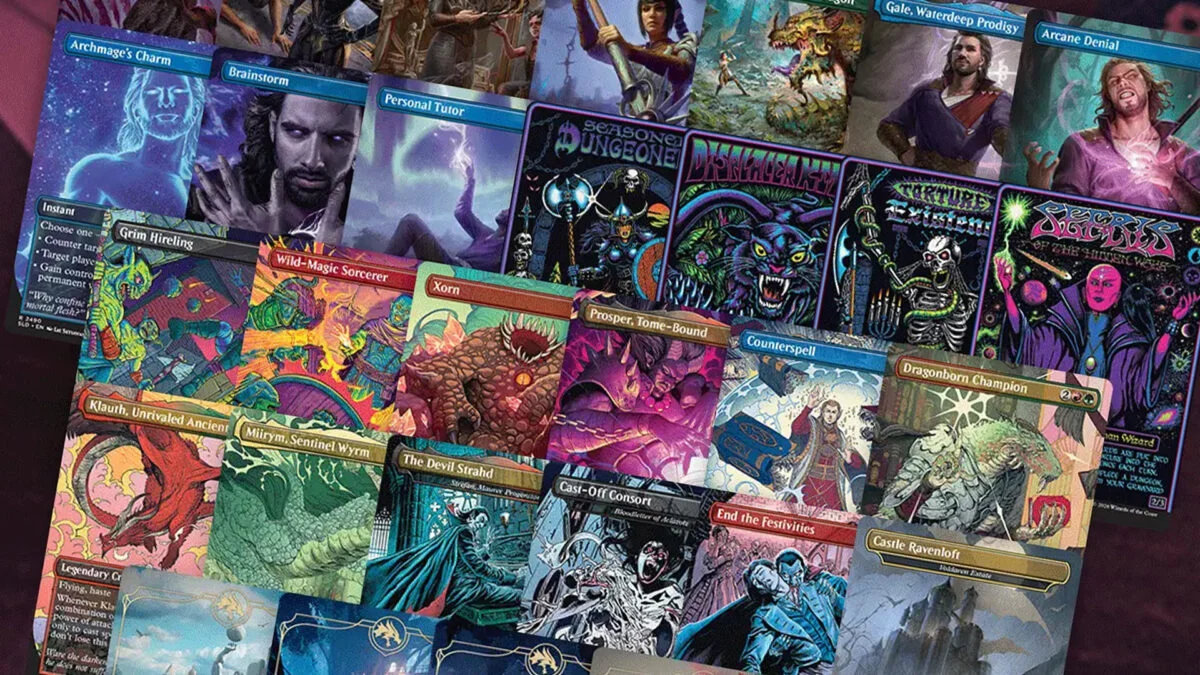
The clock ticked down, each second amplifying the tension. You refresh the page, heart pounding, only to see the dreaded words: “Sold Out.” It’s a familiar sting for any Magic: The Gathering enthusiast chasing the elusive Secret Lair drops, and despite pleas for a return to a more accessible system, Wizards of the Coast is holding firm.
“The short answer—and again, not a sexy one—is that this one is better for business,” Lindsay Bartell, Wizards of the Coast’s senior director for Secret Lair, recently explained on the WeeklyMTG livestream (via Polygon). “The last thing we want is, ‘Oh, Secret Lair had to get in there, so now Final Fantasy is going to be late.’ We don’t want to be that guy.”
“This one,” as Bartell put it, is Secret Lair’s current approach to drops, a limited-print model that means once a set is gone, it’s gone (she also firmly pushed back on the chance of Wizards ever re-releasing past Secret Lairs, arguing that part of the appeal of the program is its collectability). But that’s not always been how Wizards has approached Secret Lair. When the program kicked off back in 2019, it actually operated on a print-on-demand model, meaning Secret Lairs would be up for pre-order for a set period of time, and then whoever purchased it in that window was guaranteed a drop.
According to Bartell, citing the fact that the nature of print-on-demand meant that users ended up waiting months and months to actually receive their cards, Wizards then tried a hybrid approach that kept the on-demand preorder window but also sought to get cards in collectors’ hands quicker by pre-printing a large amount of Secret Lair products. Except predicting the popularity of each drop was difficult, meaning there would be situations where a ton of excess stock sat around disrupting the company’s supply chains, which could in turn affect the printing and rollout of main Magic releases.
So now the limited runs are here to stay, much to the chagrin of anyone who’s ever wasted an hour queuing only to not get the cards they wanted. But it’s clear Wizards sees it as the nature of the collecting beast and the least-worst option they have available (even if we’ve seen in recent months that other companies in a similar space, like Games Workshop, don’t agree).
At the very least, Wizards is trying to cut out some of the frustrating FOMO that comes with Secret Lair operating in this way. While most drops through the program reprint available cards with new art, some contain unique cards with new mechanics (like the recently revealed Fallout Secret Lair)—but Bartell noted that Wizards now finds ways to both make drops with unique cards available for longer and eventually get them released in other ways. As for queue times, Bartell acknowledged the issue but defended that while they’re still long, they’re not as bad as they were when Secret Lair initially moved to limited-run releases.
“It is never okay for me for people to be waiting five hours for their drop,” she said. “That absolutely does not meet my standard, was absolutely embarrassing, and is not something I ever want to see again.”
Bartell’s explanation is unlikely to be a popular one, but it’s still interesting to see Wizards explain their approach to collectors in this way. The next test of Secret Lair’s current model will come next week, with a massive drop of Secret Lairs inspired by Dungeons & Dragons. May your queue times be as lucky as your dice rolls!
Want more Movies & TV news? Check out when to expect the latest Marvel, Star Wars, and Star Trek releases, what’s next for the DC Universe on film and TV, and everything you need to know about the future of Doctor Who.
The Reality of the Queue: Understanding the Secret Lair Bottleneck
Think back to the last time you tried to snag a Secret Lair drop. The anticipation, the nervous energy as you wait in the digital line. The process, once a relatively smooth operation, has morphed into something of a digital gladiatorial contest. Lindsay Bartell, Wizards of the Coast’s senior director for Secret Lair, addressed the elephant in the room – the frustration – in a recent WeeklyMTG livestream. The rationale behind the limited-print model, as Bartell explained, boils down to business realities and logistical nightmares.
The core issue? Wizards wants to avoid the kind of supply chain snags that could delay major Magic releases. The Secret Lair program, while popular, can’t be allowed to jeopardize the core product line. In short, the current system is seen as the lesser of two evils, even if it leaves many collectors empty-handed.
From Print-on-Demand to Limited Runs: A History Lesson
Remember when Secret Lair drops felt less like a lottery and more like a pre-order? Back in 2019, the program launched with a print-on-demand model. For a set period, you could order whatever you wanted, and Wizards would print enough to meet the demand. It was a golden age for collectors, a time when scarcity wasn’t the primary driver. But that system had its drawbacks. Bartell pointed to the lengthy wait times. This delay became a major pain point for customers. Wizards then experimented with a hybrid approach – pre-printing a significant amount of product while still offering a pre-order window.
The problem? Predicting demand is notoriously difficult. This attempt to bridge the gap between availability and speed resulted in excess inventory of less popular drops, tying up resources and disrupting the supply chain. The move to limited runs, while frustrating for consumers, became a way to avoid the logistical quagmire of overstocking and potential delays to main set releases.
Why Can’t Wizards Predict Secret Lair Popularity More Accurately?
Imagine trying to predict the next viral meme, or the must-have toy of the holiday season (€1= $1.08). Human behavior is inherently unpredictable. The challenge lies in forecasting which themes, artists, or card combinations will resonate most strongly with the player base. While Wizards likely uses data analytics and market research, these are imperfect tools. The secondary market for Magic cards adds another layer of complexity. Speculation and hype can drive demand in ways that are hard to anticipate, making accurate forecasting a Herculean task.
The Fallout of FOMO: Addressing Collector Concerns
I’ve spoken to collectors who describe the hunt for Secret Lairs as a second job, constantly monitoring social media and Discord channels for hints of upcoming drops. The fear of missing out (FOMO) is a powerful motivator, but it can also lead to frustration and resentment. Wizards is aware of this dynamic. Bartell specifically addressed the issue of unique cards appearing in Secret Lairs. To mitigate the FOMO, Wizards is now trying to make these unique cards available for longer periods or eventually release them in other products. It’s a small concession, but it acknowledges the concerns of collectors who feel pressured to participate in the limited-run frenzy.
As for those infamous queue times, Bartell admitted they were “absolutely embarrassing” and not up to her standards. She claimed that while the waits are still lengthy, they’re not as severe as they were initially after the switch to limited runs. But as one frustrated player put it to me, “A five-hour wait is still a five-hour wait, no matter how you slice it.”
Will Secret Lair Queue Times Ever Improve Significantly?
Queue times, the bane of many a collector, are a complex issue. Wizards is likely battling several factors, including server capacity, bot activity, and sheer demand. Improving the queuing system may require significant investment in infrastructure and anti-bot measures. Another strategy could involve alternative sales models, such as raffles or lotteries, to distribute access more fairly. However, any system will likely have its detractors. Ultimately, Wizards needs to balance accessibility with the business realities of limited-edition releases, a tightrope walk with no easy solutions.
The Road Ahead: D&D and Beyond
The next test of Secret Lair’s current model is just around the corner, with a large drop inspired by Dungeons & Dragons. For many, the process has become a test of patience and luck, a far cry from the original vision of accessible, unique collectibles. Bartell’s explanation offers insight into the company’s perspective, but whether it will appease frustrated collectors remains to be seen. One thing is certain: the debate over Secret Lair’s availability is far from over.
Is this limited-run approach a necessary evil, or is there a better way for Wizards of the Coast to balance collectability with customer satisfaction?