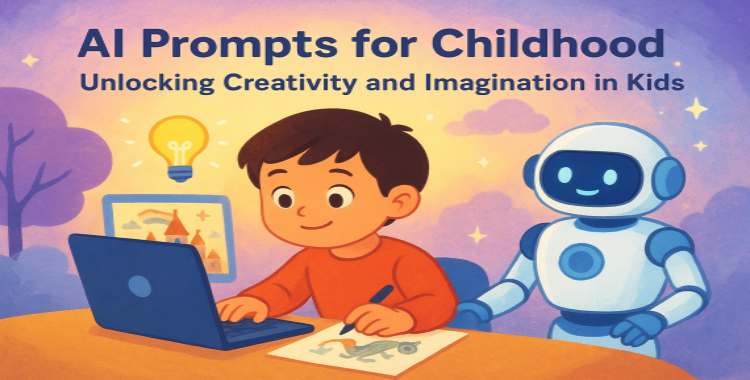
As the clock ticks past dinner time, the familiar glow of screens fills the room. A young girl sits with a tablet, her eyes darting in excitement as a digital voice encourages her imagination. “What if your toy could talk today?” it asks, igniting a spark that turns screen time into something rich and transformative.
In our digital age, children are not just passive viewers; they are active collaborators with technology. AI prompts for childhood serve as creative catalysts—guiding young minds from simple ideas to vibrant stories, meaningful drawings, and enlightening discoveries. When woven correctly into their play, AI transforms from a mere tool into a cherished companion, nurturing curiosity, imagination, and joy.
Part 1: What Is an AI Prompt for Childhood?
Remember the time when a simple question opened up a whole new world? An AI prompt acts as that question—a springboard for exploration. For example, when a child asks, “Can you tell a story about a robot that wants to learn to dance?”, the AI responds with a whimsical narrative colored with humor and emotion. This interaction fosters a creative dialogue, turning a fleeting thought into captivating adventures.
AI prompts come in various forms:
Storytelling prompts: fuel writing and narrative skills.
Drawing prompts: encourage visual creativity through AI-generated art.
Learning prompts: stimulate interest in subjects like science and history.
Role-play prompts: inspire kids to explore characters and narratives.
In essence, AI prompts morph technology into a bridge connecting curiosity and knowledge—transforming children from consumers of content into creators of their own worlds.
Part 2: Why AI Prompts Matter in Early Learning?
Childhood is a canvas, splashed with imagination and wonder. With the right approach, AI prompts can serve as paintbrushes—empowering kids to learn through playful exploration.

1. Encouraging Creative Thinking
In many classrooms, the quest for the “right” answer may stifle creativity. AI prompts, such as “What if trees could talk?”, invite boundless imagination, showing kids that their thoughts can blossom freely and that possibilities are infinite.
2. Building Language and Storytelling Skills
When children write alongside AI, learning unfolds naturally. A prompt like “A dragon who wants to learn about friendship” teaches them valuable lessons in structure and vocabulary, all while fostering their emotional intelligence through imaginative storytelling.
3. Supporting Emotional Growth
Some feelings are hard to articulate, yet AI prompts can help bridge that gap. Questions like “What makes you happy?” encourage self-reflection and confidence, allowing children to understand and express their emotions in ways that feel safe and relatable.
4. Blending Play and Learning
Imagine prompts that feel like a playful game. “A superhero and a kitten on a quest” merges humor and logic, turning educational moments into delightful adventures that kids genuinely enjoy.
5. Empowering Parents and Teachers
AI prompts cultivate connections between adults and children. Teachers can integrate them into their curricula, while parents can weave them into bedtime stories. Each prompt shared is a moment of learning and bonding.
Part 3: Creative AI Prompt Ideas for Kids
Here are some engaging AI prompt ideas to inspire storytelling, drawing, or interactive play:
- 1. Describe a day spent with your favorite toy if it came to life.
- 2. What would your own planet look like?
- 3. Write a postcard from the moon to someone on Earth.
- 4. Create a drawing of a city made of sweets.
- 5. Imagine your dream treehouse—what’s inside?
- 6. Invent a cloud-dwelling creature.
- 7. Tell a tale about a robot learning to laugh.
- 8. Write about a shy dragon seeking friendship.
- 9. Sketch your ideal school. What subjects would you explore?
- 10. Travel back to your parents’ childhood. What surprises await?

These prompts encourage active imagination, urging children to express their thoughts through words and images. Each creation helps them develop critical thinking and emotional awareness while forging deeper connections with the world around them.
Part 4: Balancing Technology with Childhood Innocence
While AI prompts can be incredibly beneficial, it’s paramount to maintain a healthy balance. Childhood should be rich with tactile experiences, exploration, and play. Therefore, parents and educators must ensure that technology complements, rather than overshadows, real-world exploration.
Here are some mindful usage tips:
When approached thoughtfully, AI prompts can foster empowerment without dependency—acting not just as tools, but as creative companions in a child’s journey.
Part 5: The Future of AI in Childhood Learning
As we look ahead, the integration of AI in education is only set to evolve. Imagine AI systems designed to adapt prompts based on each child’s unique emotional and learning style—a supportive voice saying:
Keep going, you’re on the right track! Let’s create something amazing together.

This compassionate learning model could revolutionize early education, fostering a two-way dialogue between child and technology.
That said, ethical considerations remain pivotal. Developers must prioritize privacy, inclusivity, and safety in AI design, while parents and teachers should impart to children that AI serves as a creativity partner, not an omniscient entity. The journey is to inspire curiosity without fostering dependence.
Conclusion: A Future of Imagination and Creation
At its core, an AI prompt for childhood is a catalyst for creativity. Each prompt opens doors to new stories, inventions, and expressions that may have otherwise remained hidden.
In teaching our children to collaborate with AI, they do more than consume technology; they shape it with their own imagination and feelings. They learn that creativity knows no bounds—not of age or ability, but simply needs a nudge to flourish. How might we rethink our role in guiding the next generation of dreamers, storytellers, and innovators?