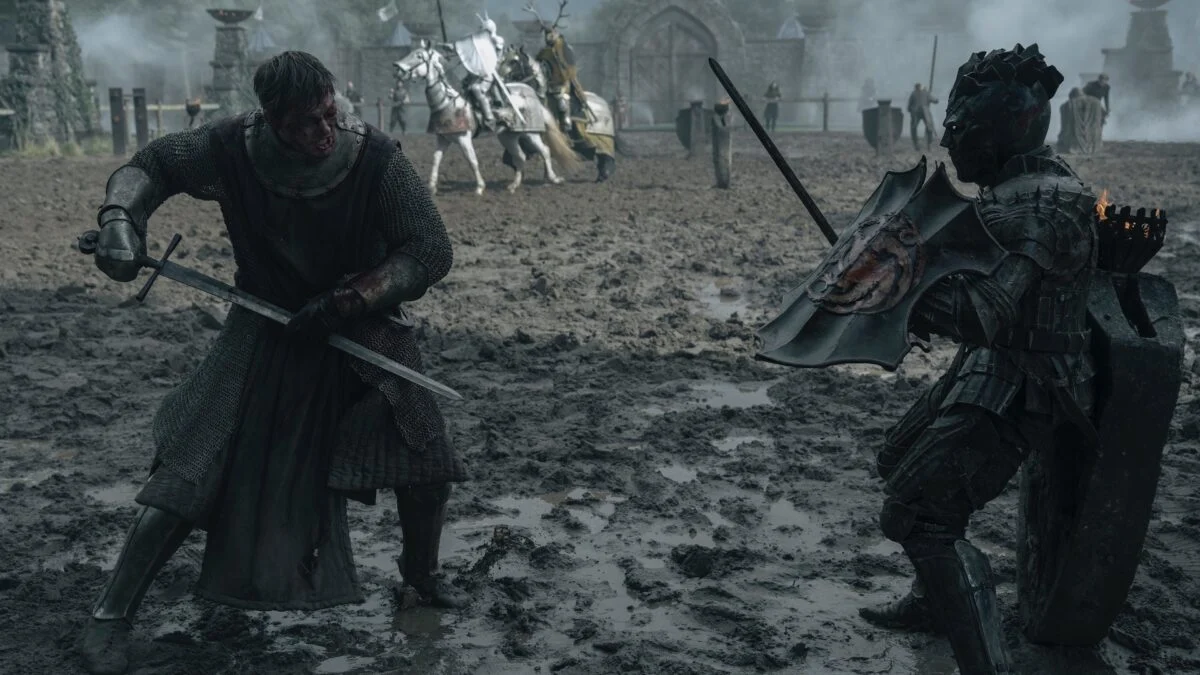
I gripped the couch arm as steel rang and a shout tore the air. You hold your breath between strikes, waiting for the next cut. For three minutes of screen time, Dunk becomes a single, collapsing focus: sight muffled, sound magnified.
I watched the Trial of Seven with a notebook on my lap and a running question: how do you make panic feel like the story’s engine? You already know the credits: Ira Parker running the show, Owen Harris directing the sequence, Peter Claffey selling every ragged inhale, and Alastair Sirkett sculpting the soundscape. What follows is how they stacked detail, performance, and design to push the scene past spectacle and into something that feels personal.
On set the lights picked up sweat and metal — and the team treated every breath as material.
The first, simple choice was point of view. Parker and Harris refused to let the camera stay godlike; they put it where Dunk experiences the trial. That meant narrowing vision, amplifying a single throat’s panic, and turning ordinary choreography into a claustrophobic struggle.
How did they film Dunk’s helmet POV?
I asked myself the same thing while watching the clip on repeat. Harris and the crew layered solutions: a helmet-framed shot that suggests being inside the visor, careful actor blocking so Claffey’s breathing synced with camera cuts, and a rigging approach that preserved realistic movement without asking viewers to suspend disbelief. IndieWire’s reporting captured the point plainly — this was a design choice meant to honor George R.R. Martin’s original, anxious inner monologue for Dunk while keeping the scene kinetically entertaining.
The field smelled of iron and adrenaline — the edit treated sound like anatomy.
Sound was not an afterthought; it was the scene’s spine. Sirkett and the sound department leaned into breathing as a rhythmic anchor, placing us inside Dunk’s chest before any steel connected. That raw inhale becomes a metronome for panic, and when cuts arrive they feel like answers to a rapid heartbeat.
The actor’s commitment mattered as much as the tech. Peter Claffey’s choice to fill the helmet with sharp, audible breaths gave the editors a physical pulse to shape. You feel the world shrink around those inhales and exhale into a collision of blades and flags.
One of the choices that made the sequence stick was a single technique: narrow sensory focus. When sight is constricted and sound is magnified, tension reads as a line item on every frame — and the viewer supplies the missing terror.
Why did the Trial of Seven feel so personal?
Because the camera, the actor, and the sound design all answered one question: what would this feel like from inside Dunk’s skull? Parker pointed to Martin’s novellas — they’re mostly Dunk’s running interior monologue — and the show copied that intimacy. You follow Dunk throughout the episode; then, in the trial, you are given the rules of his panic and forced to play by them.
The director wanted spectacle, but the crew insisted on honesty — so they mixed showmanship with restraint.
On one side you have big action ambitions: wide composition, exciting choreography, crowd energy. On the other, you have a need to preserve the character’s interior life. Harris found the seam between those aims and stitched it with choices that never let spectacle erase Dunk’s perspective.
Editing choices kept the momentum tight. Cuts favor Claffey’s reactions over showy flourishes; camera moves favor obstructions — a shield, a beaten visor — that maintain claustrophobia without losing the geography of the fight. The result is action that feels crafted rather than loud by accident.
There are two images that keep pulling at me: the helmet as a tiny theater where every sound is amplified, and the sequence itself working like a throat-closing vise that squeezes the audience the way it squeezes Dunk.
Practical craft also mattered. Training, choreography, and a willingness to let the lead play raw allowed the scene to breathe on Claffey’s minute choices. The team’s restraint — choosing the single shot that kept you in the helmet rather than a parade of flashy angles — turned a combat sequence into a character test.
The season’s final episode lands on HBO and HBO Max; if you’ve followed the series, it’s the last card the show plays this season. The sequence is already a reference point for how television can make panic feel authorial rather than incidental.
Want more io9 news? Check dates for upcoming Marvel, Star Wars, and Star Trek releases, follow the DC Universe expansion on screen, and catch updates on the future of Doctor Who.
Ira Parker and Owen Harris chose detail over décor; Alastair Sirkett turned breath into narrative; Peter Claffey handed you panic on a plate — so tell me: has television just found a new language for fear, or is this a brilliant one-off?