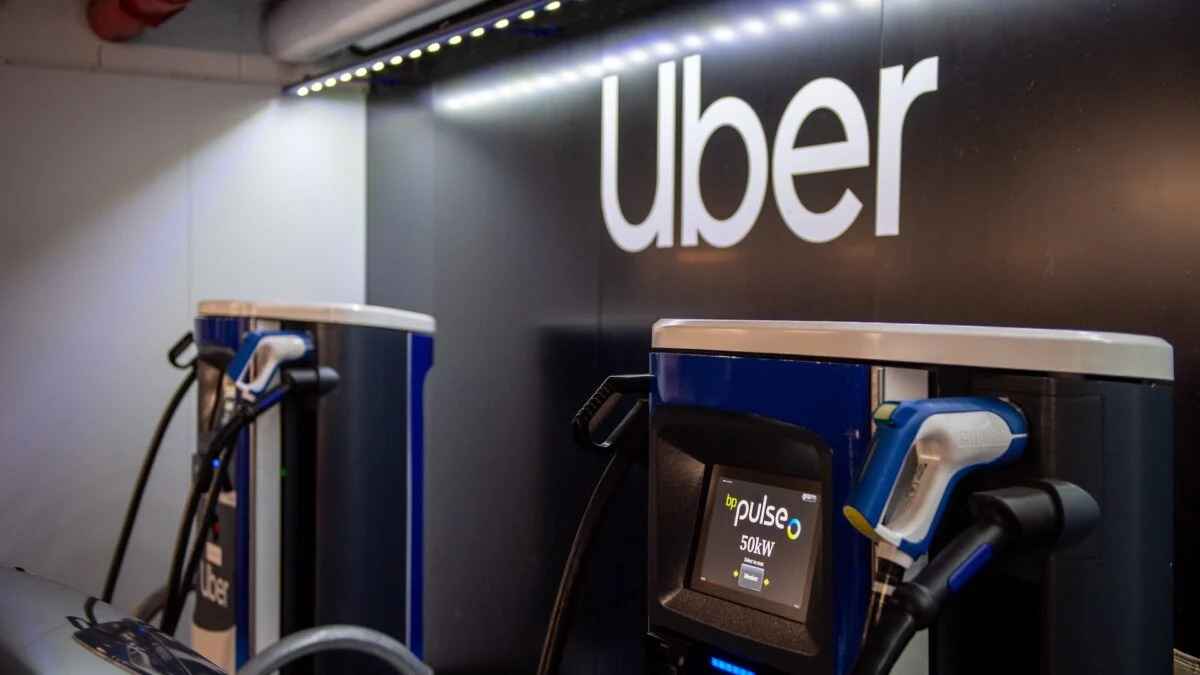
It’s 5:30 a.m. at a concrete lot where no one is driving. A row of cars slides in, ports open, and chargers snap to life. You feel the weird certainty: something is being built that will change who controls our streets.
I follow these moves because I care about what future mobility will cost you and the drivers who still make the app run. I won’t hand you a press release; I’ll tell you what Uber’s $100 million (€86M) bet on charging hubs really means for cities, fleets, and your commute.
San Francisco’s curb now smells of battery acid and optimism.
The observation: chargers are replacing payphones on the sidewalk. Uber says it will pour more than $100 million (€86M) into dedicated charging hubs and “autonomous depots,” and it plans to start in the San Francisco Bay Area, Los Angeles, and Dallas. I read that as a strategic play: if cars need power, whoever controls the plugs controls uptime.
These depots will host fast chargers and handle fleet work—cleaning, inspections, routine maintenance—so the vehicles spend more minutes earning fares and fewer hours out of service. It’s a move that treats electricity as operational capital, not just an environmental talking point.
How much is Uber investing in charging stations?
Short answer: Uber announced an investment north of $100 million (about €86 million) into hubs for autonomous and electric fleets. They’re also promising to spur an additional $100 million+ in public EV chargers by offering utilization guarantees to providers such as EVgo, Hubber, and Electra.
At the depot gate, there’s anxiety and a to-do list.
The observation: fleet managers are already juggling software updates, cleaning crews, and chargers on cramped lots. Uber’s pitch is part logistics, part data product. The company says it will use in-app trip telemetry to map demand and offer utilization guarantees so charging operators will actually get paid for building in places where drivers will use them.
I’ve watched companies try to pay for infrastructure before—this is a financial moat with a scheduling ledger behind it. For drivers, that ledger will appear inside the Driver app as real-time charging suggestions, wait-time forecasts, and offers that lower out-of-pocket charging costs.
Will Uber run robotaxis itself?
Uber is hedging. The company still runs human-driven trips, but it’s positioning as both operator and service layer for robotaxis. It already manages fleet operations for partners—Waymo in Austin and Atlanta is one public example—and it plans autonomous deployments in at least 10 cities by the end of 2026 with partners including Lucid and Nuro. That means Uber wants to be the marketplace and the backstage control room for autonomous fleets.
On a downtown street, you’ll soon be choosing between apps.
The observation: Waymo, Tesla, and other robotaxi services are already serving parts of several cities. That competition is real; Waymo runs in places like San Francisco, Phoenix, Los Angeles, and Miami, and Tesla has pushed into Austin with its own robotaxi ambitions.
Uber’s play is to convert rivalry into partnership. By managing charging logistics and daily fleet ops, Uber can make its platform the easiest place for fleet owners to sell rides. For incumbents this is comfort; for smaller players it’s leverage. You should ask whether you want a single company nudging both the driver and the charging decision.
Where will Uber deploy autonomous services?
The observation: deployments follow miles and regulatory permission. Uber has said it will roll autonomous services onto its platform in at least 10 cities by the end of 2026, starting with priority markets and expanding as partners scale vehicle production and regulators sign off.
There’s more at stake than badges and logos. Uber’s guarantees to charging providers—paired with trip-data routing—are a bet on behavioral change: drivers and fleets must adopt electrified operations, and cities must accept the new infrastructure. If that happens, ride-hailing’s cost structure shifts. If it doesn’t, those depots become expensive real estate holding tanks.
I’ve been tracking mobility for years, and here’s what I want you to keep an eye on: who owns the uptime, who sells the charge, and how regulatory frameworks treat shared autonomous vehicles. This matters for driver income, city curb use, and whether your next taxi has a steering wheel.
Brands and people you should know: Uber’s Global Head of Mobility Pradeep Parameswaran, Waymo and Tesla (robotaxi competitors), partners Lucid and Nuro (vehicle and delivery partners), and charging networks EVgo, Hubber, and Electra. Tools at play include the Uber Driver app, in-app telemetry, and third-party charging-management software.
Two final images to carry forward: a chessboard where every square is a charging port, and a backstage control room where fleets are cued for their entrance. Which side do you think will checkmate the other—tech pioneers, legacy OEMs, or the marketplaces that stitch them together?