
Two weeks ago I watched a sales deck collapse when the slide that listed “search rankings” got blank stares. The team had lots of organic traffic—but AI answers were steering buyers elsewhere. You feel that moment in your gut: ranking numbers no longer tell the full story.
I’ve tracked these shifts across products and PR campaigns, and I want you to see the gap clearly. Below I walk you through the seven AI rank trackers that matter in 2026, why they behave differently from classic SEO tools, and how to use their signals without wasting time. This is practical rather than preachy—I’ll tell you what to test first and what to ignore.
A brand manager told me her product page vanished from an AI answer during a demo. What Is AI Search Visibility and Why Does It Matter in 2026?
AI search visibility measures how often an AI-driven answer mentions, cites, or recommends your brand when users ask questions in ChatGPT, Google AI Overviews, Google AI Mode, Bing Copilot or Gemini. It’s not about position on a 10-link SERP; it’s about presence inside a single, consolidated response.
Think of AI answers as a lighthouse in fog: a single beam guides attention, and if your brand isn’t in that beam, your high organic rank can feel invisible. For teams that care about conversions, citations inside AI replies are the new real estate.
What is an AI search visibility tool?
An AI search visibility tool is software that runs representative prompts against AI services, captures the returned answers, and counts or qualifies mentions of your brand, product pages, or spokespeople. It tells you whether AIs treat your content as a source or just a passing example.
I ran identical prompts across ChatGPT and Google and the outputs diverged. How AI Rank Trackers and Search Visibility Tools Work
These tools don’t scrape positions the way classic rank trackers do. Instead they simulate user prompts, collect the AI replies, and apply entity detection to group brand name variants, product lines, and key people. That lets them report whether your brand is the primary citation, a supporting reference, or absent.
Many of the platforms also cross-reference standard SEO signals—indexed pages, Google Search Console data, crawl logs—to explain why AI systems may or may not be using your content. That layered view helps you decide whether to rewrite a page, add schema, or pitch clearer source signals to the bots.
How do AI visibility trackers work?
They run prompt libraries (real user queries and engineered prompts), record AI outputs, tag mentions with entity and intent labels, and surface trends over time. Some tools add sentiment and accuracy checks so you can spot hallucinations or misattributions fast.
We set up ten tools across live projects and a sandbox. How We Evaluated the Best AI Search Visibility Tools?
I measured which platforms they supported (ChatGPT, Gemini, Google AI Overviews, Copilot, Perplexity, Claude), how transparent the collection method was, whether they tracked historical changes, and whether they gave teams practical workflows: alerts, competitor comparisons, and prompt-level testing.
Price, scale, and reporting cadence mattered: AI answers shift quickly, so tools that update weekly felt stale; those that refresh daily or on-demand earned higher marks. I prioritized tools for content teams, in-house SEO, and enterprise governance so you can match the product to your needs.
When I lined the dashboards up side by side, patterns jumped out. Comparison of the Best AI Search Visibility Tools in 2026
| Tool | AI Platforms tracked | Core AI visibility features | Best for | Pricing model |
|---|---|---|---|---|
| SE Ranking | Google AI Overviews, ChatGPT, Bing Copilot | AI answer monitoring, brand mention tracking, SERP vs AI comparison | SEO teams | Subscription |
| Profound | ChatGPT, Google AI Overviews | Brand citation analysis, authority tracking | Enterprise brands | Custom |
| Otterly.AI | ChatGPT, Bing Copilot | Prompt-based AI visibility tracking | Content teams | Subscription |
| Peec AI | ChatGPT, Google AI Overviews | Topic-level AI visibility analysis | SaaS brands | Tiered |
| Scrunch AI | ChatGPT | Brand framing and accuracy analysis | Brand teams | Subscription |
| Brand24 | Multiple AI-driven sources | AI mention detection, sentiment tracking | PR teams | Subscription |
| PromptWatch | ChatGPT | Prompt-level AI monitoring | Advanced SEO | Usage-based |
One client asked for clarity on vendor claims. Tool Selection Methodology
I excluded legacy rank-only tools and picked products that actively query AI systems. The checklist was simple: supported AI endpoints, transparency of collection (do they show the prompt and response?), historical tracking, and team workflows—alerts, exports, and competitor comparisons.
That gave us a range: from SE Ranking (bridges classic SEO with AI signals) to Scrunch AI (accuracy and framing for risk-sensitive brands) and PromptWatch (prompt-level experiments for advanced teams).
A CMO swapped a month of experiments for a single dashboard. Best AI Search Visibility Tools Reviewed
I tested these tools against common scenarios: product comparison queries, how-to searches, and reputation checks. Below I summarize what each does well and what you can expect the first week after you sign up.
SE Ranking
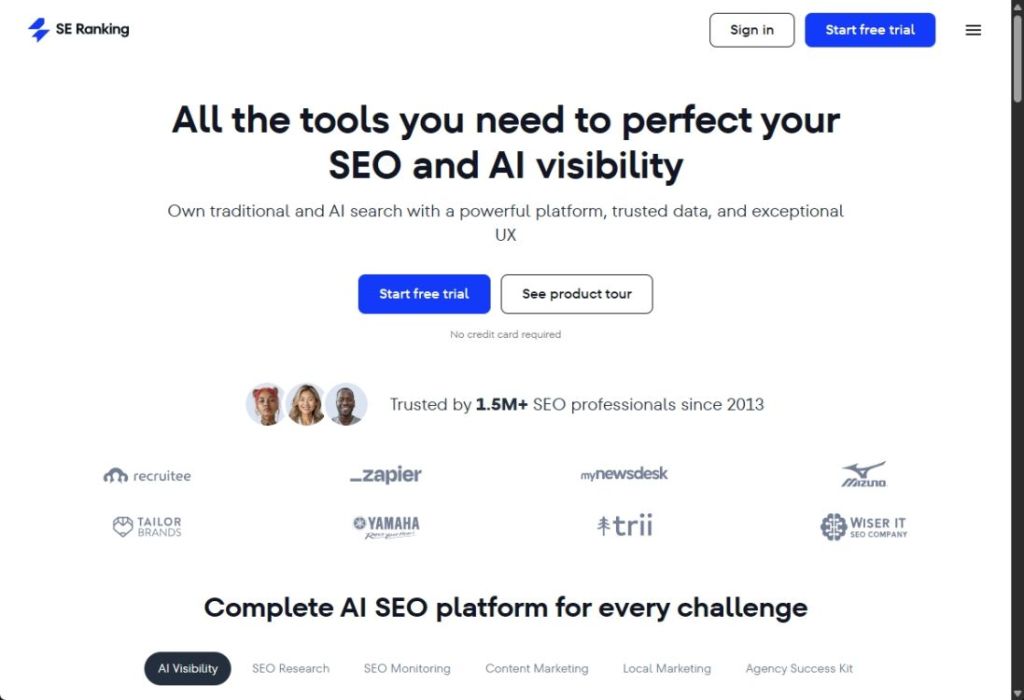
SE Ranking mixes classic rank tracking with AI visibility. It surfaces pages that rank well in organic search but never appear inside AI answers—those are the low-hanging fruit for content rewrites and stronger citation signals.
| Pros | Cons |
|---|---|
| Combines SEO and AI rank tracking in one platform | AI features are newer than core SEO tools |
| Covers multiple AI systems | Less specialized than AI-only platforms |
| Helps link content changes to AI visibility |
Pricing: AI visibility features are included in SE Ranking’s core subscriptions: Pro plan from $119/month (≈ €111/month) and Business plan from $259/month (≈ €241/month). Pricing scales by keywords, competitors, and AI prompt limits; an AI Search add-on expands prompt coverage and historical depth.
Who this tool suits best: SEO teams and in-house marketers who want AI visibility without replacing their SEO stack.
Profound
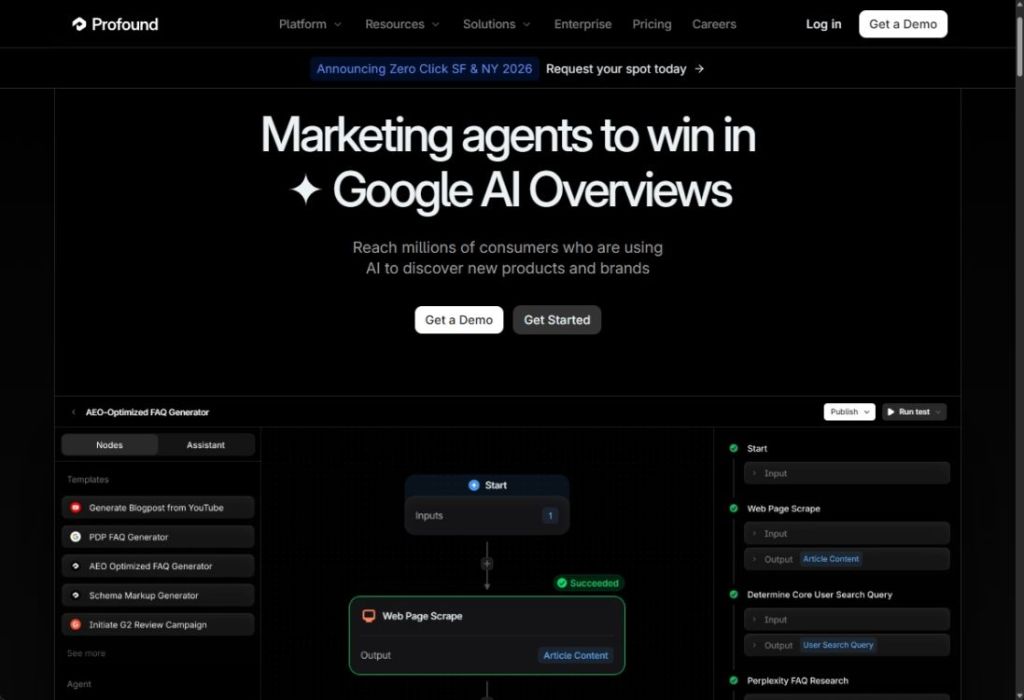
Profound focuses on brand authority inside AI replies. Enterprises use it to track how often their company is cited across answers to industry questions—not just product pages—and to see whether citation rates trend up or down.
| Pros | Cons |
|---|---|
| Strong focus on brand authority in AI answers | Less accessible for small teams |
| Designed for large datasets and trend analysis | Not built for classic SEO workflows |
| Useful competitor visibility insights |
Pricing: Paid plan starts at $99/month (≈ €92/month).
Who this tool suits best: Large organizations with a dedicated AI search strategy team.
Otterly.AI
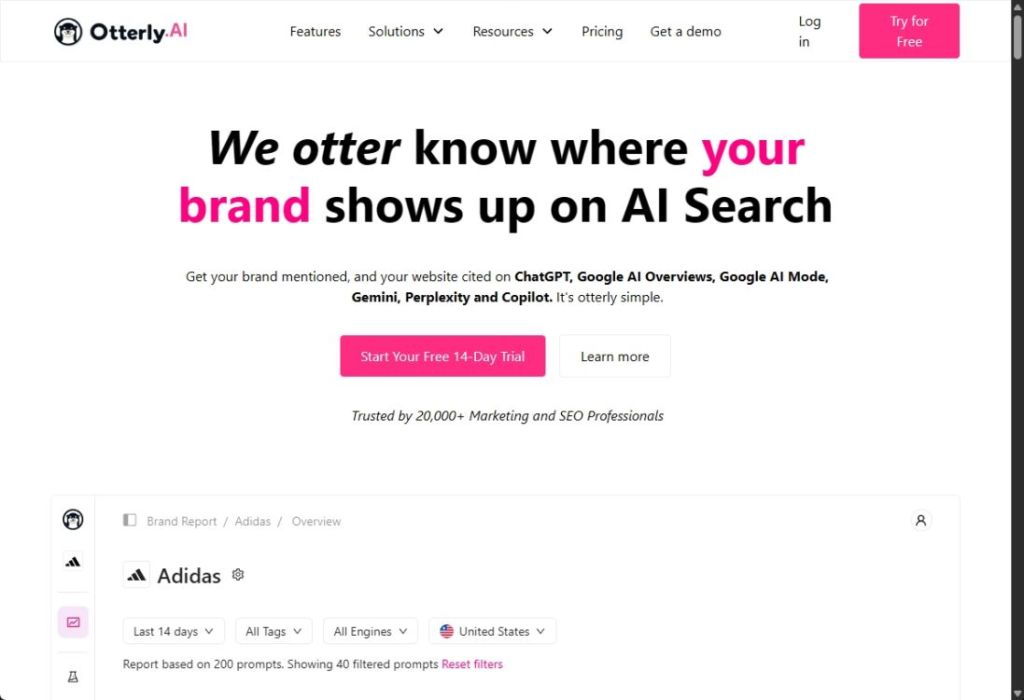
Otterly.AI is built for content teams who need quick answers: did new content start showing up in AI replies after indexing? It runs predefined prompts that mirror real user searches and reports who wins identical queries.
| Pros | Cons |
|---|---|
| Easy to use and quick to set up | Limited depth compared to enterprise tools |
| Clear visibility-focused reporting | Fewer advanced customization options |
| Good entry point into AI rank tracking |
Pricing: Paid plan starts at $29/month (≈ €27/month).
Who this tool suits best: Small content teams and marketing managers starting to track AI visibility.
Peec AI
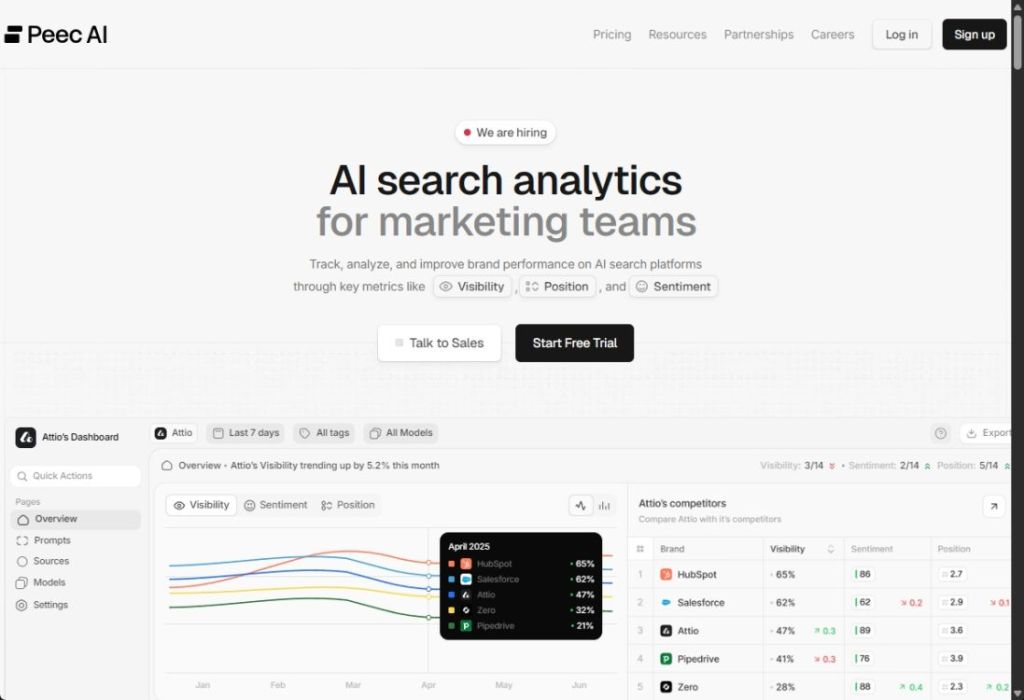
Peec AI focuses on topic-level visibility rather than keyword lists. It shows where your brand appears across categories—use cases, comparisons, tutorials—so you can patch content gaps where competitors earn AI citations instead of you.
| Pros | Cons |
|---|---|
| Strong topical visibility analysis | Less granular prompt control |
| Helpful for content planning | Not designed for traditional rank tracking |
| Clear competitor context |
Pricing: Paid plan starts at $89/month (≈ €83/month).
Who this tool suits best: SaaS companies and content-driven brands aiming for topic authority across ChatGPT, Gemini, Perplexity, Claude, and Copilot.
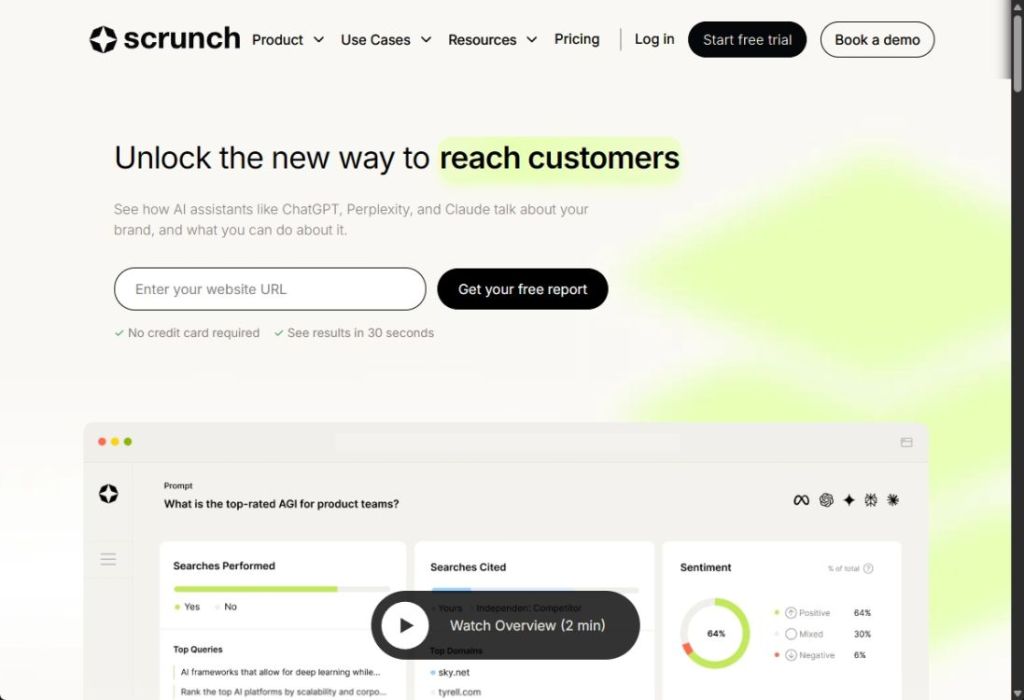
Scrunch AI
Scrunch AI inspects how AIs frame your brand. It flags inaccuracies and classifies queries by intent so you can see whether AI mentions are flattering, neutral, or harmful.
| Pros | Cons |
|---|---|
| Strong focus on brand accuracy and framing | Narrower focus than general AI rank trackers |
| Useful for risk-sensitive industries | Less emphasis on competitive benchmarking |
| Goes beyond simple mention tracking |
Pricing: Paid plan starts at $250/month (≈ €233/month).
Who this tool suits best: Communications, brand, and compliance teams that must manage reputation in AI-generated content.
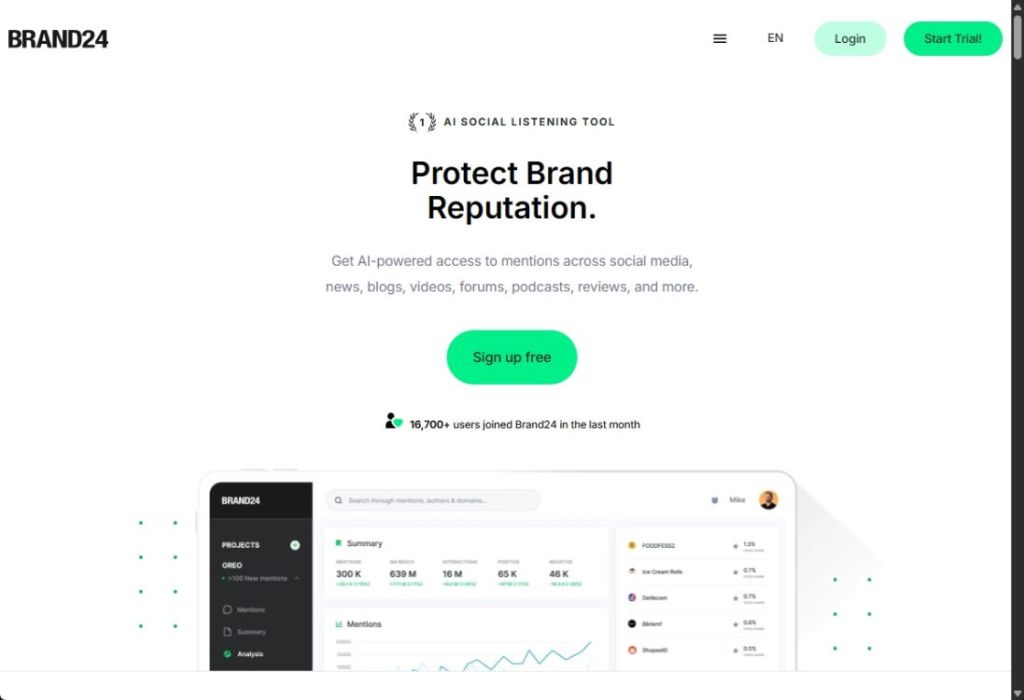
Brand24
Brand24 expanded from social listening into AI mentions, combining sentiment and detection across ChatGPT, Gemini, Perplexity, Claude, and Copilot. PR teams use it to alert when AI-generated sentiment shifts.
| Pros | Cons |
|---|---|
| Combines AI visibility with sentiment analysis | AI visibility tracking is not its core focus |
| Useful for reputation monitoring | Less prompt-level control |
| Familiar workflows for PR teams |
Pricing: Paid plan starts at $199/month (≈ €185/month).
Who this tool suits best: PR and communications teams focused on reputation across AI platforms and media channels.
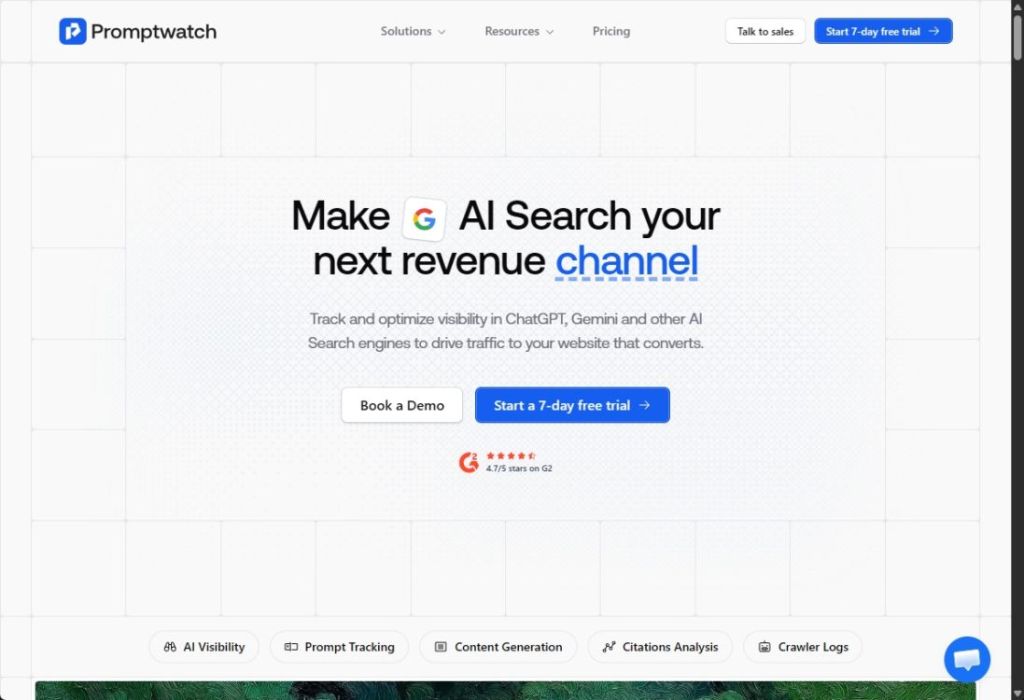
PromptWatch
PromptWatch scrutinizes sensitivity to small prompt changes. It answers the question: when a user swaps a phrase, which brands survive the shift? It also analyzes crawler bots like GPTBot and PerplexityBot to show indexing frequency.
| Pros | Cons |
|---|---|
| Deep insight into prompt sensitivity | Less beginner-friendly |
| Useful for testing AI behavior | Narrower focus than all-in-one platforms |
| Clear competitive comparisons |
Pricing: Paid plan starts at $99/month (≈ €92/month).
Who this tool suits best: Advanced SEO teams and marketers experimenting with prompt-driven behavior.
At a meetup a founder asked, “Which tool should I buy first?” Which AI Search Visibility Tool Is Right for You?
If you already use SE Ranking or a standard SEO stack and want a cheap lift, start with SE Ranking to add AI visibility without replacing workflows. If you need topic-level authority for a SaaS product, Peec AI gives a fast map of where you’re absent in AI answers. If brand framing and accuracy matter—legal, healthcare, finance—Scrunch AI or Profound are the safer bets.
Small teams with limited budgets can get meaningful signals from Otterly.AI (from $29/month; ≈ €27/month). Agencies that must show side-by-side reports and historical context will prefer Profound or SE Ranking’s Business tier.
Are AI rank trackers replacing SEO tools?
No. They complement them. Think of classic SEO as your foundation and AI visibility as the doorbell: you can have a beautiful house, but if no one rings the bell the guest may leave. Use AI trackers to map where that doorbell is being pressed, and then use SEO workflows to fix the path.
An analyst said buyers now ask AI first, humans later. Why AI Rank Trackers Are Now Part of SEO
More people are getting answers from chat interfaces and AI-driven summaries inside Google and Microsoft products. That means a single AI response can replace a whole session of browsing. AI rank trackers let you see who gets mentioned, for what intent, and with what sentiment—information that classic rank-only reports miss.
An AI mention can act as a backstage pass to awareness: it can shortcut discovery, recommendation, and purchase if your brand is present and framed correctly. Track weekly if you’re experimenting and daily if you run paid campaigns or reputation-sensitive messaging.
How often should AI visibility be tracked?
Most teams track weekly to monitor trends; teams that publish fast or depend on short campaign windows will want daily checks. The frequency depends on how quickly the tracked AI endpoints update and how volatile your category is.
If you want a single practical experiment: pick three representative prompts for your product (a how-to, a comparison, and a pricing query), run them across ChatGPT, Gemini, and Copilot, and measure whether your domain appears in the answer or citations. If you’re absent, test a focused content rewrite and re-run the prompts—repeat until you see movement.
I’ve given you tactical choices and a map of strengths for seven vendors. Which signal will you chase first: a mention, a citation, or a correction—and what will you risk if you wait?