I tapped a random image in my feed and the tiny Gemini mark in the corner felt like a clue in a crime scene. I froze—was the photo real, or had an AI just stitched it together? You will start scanning corners the next time something looks too perfect.
I write about these rollouts so you don’t get surprised when the tools arrive in the apps you already use. I’ll walk you through what changed, what stayed the same, and where this will matter for anyone from a social media manager to a creative director at an agency.
You scroll through a search result and notice the image renders in a second—what changed?
Google has folded Nano Banana 2 into the Gemini 3.1-Flash pipeline. Practically, that means speed is the headline: images that used to take a few breaths now finish faster. If you’ve waited on renders inside Google Search, Flow, or AI Studio, this is the change you’ll feel first.
That speed matters for human workflows. Faster renders shorten the feedback loop between idea and output, so teams iterate more often. Think of it like trading a backpack for a duffel bag—lighter to carry, more room to throw things into when you’re moving fast.
You notice the text looks readable instead of mangled—how did that happen?
Nano Banana Pro had a reputation for doing text better than most generative image models, and Nano Banana 2 tightens that skill by tying the generator to Gemini’s broader knowledge graph. The model now consults web search and real-world references to render specific subjects and labels more accurately.
How is Nano Banana 2 different from Nano Banana Pro?
The short answer: integration and velocity. Nano Banana 2 merges the creative control of Pro with Gemini 3.1-Flash’s speed and access to live search signals. Functionally, you still get multi-character scenes and layered object control—up to five characters and 14 objects—but with quicker turnaround and improved fidelity.
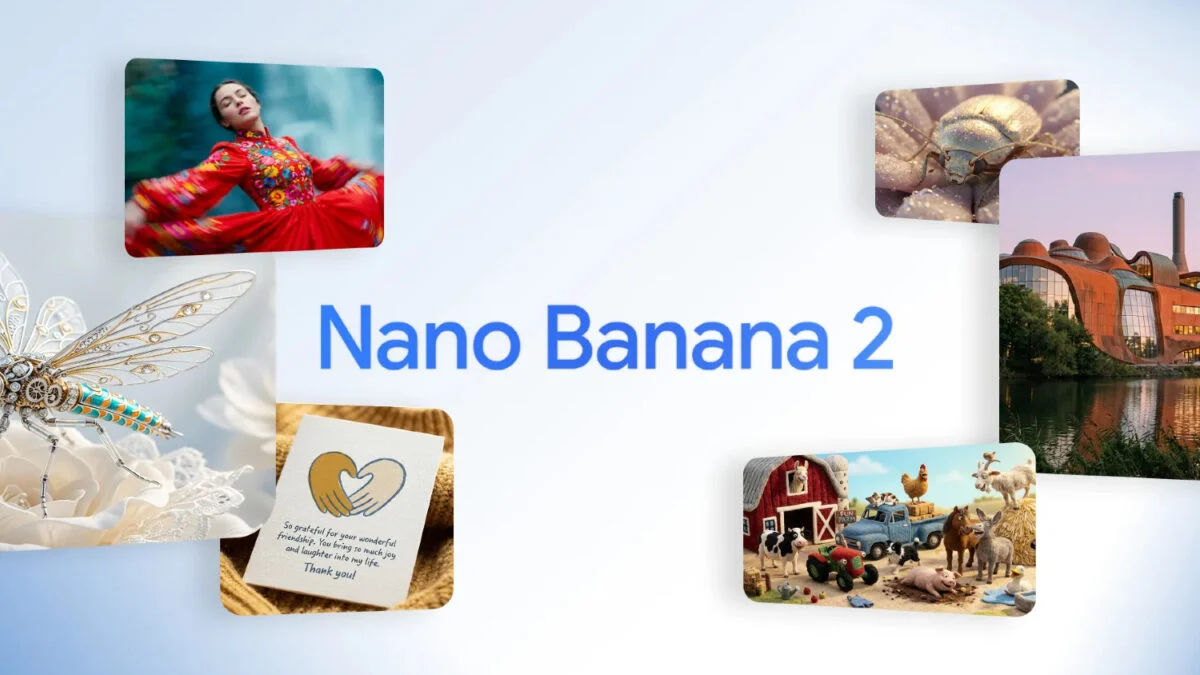
Practically, that means better lighting, improved textures, and tighter adherence to prompts. The model claims improved translation and text rendering, which will be useful for infographics and data visualizations—areas where a shaky label can wreck credibility.
You check your apps and wonder when the change will land where you work.
Google says Nano Banana 2 is available starting today and will replace the older models across its suite. Expect it inside the Gemini app as the default, with the option for Google AI Pro and Ultra subscribers to revert to the prior model if they prefer. Over the next few days it will surface in Google Search, Flow, AI Studio + API for developers, Google Cloud, and Google Ads.
When will Nano Banana 2 be available?
Available now in the Gemini app and rolling out to Search, Flow, AI Studio + API, Google Cloud, and Google Ads over the coming days. If you run enterprise workloads on Google Cloud or manage campaigns in Google Ads, you’ll see the new model show up in platform UIs and APIs soon.
You’re worried about misuse and whether the watermark will be reliable.
Google’s visible watermark—the Gemini tag in image corners—becomes a practical tool for provenance, but watermarks aren’t foolproof. They’re a cue, not a guarantee. Expect mislabeling, deliberate masking, and edge cases where the watermark is absent.
For creators and editors, the countershift will be detection and context: provenance layers in Google Search, version history in Flow, and audit trails inside AI Studio. For fact-checkers, the model’s access to web signals may help or hinder verification depending on how clearly sources are surfaced.
Can Nano Banana 2 render text in images accurately?
Google claims better precision in text rendering and translation than prior iterations. In testing, the model often produces legible labels and multilingual text that reads correctly more frequently than many competitors. Still, real-world accuracy will vary with font complexity, small sizes, and noisy backgrounds—the machine isn’t a perfect typesetter yet, but it’s closer than before, printing characters like a meticulous typesetter.
Where this integrates matters: marketers using Google Ads, designers in Flow, and developers calling the AI Studio API will need to validate outputs before publication.
Look at the rollout through one practical lens: speed plus improved prompt adherence will push Nano Banana 2 into everyday creative loops at agencies, product teams, and ad studios. The model’s availability inside Google Search and Ads makes it a distribution event as much as a product update—images generated by Nano Banana 2 will reach customers, searchers, and voters without warning.
If you care about signal quality, that should raise two questions for your team: who signs off on AI-generated assets, and what traceability will you demand? My bet is you’ll see tighter internal checks and a new layer of metadata requirements across asset pipelines.
Google’s Nano Banana 2 is faster, more integrated with Gemini, and promises cleaner text and better prompt fidelity—but the small stamp in the corner won’t solve the broader trust problem by itself. Are we ready to treat that tiny watermark as fragile evidence, or will we keep assuming the image tells the whole story?