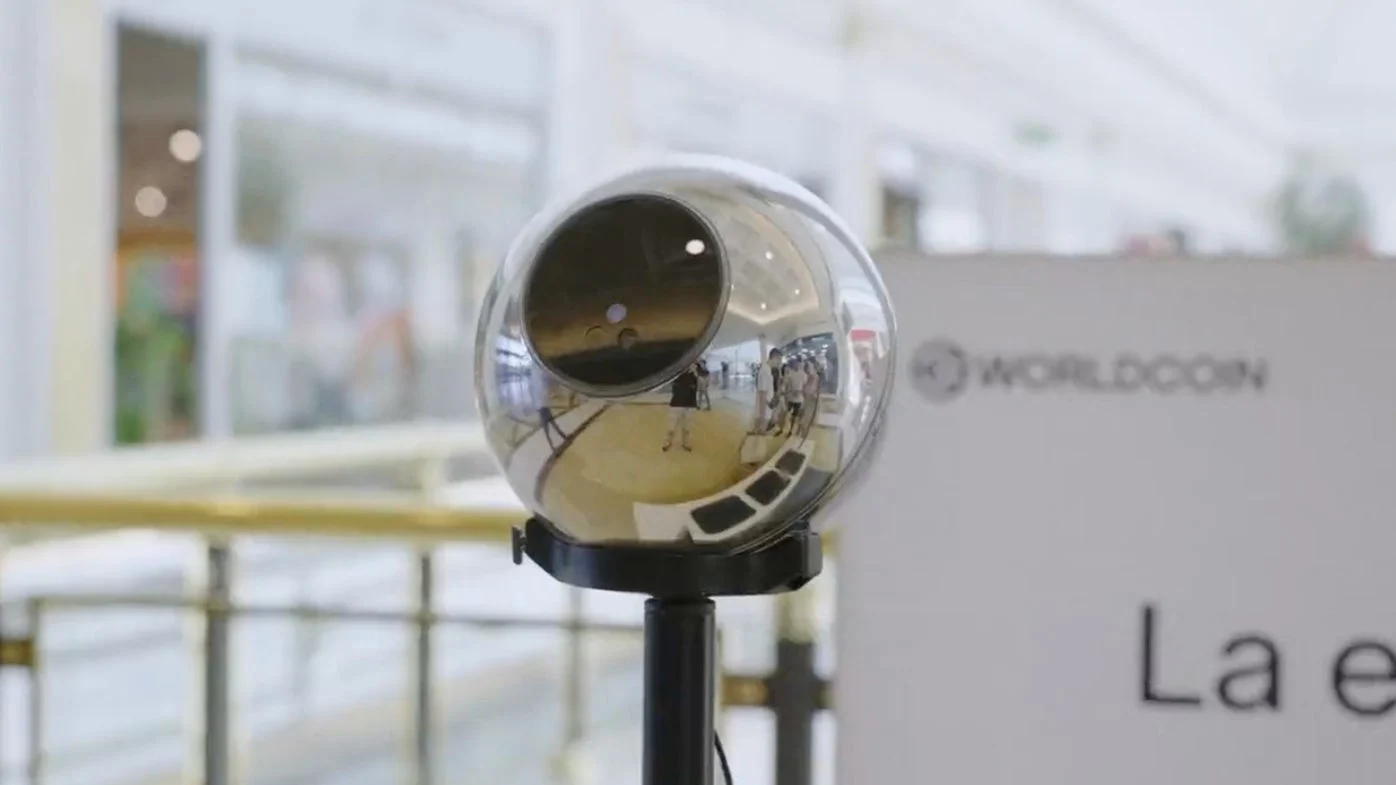
You’re at a Gap register. A staffer asks you to step forward and hold still while a silver orb hums and scans your iris. I remember thinking the orb looked like a tiny lighthouse in the fog.
I’ve been tracking this project closely, and you should know what’s happening before an orb whispers your identity to a corporate server. Sam Altman’s World (formerly Worldcoin) has quietly stitched itself into apps and stores you already trust — Tinder, Reddit pitches, a Visa pilot, and now retail aisles — and it wants to be the plumbing for proving you’re human.
A Gap store in San Francisco is offering World ID signups at checkout.
That isn’t theoretical. According to the Wall Street Journal, clerks have been inviting shoppers to step up and have their irises scanned inside World’s glass-and-aluminum orbs. Trevor Traina, World’s chief business officer, told the Journal that the company expects partners to carry the message for them: trust will transfer from familiar brands to the technology.
What is Worldcoin’s World ID?
World ID is a digital credential created from an iris scan. You submit an eye imprint through the orb, the system converts that biometric into a unique identifier, and the ID is intended to prove you are a distinct human in services where identity matters — banks, social platforms, or anti-bot layers on dating apps such as Tinder. The company also introduced a token, Worldcoin, originally used to reward signups but now often downplayed in public pitches.
A cashier asks people a simple question: Do you want some crypto for an eye scan?
That proposition changed the frame for many early recruits. In poorer regions, World offered Worldcoin in return for an iris scan; critics called the practice exploitative and, in some reports, deceptive. The MIT Technology Review and other outlets flagged early rollouts for aggressive sign-up tactics and unclear consent.
How does Worldcoin verify identity?
The system captures an iris image, runs it through proprietary processing, and issues a World ID token tied to that biometric signature. World says the raw biometric data isn’t stored centrally in a way that can be reconstructed, but critics and privacy experts remain skeptical about reidentification risks and how the IDs may be reused across services.
More than 33 million people have interacted with World so far, but adoption is uneven.
World reports some 33 million users and about 18 million verified World IDs, yet only 1.1 million are in North America. That split is important: initial growth came from markets where the Worldcoin incentive was more attractive, and regulators and civil-society groups raised alarms about consent and data protection.
Is Worldcoin safe?
I’ll tell you the blunt part: safety depends on future decisions more than current code. The technical team may implement strong encryption and decentralization promises, but the business model ties biometric identifiers to a corporate project led by a high-profile founder. Platforms such as Tinder and payments partners like Visa bring visibility; they also shift everyday trust toward a single verification layer. If that layer falters, the fallout could be broad.
World’s strategy is plain: embed verification where people already shop and swipe. Partnerships do the heavy lifting of persuasion; you show up for a sale or a date, not for a privacy contract. That gives World a runway to grow without ever needing a flashy campaign — the pitch moves through loyalty and convenience.
There’s another danger: once an ID system spreads, adoption compounds. The technology can spread like invasive ivy, wrapping itself around services and standards until opting out becomes hard or costly.
Keep your eye out for the orb. Will you hand over a scan to prove you’re human, or will you demand different proofs of identity first?