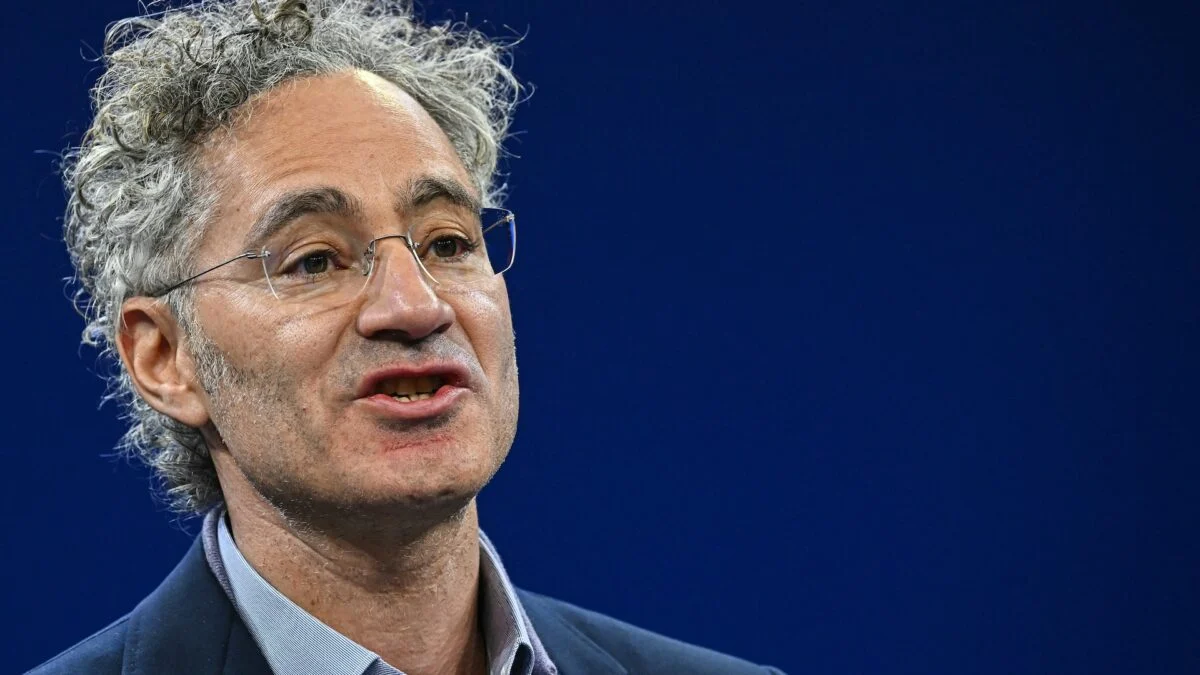
He sat under CNBC lights, speaking in measured evasions that felt like a confession. I watched him thread two incompatible claims together: “I don’t believe in regime change,” followed by steady praise for the war unfolding in Iran. You can hear the racket of strategy and PR colliding—and the fallout lands on real bodies.
On CNBC Thursday, Alex Karp tried to have it both ways — posture against regime change while praising a war he says he supports
I watched the interview so you didn’t have to. Karp repeatedly refused to confirm classified details yet kept circling back, apparently eager to take credit for how modern tools shape conflict. He praised frontline troops, then immediately praised the “resources” — including Palantir’s Project Maven and Foundry — that he suggested have “shifted the way in which war is fought.”
In the studio, a short exchange about Project Maven revealed more than what was said — and less than we deserve
The reporter tried to pin down whether Project Maven and Palantir’s systems were used to target Iran’s Supreme Leader; Karp said he “can’t go into specifics.” That answer was a shield and a boast at once: he declined to confirm classified operations while hinting they exist. Palantir’s tech is already described publicly as integrated with Anthropic’s Claude inside Maven; the Pentagon’s dispute with Anthropic over guardrails only raises the stakes.
Is Palantir involved in the Iran war?
Short answer: the CEO won’t confirm. Longer answer: Karp repeatedly suggested allied militaries in the Middle East “may or may not be users” of Palantir’s platforms, and he framed Foundry as the indispensable coordinating tool for multi-party operations. You’re meant to infer the rest.
On the battlefield and in classified rooms, the ethics claim and the practical claim diverge
Karp told viewers he “doesn’t really believe in the wars we’ve fought in the past, because I don’t believe in regime change,” while also saying he supports the current policy. That’s not a factual contradiction so much as a rhetorical one. If a leader and much of Iran’s top command were assassinated early in the campaign, backing a policy that enabled that outcome is functionally indistinguishable from supporting regime change in practice.
Palantir CEO Alex Karp on his support for Trump’s Iran war: “I don’t really believe in the wars we’ve fought in the past, because I don’t believe in regime change. And that’s one of the reasons I’m supportive of this policy we currently have.”
— Aaron Rupar (@atrupar.com) March 12, 2026 at 6:25 AM
At the policy table, he invoked privacy and the Fourth Amendment — then limited it to the battlefield
Karp said, “No one believes it, but Palantir is the most important protector of the Fourth Amendment… or Fourth Amendment, meaning the right of privacy, in this country because of the way our product works.” Then he added, baldly, “The Fourth Amendment does not apply to adversaries on the battlefield.” That distinction is as convenient as it is elastic: it protects corporate posture at home while clearing the way for broad collection and targeting abroad.
Does Palantir support regime change?
Karp’s public line is: not in principle. His actions and the capabilities he praises — Project Maven’s targeting, rapid allied coordination via Foundry, and integrations with LLMs like Claude — suggest support for policies that produce the same outcomes. If you weigh rhetoric against outcome, you should pick one to trust.
On stage, Karp also reframed AI as a political reshaper — and his language was pointed
He argued that AI shifts economic power from “humanities-trained, largely Democratic voters” toward vocationally trained, working-class voters, often male. That framing did two jobs: it casts AI as a partisan balancing tool and it gives a moral gloss to military uses. I heard a CEO trying to sell a narrative where technology pays back certain voter blocs for political support.
Palantir’s positioning is like a chess player rearranging pieces under a tablecloth; it’s precise and hidden. Its platform is a Swiss Army knife for wars of the 21st century.
Is Palantir using Anthropic’s Claude?
Karp avoided specifics but acknowledged integrations with “other large language models” amid the Pentagon’s dispute with Anthropic. Remember: Anthropic refused certain DoD terms to preserve guardrails against domestic surveillance and fully autonomous weapons. That standoff forces choices about safety, market access, and whether government procurement will erode private guardrails.
In public, you get posture; in private, you get alignment between profit, policy, and power
You should ask how much of what Karp said was sincere belief and how much was position-taking designed to protect contracts and markets. He praised troops, yet circled back to product bragging. He mouthed privacy language and then limited it to “adversaries on the battlefield.” That’s a neat legal line; it’s a messy moral one.
The one figure missing from his carefully chosen words was accountability: for civilians killed in Iran, for the ethics of integrated AI targeting, and for what happens when tech firms and governments blur into a single operational unit. The United Nations has already recorded at least 1,300 dead and about 9,000 injured in Iran so far; those are numbers that don’t hide behind corporate evasions.
On the broader stage, tech, the Pentagon, and politics are now in a wedge that will shape elections and conflicts
I want you to keep a few things in view: Project Maven; Foundry; Anthropic and Claude; the Department of Defense; and the political backdrop—President Trump’s demand to purge Anthropic from DoD use within six months. Those names are the knobs being turned right now.
If Palantir’s CEO can both deny regime-change intent and applaud a campaign that looks like one, what does that say about the choices we’re being given as citizens and voters?