
I was walking through Oakenshield Manor when a painting stopped me cold. You know the instant—everything in the room goes still and you realize something is off. I felt that jolt again when faces and horses in the mural dissolved into uncanny shapes, like a fever dream rendered on canvas.
I’ve tracked games and art controversies for years, and I want to walk you through what I found in Crimson Desert, why it matters, and where this could leave Pearl Abyss and players who care about origin and credit.
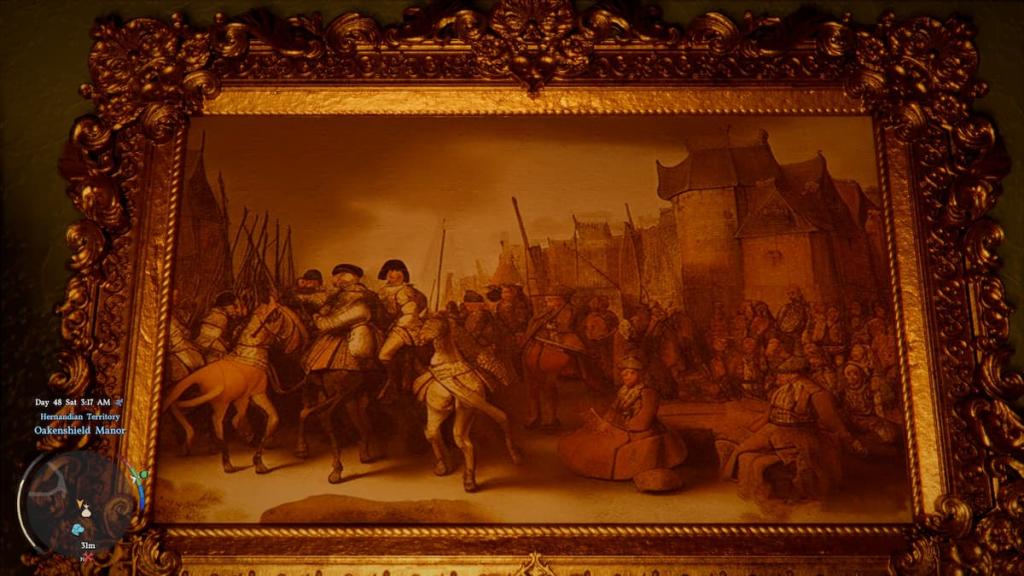
In Oakenshield Manor a wall painting reads as a historical scene
The mural sits in Hernand’s public spaces, a piece players pass several times early on. Bluesky user lexluddy.xyz flagged it first and the image was picked up by Moyens I/O.
At close range, faces warp, horses lose heads, and brushstrokes stitch together in ways that betray generative algorithm artifacts. Those visual quirks—distorted anatomy, mismatched limbs, repeating textures—are classic fingerprints of models such as Midjourney, Stable Diffusion, or DALL·E being used to generate concept assets or placeholders.
Did Crimson Desert use AI art?
Short answer: the painting bears the hallmarks of generative AI, and at present there’s no public statement from Pearl Abyss confirming or denying that. I reached out to Pearl Abyss for comment; they had not replied by the time of publication. If you want to judge for yourself, examine the faces and repeated patterns; those inconsistencies are what tipped off players and analysts.
The game’s final build includes assets that may have begun as ideation material
Walking through the early chapters, you encounter the mural multiple times; it’s not hidden or labeled as temporary. That suggests the image made it into a shipped build rather than being scrubbed as placeholder material.
We’ve seen a near-identical scenario before: Clair Obscur: Expedition 33 shipped with placeholder AI art, was later updated, and ended up disqualified from an Indie Game Awards cycle. Here the risk is reputational—and possibly regulatory—if undisclosed generative content violates contest rules or platform policies.
Was the AI art disclosed by the developers?
Not at the moment. Pearl Abyss has not published a disclosure about generative tools used in art or concepting for Crimson Desert. That silence matters because players, press, and juries increasingly expect transparency on tooling and source material when AI is involved.
Fans and creators react in public spaces like Bluesky and forums
Within hours of the discovery, posts and screenshots spread on Bluesky and other communities. You can see the same pattern: a single screenshot becomes a thread, threads spawn scrutiny, and the story takes on its own momentum.
The community angle matters for two reasons. First, player expectation: many folks buy into a world crafted by artists and studios, and undisclosed machine generation feels like a breach of that trust. Second, developer response: a timely clarification or asset swap can soothe backlash, but silence amplifies suspicion.
Can AI art disqualify a game from awards?
Yes—there’s precedent. Awards and festivals have been updating rules to limit or require disclosure of AI-generated content. If a title wins prizes with undisclosed AI assets, organizers may revisit eligibility, as happened with the Clair Obscur case.
My read on what likely happened and why it matters
The most plausible sequence: concepting used generative outputs as quick ideation or placeholders; at some point an image made its way into the final scene by mistake or as a time-saving decision. If that’s true, it’s a production oversight with ethical ripple effects.
This isn’t an auto-condemnation of the game’s overall craft. Crimson Desert contains enormous technical and artistic work. But the inclusion of an AI-looking mural without disclosure raises questions about credit, licensing, and creative authorship that studios are being forced to address right now.
I’m watching for an official reply from Pearl Abyss, and I’ll update the record if they respond. Until then, the mural sits in Hernand, a strange relic in a vast, beautiful world—like a glitching fresco in a cathedral of hand-crafted assets.
How should studios balance speed, tools, and transparency when generative art is part of their pipeline?