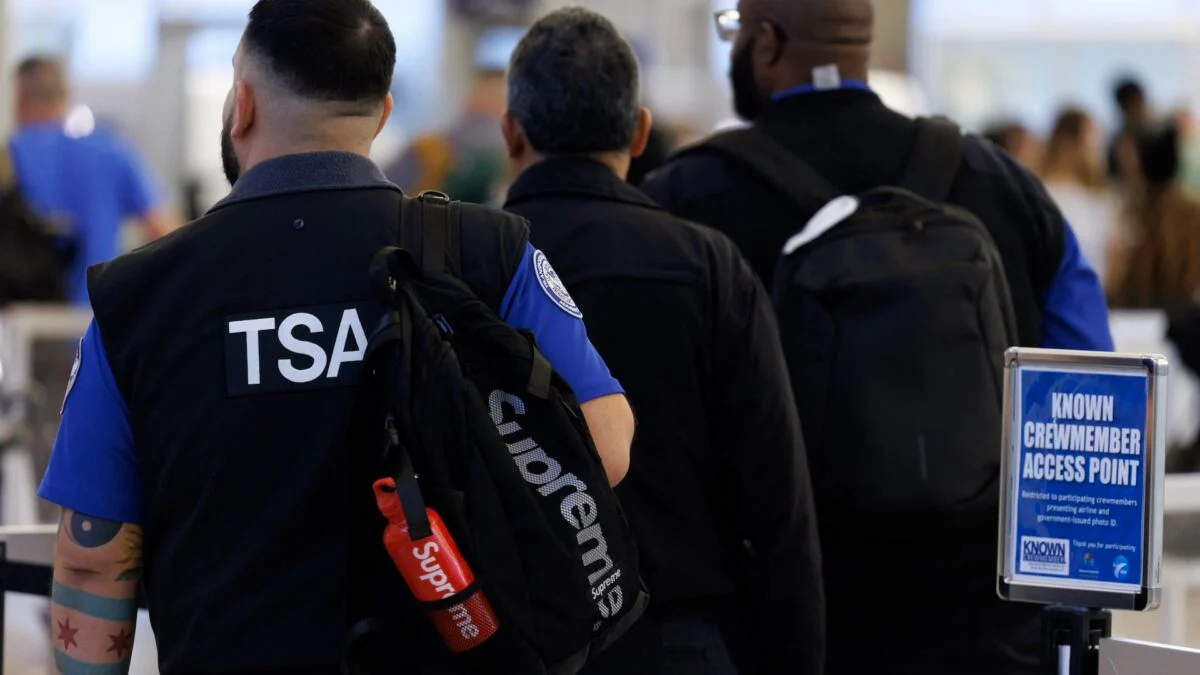
At Dulles, a TSA officer stands by the payroll office and scrolls through messages while passengers drift past an empty pay window. I watched Elon Musk post on X: “I would like to offer to pay the salaries of TSA personnel…” You felt that odd mix of relief and déjà vu—hope, and then the instinct to ask, “How?”
At a security checkpoint you can see payroll notices on the wall: The phrase “I would like to offer” is a performance, not a payment
I’ve watched wealthy figures tweet generosity before, and you probably have, too. Musk’s phrasing—“I would like to offer to pay”—reads like an invitation to a negotiation, not like a cleared bank transfer. You and I both know the difference between an announcement and a wire.
Words matter here because they set expectations for people who are counting on a paycheck to pay rent and buy groceries. When Transportation Secretary Sean Duffy described agents “paying rent and trying to put food on the table,” that wasn’t rhetoric; it was an accounting problem at an airport gate.
I would like to offer to pay the salaries of TSA personnel during this funding impasse that is negatively affecting the lives of so many Americans at airports throughout the country
— Elon Musk (@elonmusk) March 21, 2026
At airports lines have shortened and staff have quit: The logistics of a billionaire paying federal workers are messy
You can’t just write a check and stop a payroll system. Federal paychecks run on Department of Homeland Security and Treasury rails; hiring private funds to cover federally mandated labor raises legal and accounting questions. If Musk wanted to pay, he could move assets, sell stock, or set up a fund, but each path touches tax filings, employment law, and department policy.
Remember Musk’s prior gestures. In 2018 he offered water filters for Flint residents and later donated roughly $500,000 (€460,000) to school drinking fountains—helpful, but narrow and conditional. In 2021 he said he would sell Tesla stock if the World Food Program explained exactly how $6 billion (€5.5 billion) would end hunger; the public back-and-forth looked more like a transparency stunt than a pledged payout.
Will Elon Musk pay TSA workers?
Short answer: possibly, but likely with strings attached. Public promises on X (formerly Twitter) often turn into conditional campaigns—requests for documentation, plans, or public explanations—rather than immediate payments. If you want certainty, public policy and congressional action are more reliable than a social-media offer.
At a nearby newsstand a headline reads “ICE to the airports”: Trump’s alternative is a political sledgehammer
President Trump posted on Truth Social that he plans to send Immigration and Customs Enforcement (ICE) agents to perform security duties. You should notice two things immediately: staffing ICE into TSA roles shifts mission focus, and it escalates enforcement at sites already fraught with public and legal scrutiny.
That plan is simpler in rhetoric than in execution. ICE has different training priorities and legal authorities than TSA; swapping personnel could create operational gaps and civil-rights concerns. You might prefer a billionaire writing checks to a heavier enforcement presence, but both options expose airports to new risks.
Can a private individual legally pay federal employees?
Yes and no. Technically, private funds can be used for certain support functions or through charitable foundations, but direct substitution for federally authorized pay usually requires formal agreements and approvals. Any payment that bypasses standard payroll could trigger scrutiny from the Office of Personnel Management, DHS, and auditors.
At a coffee shop near the terminal you hear agents trade stories: History shows Musk’s offers are dramatic and selective
When I followed coverage of Musk’s prior offers, the pattern was clear: big pronouncements on X, limited follow-through, and high public attention. That pattern is a tool of influence—an attention engine that benefits platforms, media outlets, and sometimes the person making the offer.
The pattern can work in two ways: it produces fast relief for a headline, or it becomes a distraction that keeps structural fixes from happening. The metaphor here is simple: sometimes a billionaire’s gesture is like an expensive Band-Aid on a broken limb—visible, costly, and not a substitute for surgery. It can also act like a magnifying glass over a puddle, making one problem seem enormous while other failures remain unaddressed.
What happens to TSA pay during a government shutdown?
During funding lapses, TSA agents have been required to work without pay when Congress fails to pass appropriations. The Department of Homeland Security may use limited stopgap authority for essential operations, but those mechanisms are short-term. Workers can face delayed paychecks until legislative action restores funding.
I’m not arguing against private philanthropy; I’m arguing for clarity. If Musk wants to help, you and I should see a plan: who gets paid, by what mechanism, and under which legal framework. Otherwise, his post remains a public relations ripple around a private gesture.
Platforms like X, outlets including CNN and Gizmodo, and agencies from TSA to DHS will keep parsing the offer. You’ll read headlines and watch for filing activity—Tesla and SpaceX stock moves, charitable filings, or statements from the Department of Justice can tell you whether a promise is paperwork or payroll.
So will the paychecks arrive because Elon Musk “would like to offer” them, or will Congress and federal systems decide who gets paid? Which outcome would you bet on?