
The conference call ended, and someone joked that the meeting had just become a poker table. I felt the air change—you could hear strategy rearrange itself. You know when one sentence in public becomes an instruction behind closed doors.
I’ll walk you through why Disney’s flirtation with Epic Games feels less like gossip and more like a plan testing its seams, who’s pushing, who’s resisting, and what it would mean for the industry and for you as a player or creator.
Kevin Mayer named Epic out loud in an interview — Former Disney executive signals games are on the table
On CNBC, Kevin Mayer put gaming in the frame as a growth lever for Josh D’Amaro’s Walt Disney Company. Mayer praised Disney’s recent $1.5 billion investment as a smart step (€1.4 billion), then suggested an acquisition of Epic Games would make strategic sense.
You can hear the logic: Disney already owns a meaningful minority stake in Epic. The company’s leadership—D’Amaro among them—has publicly embraced ideas such as premiering films inside Fortnite. Mayer’s comment wasn’t a throwaway; it was a directional signal. If you follow media M&A, signals matter.
Will Disney buy Epic Games?
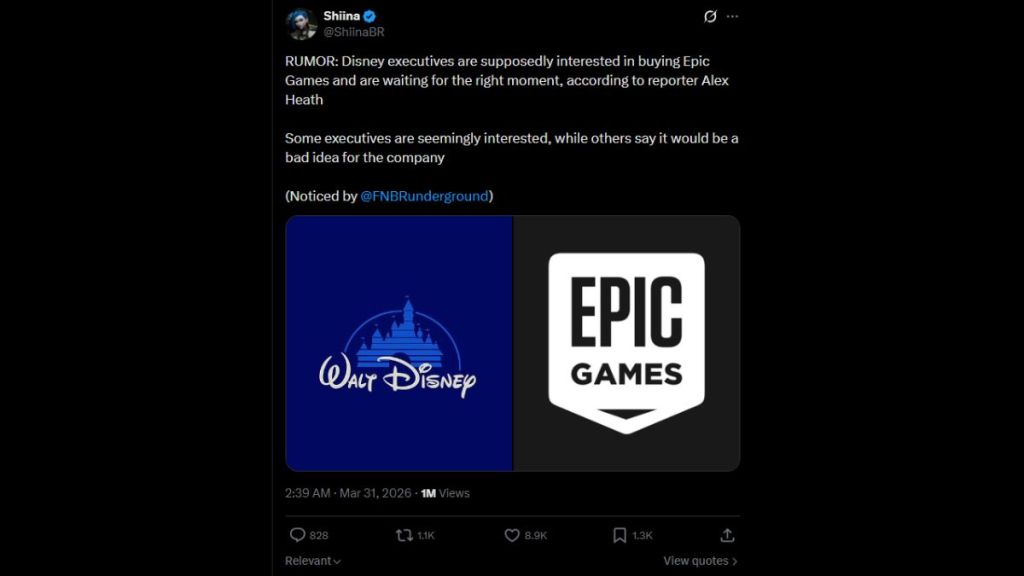
Short answer: it’s possible but complicated. Alex Heath told Matt Belloni’s The Town podcast (Puck) that senior Disney executives are waiting for the right moment to bid. That’s a public nudge—enough to set markets and boardrooms moving, but not enough to force Tim Sweeney’s hand.
Remember: Epic is founder-controlled. Sweeney holds the voting stock and has repeatedly pushed back against “walled gardens.” Buying Epic would be a cultural act as much as a financial one. I’d expect Disney to make a very specific offer only if it could convince Sweeney he’d preserve Epic’s creative independence.
Recruiters were scrolling resumes while layoffs landed — The context behind the whispering
Epic recently cut more than 1,000 roles and announced $500 million in cost reductions (€460 million), which sharpened the rumors. You don’t hear layoffs and not wonder who’s suddenly for sale.
Alex Heath argued that Disney would be “the most natural home” if Epic ever chose to stop operating independently. From Disney’s perspective, owning Fortnite and Unreal Engine would not only offer IP synergy but also reduce long-term production costs across Disney’s studios—Stagecraft, Star Wars games like Star Wars Jedi Survivor, and other Unreal Engine-based projects already rely on Epic’s tech.
How would a buyout affect Fortnite players?
If Disney bought Epic, you’d see integration pressure in both directions. Heath imagines a scenario where Fortnite becomes a Disney playground—events, film tie-ins, even park activations. That could mean more crossovers and themed seasons, but it could also reshape monetization and creative freedom inside the game.
As a player, you should watch two things: whether Epic’s developer tools and mod-friendly features survive intact, and how Epic’s community creators are treated. Disney could become a gravitational well for talent, pulling developers toward exclusive projects—or it could clamp down on experimentation.
Producers were tallying CGI hours during a coffee break — The business case and the friction
Disney already pays Epic for Unreal Engine. Owning Epic would convert a recurring external cost into an internal asset, which is persuasive on a balance sheet. Analysts hear “pay for itself” in that line of thinking; Alex Heath even suggested a buyout could be announced as self-funding.
But there’s friction. Sweeney’s philosophy opposes closed ecosystems. Some Disney execs reportedly worry about culture clash and whether an Epic acquisition would alienate players who prize openness. Meanwhile, rival platforms like Roblox would likely tout their independence if Disney moved in—competition that would sharpen scrutiny from regulators and creators alike.
Think of the outcome as a chessboard: IP moves, engineering assets, regulatory responses, and community trust all shift together. The next few quarters will tell whether Disney makes an aggressive bid or keeps Epic as a strategic partner.
I’ve named the players, the incentives, and the tensions. Now I want to know what you see: would Disney owning Epic be a renaissance for interactive storytelling or the beginning of a closed garden for play?