He posts on LinkedIn at 9:12 a.m., three lines that feel both abrupt and final. The AI team he led for seven years is gone; the company is silent. You can sense the runway shortening as GTA 6’s launch approaches.
I’ve been watching publisher moves for years, and you should know what to read between the lines. This isn’t just another staffing notice — it’s a signal from Take-Two about how it plans to marry human craft and machine assistance. I’ll walk you through what happened, why it matters, and who’s likely watching closely.
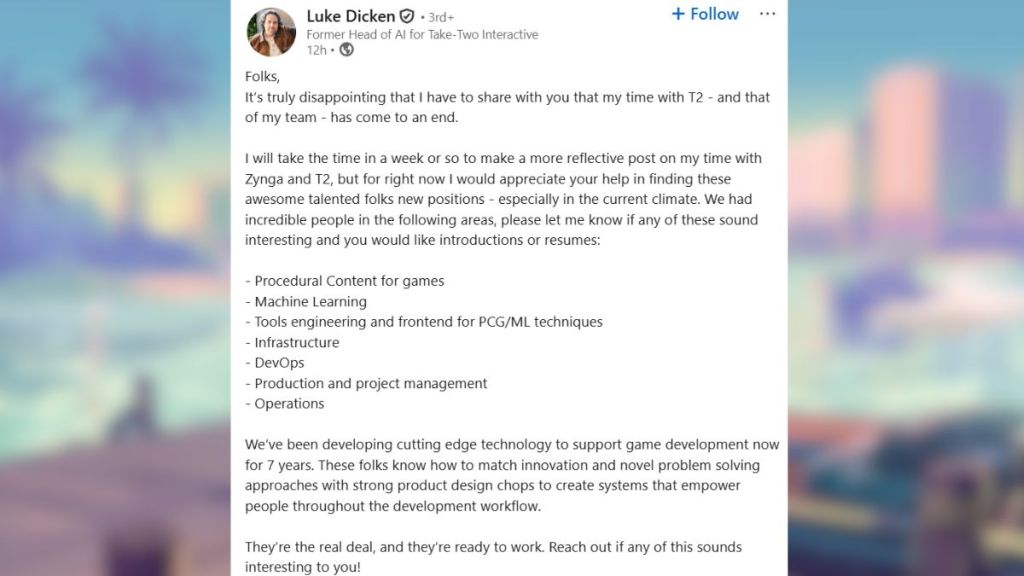
On LinkedIn, a simple resignation becomes a headline: Take-Two cuts its Head of AI and several teammates
Luke Dicken — hired from Zynga to lead Take-Two’s AI push — wrote that his “time with T2” and that of his team had ended. That single post collapsed weeks of speculation into an unavoidable fact.
I read that message as a strategic contraction rather than a failure. Take-Two’s CEO, Strauss Zelnick, has publicly argued that AI can speed workflows but cannot replace the creative core that makes a AAA title like GTA 6. Your immediate takeaway should be: the company is tightening the balance between automation and human authorship.
The move is a reminder that big publishers are making political as well as technical choices about AI. You’ll see similar debates at Rockstar, and across publishers like Capcom and Zynga, where policy memos and productivity claims bump into concerns about quality and morale.
Why did Take-Two lay off its Head of AI?
Because leadership prioritized a narrower, perhaps safer, integration of generative tools. I can tell you this: when companies say they’ll use generative AI “where efficiency gains can be made,” they often mean pipeline tools for testing, assets, or localization — not replacing writers, designers, or directors. The public tension between Zelnick’s comments and the layoffs signals a rebalancing act.
A quiet deadline shadow hovers months before GTA 6’s release: the timing raises questions
Multiple teams at Rockstar and Take-Two have faced cuts recently, and those layoffs included senior GTA 6 contributors last year. That context matters because staff churn so close to launch changes how remaining teams will prioritize work.
I want you to imagine a chessboard: removing a knight mid-game forces players to rethink strategy. That’s where developers now stand — fewer AI specialists, more pressure to keep creative momentum. If you follow industry tools, note that Nvidia’s DLSS 5 demo and Capcom’s AI policy have shown both promise and peril for game quality and production speed.
Practical effect: expect minimal, cautious AI use inside GTA 6 — tools for QA, content tagging, or animation smoothing rather than generative worldbuilding. That’s consistent with Zelnick’s repeated line that human creativity will remain primary.
Will AI be used in GTA 6?
Short answer: yes, but sparingly. You’ll likely see AI in background systems — procedural helpers, voice-to-text workflows, asset compression and QA tooling — rather than in core narrative or design decisions. If Take-Two is trimming its AI leadership now, it suggests the company prefers conservative, engineering-driven deployments rather than broad creative automation.
At industry scale, one firm’s reorg ripples across studios and investors
Investors and rival publishers watch moves like this for hints about risk tolerance and product timelines.
I pay attention to signals: layoffs trigger shareholder questions, and those questions affect how much risk a publisher will take on experimental AI features. Rockstar’s earlier dismissals over alleged leaks already dented internal morale; another round of cuts compounds that strain. Think of it as a storm front rearranging a skyline — patterns change fast and everyone notices which buildings remain standing.
Brands and platforms in the conversation include Zynga (where Dicken and his team previously operated), Rockstar (the studio building GTA 6), and tools like LinkedIn (the platform that carried the news). Nvidia and Capcom have introduced counterexamples: one shows AI’s visual potential, the other formalizes productivity rules.
What does this mean for game development jobs?
For you as a developer or manager, this is a signal to specialize and to make your AI literacy practical: learn model-assisted pipelines, version control for generated assets, and ethical guardrails. For teams, the message is clear — employers want AI that augments measurable efficiency, not speculative creative replacement. Expect roles to shift toward AI ops, prompt engineering, and quality assurance around generated content.
There’s no tidy moral here. I’m not telling you that AI is a job-killer or a savior — only that companies are choosing where to let it in. Take-Two’s decision to part ways with Luke Dicken and his team is a public pivot that says more about corporate appetite for risk than it does about the technical promise of generative models.
I’ll leave you with this: if you had to bet on where generative tools will actually add value in AAA game development, where would you place your chips?