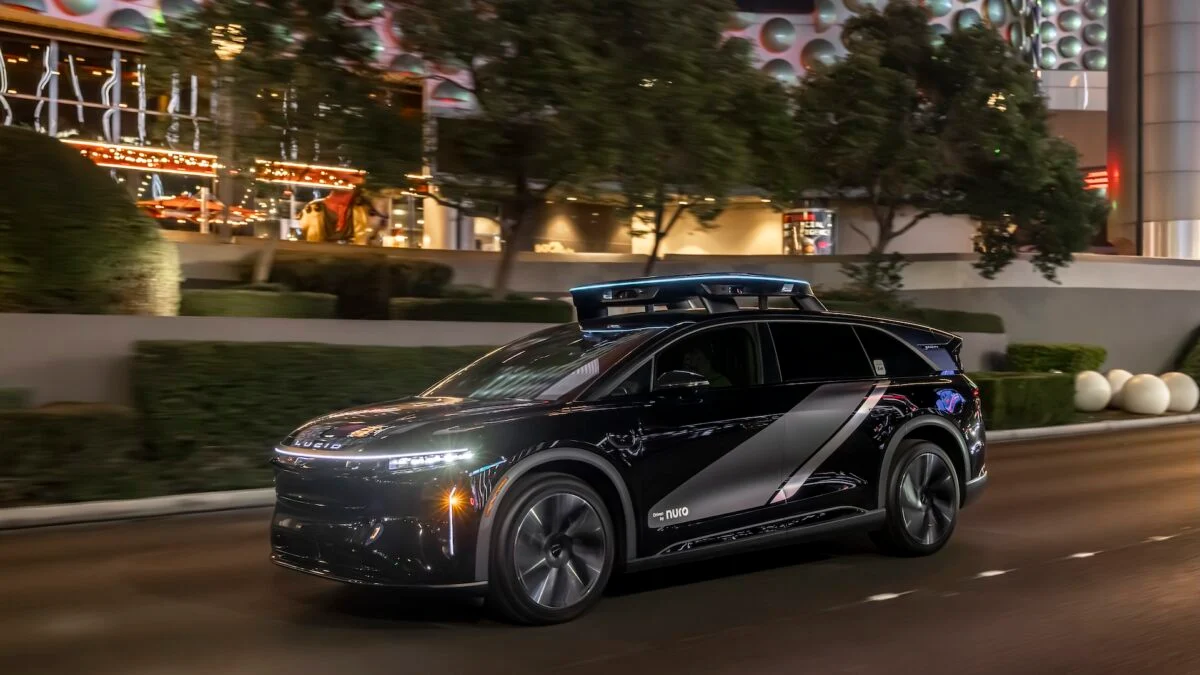
I watched a Lucid Gravity glide past an empty dealership lot last week, its badge catching the sun like a promise. Boardroom calls hummed in the background as a fresh stack of capital moved across the table. You could feel the stakes tighten: production needs cash, and cash just arrived.
A Lucid sedan idled under a warehouse light.
I’ve seen corporate turnarounds hinge on two things: a steady hand and enough runway. Lucid Motors announced a new CEO, Silvio Napoli, and a total of $750 million (≈ €690M) in fresh investment aimed at giving both.
Napoli, the former chief executive at Switzerland’s Schindler Group, is being pitched as an operator who can tighten margins and run factories like precision machines. I say that because his resume is industrial, not Silicon Valley flashy—exactly the kind of discipline many EV startups lack when growth outpaces shop-floor control.
Who is Lucid’s new CEO?
Who is Lucid’s new CEO?
Silvio Napoli spent roughly six years across two stints leading Schindler, a global elevator and escalator maker. Lucid’s board highlights his operational focus and financial discipline as the reasons he’ll steer production scaling for the Air sedan and the Gravity SUV.
An email from Uber raised the expected fleet count on a conference call.
Numbers matter because orders become production targets. Uber is doubling down on Lucid: an extra $200 million (≈ €184M) brings Uber’s total equity in Lucid to $500 million (≈ €460M), and its fleet commitment has grown from at least 20,000 Lucid Gravity SUVs to at least 35,000 vehicles that will also include future midsize models.
That investment is strategic: Uber’s plan ties hardware purchase to drivers of autonomous software—Nuro was named earlier—and the larger the order, the more leverage Lucid has over its supply chain and unit economics. You should watch whether factory output can convert those purchase intentions into VINs.
How many Lucid vehicles will Uber buy?
Uber now plans to deploy at least 35,000 Lucid vehicles globally for its robotaxi fleet over the coming years, expanding a previously announced commitment of 20,000 vehicles and explicitly including upcoming midsize models.
The deal acts like a relay baton: Uber’s money and volume commitments push Lucid to speed up production planning, which in turn makes these orders more attractive to suppliers and financiers.
You can see policy shifts and competition in small, public moves.
I’ve been tracking EV policy since the incentives era began; the landscape in the U.S. has narrowed. Federal EV subsidies have expired and fuel-efficiency rules have been eased, leaving manufacturers with less margin support and a tougher demand environment.
Lucid felt that pressure in February when it cut more than 300 jobs. Now it’s leaning into robotaxis and lower-cost midsize platforms to chase volume and recurring revenue from mobility services, rather than relying only on high-margin luxury buyers.
Why does this matter for robotaxi rollouts?
Robotaxi providers—Uber among them—need predictable vehicle supply, affordability, and software integration. Lucid’s pivot toward a midsize, software-defined platform is pitched as a way to lower vehicle cost per mile for autonomous fleets and simplify manufacturing for mass deployment.
The PIF keeps writing checks; the optics are clear.
The money isn’t just from a handful of venture accounts. Ayar Third Investment Company, an affiliate of Saudi Arabia’s Public Investment Fund, added $550 million (≈ €506M) to the pile; Ayar Third had already committed over $1 billion (≈ €920M) earlier in 2024.
When sovereign capital pairs with a strategic partner like Uber, you get both financial runway and an industrial pilot channel. That combination changes the narrative from “can they make cars?” to “can they make cars that someone will operate at scale?”
Lucid’s interim CEO, Marc Winterhoff, framed this as progress for their midsize platform and partnerships with Uber and Nuro. He said the company’s software-defined EV architecture is designed to serve next-generation mobility networks with manufacturing simplicity and cost efficiency.
There are risks: competition from China, a tougher U.S. policy environment, and the eternal challenge of automotive execution. But if Napoli can tighten production and Uber’s orders hold, Lucid’s paper plan becomes an industrial one.
I’ll be watching factory outputs, supplier commitments, and whether these investments translate into daily rides rather than quarterly headlines. Do you think this bet will remake Lucid into a volume player, or will it be another expensive experiment in mobility?