
I stood in a crowded forum thread where every comment assumed GTA 6 would end the year. Instead, the feed kept snapping back to three Capcom launches, one after another. It felt like watching a chessboard reset mid-game.
I write about games for a living; you play them. So when I tell you Capcom quietly reshaped 2026, believe me: this wasn’t a lucky streak. You’ve been trained to wait for the one seismic release. Capcom decided to rule the calendar instead.
Capcom’s Early Hattrick Is Already the Story of the Year
Observation: Stores, streams, and Steam charts all lit up in early 2026 around Capcom releases.
While most of the industry held its breath for Rockstar’s return to Vice City, Capcom rolled out three hits that reframed expectations. Resident Evil Requiem arrived first and didn’t just perform — it sprinted. As of mid-March 2026, RE: Requiem sold over 6 million units globally and became the fastest-selling title in the franchise’s 30-year history. It also led US sales for the year so far.
Then Monster Hunter Stories 3 quietly chewed up free time and remained in the top three of Steam’s sellers chart while moving 54,906 physical copies. And finally Pragmata exploded onto the scene, a new IP that recorded 1 million sales in 48 hours. That sequence reads like deliberate planning, not chance.
Why is Capcom dominating 2026?
Because they control the full stack: strong IP, tight release cadence, and a proprietary engine that reduces chaos during launch. Capcom built momentum by alternating familiar franchises with bold bets, keeping players engaged without forcing live-service hooks like battle passes. The result is constant cultural presence rather than one spotlighted event.
Another Resident Evil, Another Hit
Observation: Fans lined up for physical copies and DLC announcements with equal enthusiasm.
Capcom showed institutional confidence by stacking the calendar. Requiem’s early DLC plans signaled they planned for longevity rather than a single launch spike. Where many studios need massive post-launch patches to steady performance, Requiem landed in a stable state—and that reduces friction for players and press alike.
Capcom Bet on New IP and Won Big with Pragmata
Observation: New franchises usually struggle for attention in a remake-heavy market.
Pragmata undermined the “nostalgia-first” trend. By shipping a short, focused single-player sci-fi with tight mechanics, Capcom proved audiences will reward originality when the execution is uncompromising. The game’s tactical systems and its android-human narrative hooked mainstream players and critics alike, and Capcom banked a lot of goodwill that will carry into sequels and cross-media projects.
Will Capcom beat Rockstar this year?
If you mean cultural footprint and sustained revenue across quarters, the answer looks like yes. Rockstar may still deliver a blockbuster event with GTA 6, but a single launch that dominates headlines for a month isn’t the same as multiple successful releases that refuel conversation every quarter.
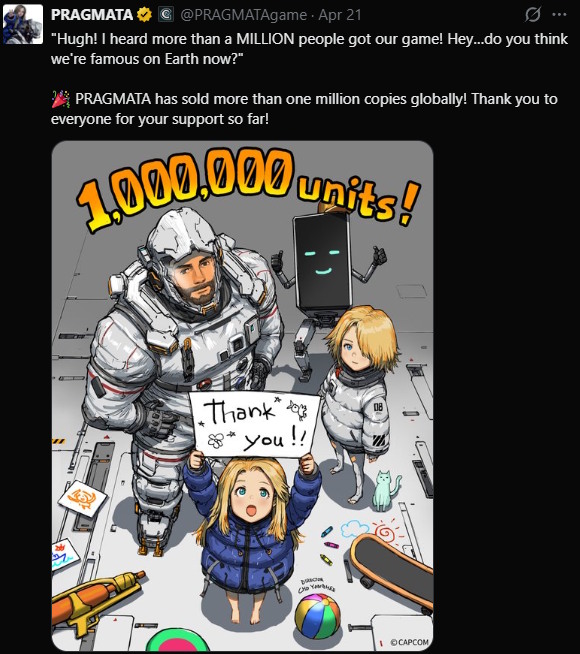
Onimusha Returns to Close Capcom’s Banger Year
Observation: Fans asked for Onimusha on every social feed for years; Capcom scheduled it for late 2026.
Onimusha: Way of the Sword is the season-closer that stitches the year together. A new IP like Pragmata excites, but a technically slick, nostalgia-fueled samurai title gives hardcore players the anchor they want. Releasing Onimusha in the same window as GTA 6 is a strategic call: Capcom isn’t trying to outshout Rockstar in one moment. They’re guaranteeing there’s a Capcom reason to play in every quarter.
RE Engine: The Backbone of Capcom’s Dominance
Observation: Launch-day performance has become a reputation test for studios.
The RE Engine is the reason Capcom can run this pace. It is a Swiss watch of game engines—lean, consistent, and predictable. While many Western teams migrated heavily to Unreal Engine 5 and wrestled with frame drops and last-minute fixes, Capcom’s in-house tech gave full control over the pipeline. That control meant smoother ports to PlayStation 5 Pro and the Nintendo Switch 2, and surprisingly strong cloud performance: in testing, Requiem hit 60 FPS on platforms like iPhone 15 and Nothing Phone 2a via GeForce Now.
What is the RE Engine and why does it matter?
RE Engine is Capcom’s proprietary development platform that scales across genres—from the photoreal corridors of Resident Evil to the sprawling ecosystems of Monster Hunter and the effects-heavy Pragmata. The payoff is lower risk on launch, faster iteration between projects, and a consistent player experience that builds trust over time.
Capcom Takes the Fight to Hollywood
Observation: Studios that control IP and audience attention can sell more than copies; they sell stories across media.
Capcom isn’t confining itself to discs and downloads. The Street Fighter movie, with names like 50 Cent, Noah Centineo, and Jason Momoa, aims to pull non-gamers into the brand’s orbit. Resident Evil projects and the second season of Devil May Cry are part of the same strategy: feed the gaming pipeline with mainstream exposure and then convert viewers into players. Streaming hits like The Last of Us and Fallout proved this model works; Capcom is scaling it aggressively.
Across Steam alone Capcom pushed revenue past $400 million (€370 million). That’s not pocket change; it’s the kind of recurring income that funds new experiments, sequels, and cross-media deals. If Rockstar delivers a two-billion-dollar crime simulator (€1.8 billion), it will be a cultural event. But Capcom’s season-long approach builds a steadier, arguably more defensible business.
I’ve tracked big launches for years, and I’ll say this plainly: the industry doesn’t require a single blockbuster to validate growth anymore. Capcom’s plan—engine control, cadence, original IP, and media expansion—reads like a new template. What will the next decade prize: the one-off spectacle or the season-long chokehold?