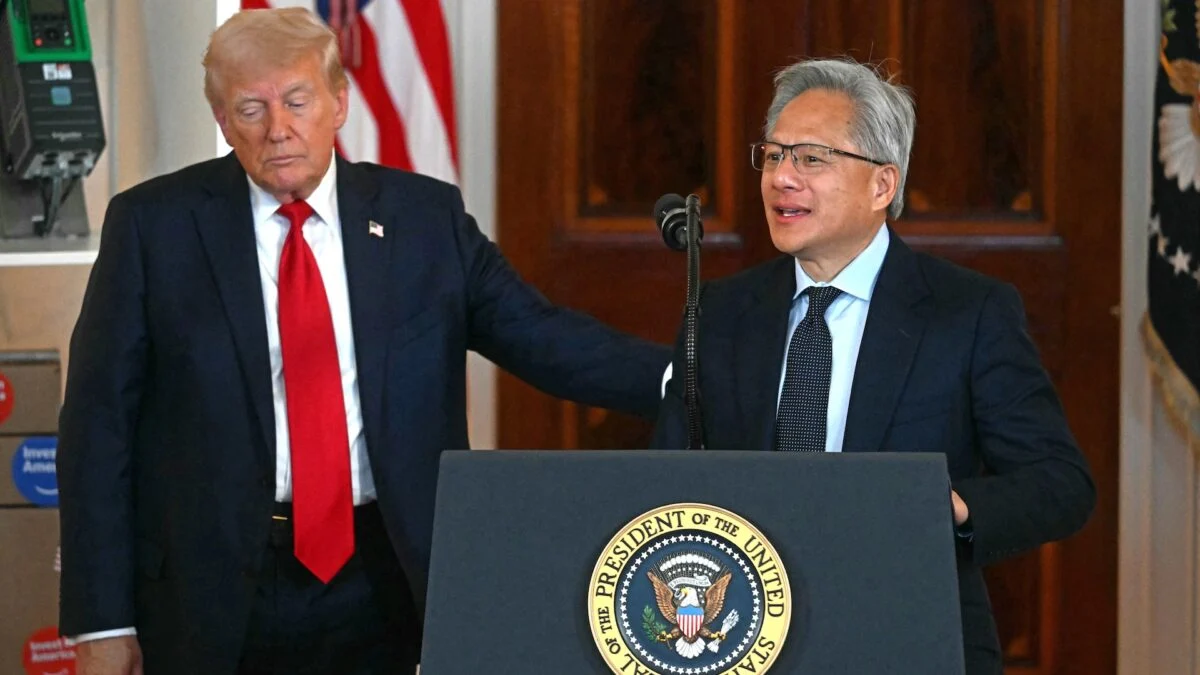
I watched the live feed from Alaska with you—snow on the runway, cameras trained, a silhouette stepping aboard a presidential jet. For days the rumor mill had built a small, urgent hurricane: was Jensen Huang coming or not? When the door closed, a very public question got its answer.
I want to tell you what that moment means beyond the headlines, and why it matters if you’re tracking geopolitics, semiconductors, or how business and statecraft now play tag-team on one stage.
On the tarmac in Anchorage, cameras caught Jensen Huang boarding Air Force One
That single, visible action shattered a narrative and reopened debates. You may have seen the CNBC roster and assumed Nvidia was off the guest list; Bloomberg argued the absence was a setback for Huang’s bid to sell chips in China. Then the New York Times reported he joined the flight in Alaska, and the story flipped.
Here’s what I take from that micro-moment: appearances are policy signals now. A CEO’s presence beside a president acts like a public envoy—no credentials required. For Nvidia, which has flagged China as a roughly $50 billion (€46B) opportunity, a seat on Air Force One is more than prestige; it’s leverage.
Why wasn’t Jensen Huang initially listed on Trump’s China trip?
The short answer: lists change and politics burps. The longer answer is about optics and trade-offs. White House rosters are curated for messaging, security, and bilateral sensitivity. A late boarding can mean negotiations behind closed doors, unresolved export-control choreography, or simple logistics. It also fuels speculation—exactly what happened when outlets parsed the original manifest.
In the press pool outside the plane, reporters traded names and theories
Reporters heard the same roster you did—Musk, Tim Cook, Larry Fink, Stephen Schwarzman—and the omission of Nvidia became a lead. You felt the gap: the world’s most valuable company’s absence from a summit with Xi would have been a headline in itself.
So when Huang showed up, it rewired the story. You can read this as a tactical win for Nvidia: face-time in Beijing may blunt export-control friction and keep channel conversations alive. But it’s also a reminder that business diplomacy now runs on spectacle; a CEO’s appearance is a bargaining chip as much as any memo.
Will Jensen Huang’s presence help Nvidia sell chips in China?
Maybe. Meetings matter in Beijing. Huang’s charm with leaders—and his track record of traveling with U.S. administrations—gives Nvidia access that rivals crave. But access doesn’t erase policy. Export controls, sanctions, and national-security red lines remain. Your takeaway should be cautious: Huang can open doors; he can’t rewrite government policy alone.
Who else is traveling with Trump to China?
The delegation reads like a who’s-who of corporate America: Elon Musk, Tim Cook, CEOs from Blackstone and BlackRock, plus executives from Boeing, Goldman Sachs, Meta, Micron, Qualcomm, Visa, Mastercard, and more. That lineup sends a clear signal—this is a business-focused summit where finance, manufacturing, and chips occupy the front row.
Let me be direct with you: when CEOs board presidential flights, you’re watching a choreography of influence. I’ve seen similar moves before—an executive presented as a bridge one day can be the lightning rod the next. Think of the delegation as both a brass band and a pressure gauge.
Trump himself amplified the drama on Truth Social, calling reports of Huang’s exclusion “incorrect” and, with the familiar flourish you’ve learned to parse, labeled some reporting “FAKE NEWS.” That public dispute over guest lists is itself a negotiating tool. When the host disputes the press narrative, it reshapes leverage before any meeting begins.
Nvidia’s stake is concrete: the $50 billion (€46B) figure the company has eyed for China sales isn’t just a marketing line. It represents supply agreements, data-center deals, and geopolitical risk packed into a single number. If you trade on semiconductor supply chains, or follow cloud providers and AI startups that rely on Nvidia silicon, you should care about who gets to speak in Beijing and what doors those conversations open.
I’ll leave you with this: CEOs boarding a presidential plane are not just passengers—they’re emissaries, lobbyists, and sometimes a bargaining chip. Does Huang’s presence in the delegation tilt the scale toward commerce or toward containment, and who will decide which wins in Beijing?