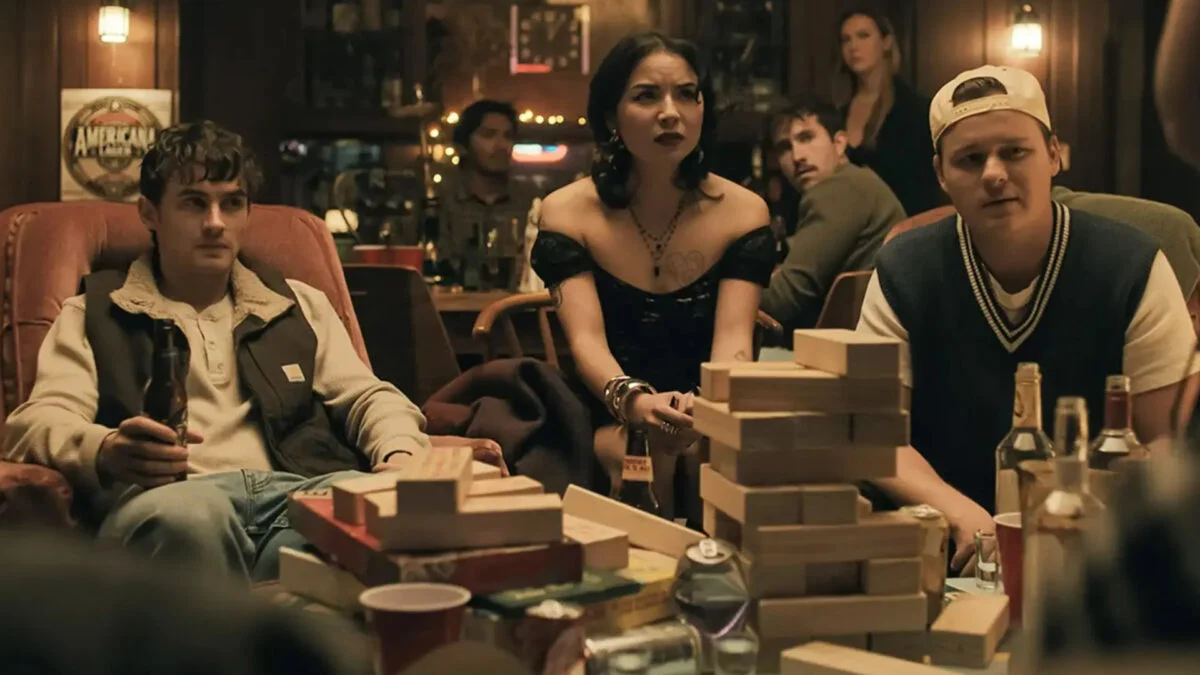
I remember the first time I watched that party scene and felt the room tilt. One second it’s a flirtatious beat, the next a friend’s life is erased in a shock so precise you almost applaud. You can still hear the TIFF audience cheering in my head.
I’m going to walk you through how that moment was built, what Megan Lawless said about getting smashed on camera, and why the movie makes you question who bears responsibility. Read this like a set report from someone who watches craft with the same hunger you bring to spoilers.

At TIFF the crowd cheered—then the work behind that cheer became the story
When I read Megan Lawless’s Hollywood Reporter interview, I saw the split between audience reaction and on-set craft. You hear the roar at the screening; I care about the helmeted wig and the doll that made the roar safe. The scene plays as pure shock, but it was engineered with a stunt plan and practical effects so neat it almost hides its mechanics.
Megan Lawless told THR she loved that her death landed as “iconic” and that filming it was her favorite day on set. I believe that. Actors crave moments where performance and practical tools intersect—where a single beat can carry an entire emotional ledger. Inde Navarette used a helmeted wig to smash through glass, then simulated the repeated impact while Lawless “bashed” her own head against brick for the camera. After the heavy physical takes, the crew swapped in a doll and prosthetic closeups to finish the sequence.
How did the death scene in Obsession happen?
Short answer: choreography, props, and surgical editing. Long answer: stunt choreography set the rhythm; practical effects created believable trauma; and camera choices sold the continuity. The helmeted wig did the dangerous part of the glass break. Lawless completed the tactile beats until producers and stunt coordinators called for a doll to take the final hits. Closeups used prosthetics to sell the aftermath without putting an actor at risk. The result is a continuous, brutal moment that reads as one seamless event.
On set they swapped an actor for a doll—what that decision tells you about horror and control
Watching a crew lift a doll into place is oddly clinical, a reminder that every atrocity you see on screen was planned to protect people. That clinical care is also what lets the film go where it does emotionally. I want you to notice how the practical choices force your imagination to finish the violence; the filmmakers give you enough detail to trigger nausea while keeping performers safe.
Lawless said there were two takes to get the sequence right. You can feel the commitment in that admission: the team treated the dark humor of the beat and its brutality with equal seriousness. At TIFF, the cheering felt like a crowd colluding with the film; horror fans enjoy the shock in ways most audiences don’t, and Lawless welcomed that sick delight.
What did Megan Lawless say about her shock scene?
She called it her favorite day on set and said the crew had “two takes to get it right.” She described the physical process: Navarette wearing a protective helmeted wig to simulate the break, Lawless performing the head hits until the safe point, then a doll and prosthetic closeups completing the ruin. Lawless found it funny in a dark way and was surprised, but amused, by the cheering at TIFF—because horror crowds are gleeful in their morbidity.
At the party the characters nearly kiss—then the mechanics of character choice make the scene mean more
The party scene is a tiny sociology experiment: three people, shifting loyalties, everyone performing. Both Michael Johnston and Lawless have said their characters might have had something under different circumstances, and that uncertainty fuels the scene’s cruelty.
I want you to see two layers at work: the physical construction of the death, and the moral construction of blame. Wish Nikki acts with an invented entitlement; Bear is left holding a sense of responsibility. Lawless rejects the idea of Sarah as a villain—she thinks Sarah wouldn’t have kissed Bear while he was still with Nikki. That ambiguity is the film’s lever; you feel loss and accusation at the same time. The smash lands like a gut punch, and it forces you to pick sides.
You can read the full Hollywood Reporter interview with Megan Lawless for more specifics on the staging, the party’s lead-up, and how Sarah becomes, in the film’s final moments, both object and catalyst. I pull for performances that make you disagree with yourself—do you think Sarah, Nikki, or Bear deserved better?