
I refreshed Metacritic over my coffee and felt the small jolt of disbelief that happens when expectations break. You’d expect the leaderboard to read like a corporate press release—so seeing an 8-bit mouse at the summit felt almost personal. I’ve followed Yacht Club Games since Shovel Knight; this was not the sequel I imagined, but it demanded attention.
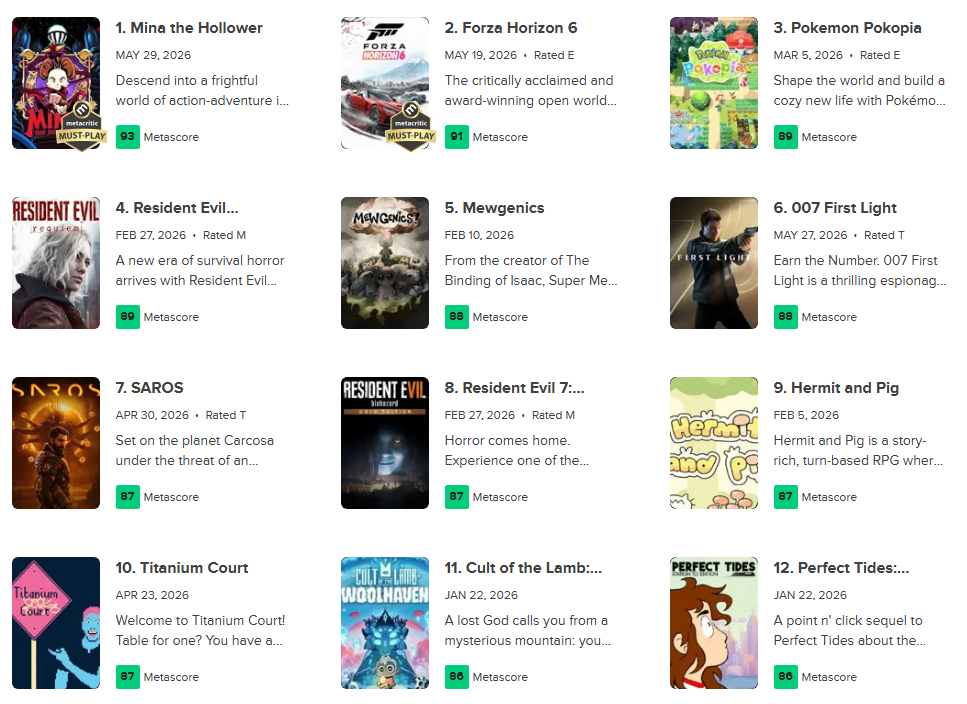
The Metacritic leaderboard looked steady the morning it moved — then an 8-bit indie rewrote the top.
Here’s the fact that made me pause: Mina the Hollower, a 2D platformer starring a mouse, sits at a 93 aggregate on Metacritic after 38 critic reviews, including 11 perfect 10s. That score pushed it ahead of heavy-hitters like Forza Horizon 6, Pokémon Pokopia, Resident Evil Requiem, 007 First Light, and SAROS.
I won’t hide that 38 reviews is a small pool. Statistically, averages this young move fast. You and I both know the headline is fragile—one big outlet changes a score and the narrative shifts—but the momentum matters. It signals a critical consensus forming around design choices that feel intentional rather than trendy.
The review pages told a story the day I scrolled through them — clear praise threaded from multiple outlets.
Mina the Hollower is getting unanimous nods for its Zelda-inspired structure, tight combat, and a world that rewards replay with New Game-Plus. GamingTrend summed it up with a 10/10: “Mina the Hollower is another masterpiece from Yacht Club Games, a Zelda style game that manages not only to equal the series that inspired it, but in some ways surpasses it.”
I’ll say this plainly: the design choices show a developer who learned restraint from retro design and colored it with modern sensibilities. Mina the Hollower is a love letter to the NES era—and it reads like one written by someone who understands pacing, not nostalgia revenue.
Why is Mina the Hollower rated so highly?
The short answer: execution. Reviewers praise the game for marrying classic exploration with careful level flow, convincing boss design, and a crisp control scheme. If you follow outlets like GamingTrend, IGN, and Moyens I/O, you’ll see repeated notes about how the game’s map design encourages curiosity without flailing the player.
Critic snippets and the 11 perfect scores point to a shared conclusion: this isn’t just retro aesthetics; it’s expert-level game architecture packaged in 8-bit veneer.
Is Mina the Hollower better than triple-A games?
On paper, a Metacritic lead over AAA titles is a headline magnet. In practice, comparison depends on what you value—scale and spectacle or design precision and replay value. The list of high-rated 2026 games shows breadth: AAA studios still command budgets and reach, but an indie can outscore them on pure critical appraisal. Its Metacritic score is a lighthouse in a fog of AAA releases, drawing attention to craftsmanship rather than budget alone.
I noticed conversations on Twitter and Discord the moment scores landed — the community reacted fast.
That buzz matters. Critics are one thing; player chatter creates commercial velocity. Moyens I/O did not receive an early access code, so our planned review doesn’t factor into the current Metacritic aggregate. Still, player reaction and influencer streams could add more high marks in the coming days.
When does Mina the Hollower release?
Mina the Hollower launches May 29 on PC, PS5, Xbox Series X|S, Nintendo Switch 2, and Nintendo Switch for $19.99 (€18). If you follow Yacht Club Games and storefronts like Steam, the PlayStation Store, Microsoft Store, or Nintendo eShop, you’ll see storefront pages populate as launch approaches. Keep an eye on GamingTrend’s review and other outlets for how post-launch impressions evolve.
This is the kind of upset that resets expectations about what a small team can achieve—so what happens when critics, players, and streamers start arguing over whether an indie should be allowed to dominate the conversation about the year’s best game?