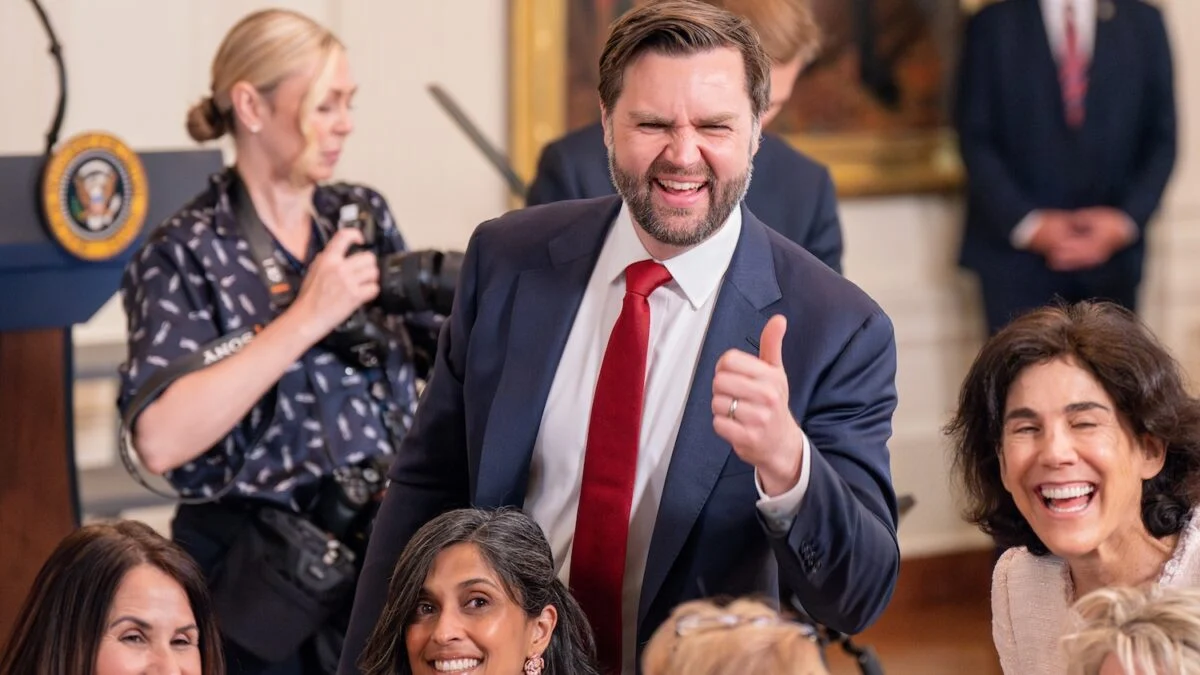
He deleted Elon Musk’s X for Lent and felt lighter. He praised a papal encyclical on national television and watched a billionaire donor roll his eyes. You can almost see the tug: prayer on one side, private servers on the other.
At a podium in Ohio, with the Flames of Hell Licking at His Feet, JD Vance Ponders the Future of AI
I’m going to be blunt with you: this isn’t a policy spat dressed in suit jackets. It’s a moral tug-of-war with money, faith, and raw political survival on the line. You read the quotes and the memos; I’ll tell you what the posture says about power.
On NBC, Vance praised Pope Leo XIV’s encyclical and called it “profound.”
The observation is simple: on camera he gave the pope public praise. That mattered. You and I both know public praise from a vice president is a signal to institutions, donors, and voters—especially when that praise concerns a document that rails against the technocratic mindset the pope warned of in the New York Times and Wired.
Vance framed the encyclical as moral leadership: the principles are constant, the applications change. That’s a line that lands with believers and moderates who worry AI will scramble work, warfare, and interpersonal trust. When a politician leans on religious authority to answer technological questions, you should notice who gains credibility and who loses it.
What does JD Vance believe about AI?
Vance has said AI raises questions about work, war, and how we treat one another—he told NBC that moral leadership is what’s needed, and he named the church. That stance ties his public identity to a faith-based framework rather than a market-first tech framework advanced by groups around OpenAI or Google DeepMind.
At a donor event, Peter Thiel’s influence was whispered into ears and then into memos.
Reporters noted Thiel advising Vance to ignore papal moral counsel. That’s the fact; the rest is consequence management. You can’t separate Thiel’s lectures on apocalyptic themes and his investments in AI infrastructure from a strategy to steer policy toward private control and accelerated development.
Thiel is a man with billions of euros in leverage who has made Vance relevant in conservative funding circles. His worldview favors powerful technology platforms and an oligarchic steering wheel. That makes him a counterweight to the pope’s call for human-centered restraint.
Who is influencing JD Vance on AI?
Short answer: everyone in his orbit. The pope offers moral framing; Peter Thiel offers capital and policy architecture; Trump provides the political shelter. Each brings different incentives. Vance now looks like someone weighing an ethereal kingdom against a very tangible one: he stands between a cathedral and a server farm.
In the West Wing, a Trump decision quietly reshaped the field: a regulatory executive order was shelved.
That move was reported by the Wall Street Journal and it signaled the administration’s openness to industry asks. The fact that Trump signed away an executive order suggested the White House could remain malleable; yet Vance’s public embrace of the pope’s encyclical hints at friction within conservative leadership.
If Vance returns to X—the platform Elon Musk built—or lets staff run a heavily curated presence, his instincts will be tested. He already said social media exposes raw opinions that he needs to hear. That openness could drag him back toward populist instincts, or it could harden his commitment to moral arguments that cut against Thiel’s preferences.
Can a billionaire buy policy on AI?
Money buys access, not inevitability. Thiel’s euros move conversations and campaigns, but policy still meets public opinion, institutions like the Church, and the noise of platforms such as X. OpenAI, Google DeepMind, and other actors shape tech realities; donors shape the law. Both matter, and the collision will decide whether control is centralized or checked.
At a private dinner, aides quietly drafted messaging to fuse faith and tech into a palatable line for voters.
That was reported behavior, not just speculation: staff were preparing the public arc—Vance praised the pope, then downplayed donor friction. Messaging teams do that when a politician is testing a path that might cost donors, voters, or both.
You should notice how Vance frames the debate: not as an expert-engineered policy question but as one that requires moral leadership. That formulation widens his audience beyond the tech faithful and into families worried about jobs and ethics. It also complicates Thiel’s calculus: a candidate who courts religious authority cannot fully be the oligarch’s instrument without visible contradiction.
Here’s what I think you should watch: who gets the closing argument. The pope offers a moral vocabulary, the tech titans offer platforms and patents, and Vance is trying to convert private conviction into public policy without burning his coalition.
Every move is a test: will Vance protect human dignity in a way that restricts runaway model deployment, or will he tilt to the donors who promise immediate power and infrastructure? You’re watching two forces with different endgames—one promising salvation after death, the other promising dominion in this life.
If he chooses the latter, he risks alienating voters who heard him praise Leo XIV; if he chooses the former, he risks a donor blackout and political isolation. Which does he value more?