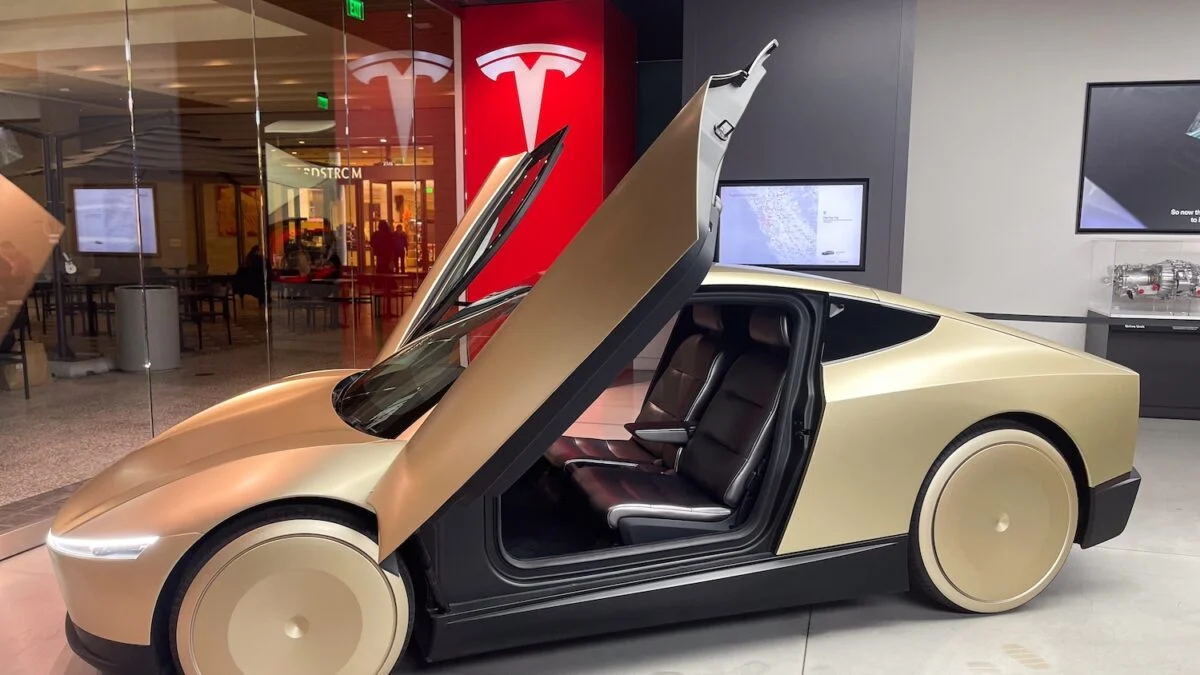
I remember opening the EPA filing on a flight and feeling my coffee go cold. A two-seat, wheel-less Tesla — barely more than a battery and a shell — stared back from the spec sheet. If you follow Musk’s promises, that moment lands with a mix of excitement and a tiny, nagging doubt.
I’m going to walk you through what the paperwork actually says, why it matters, and where you should keep your skepticism. You don’t need to be an engineer to read these signals; you need to know what to watch next.
A surprisingly light EV at 3,113 pounds
The EPA filing lists the Cybercab’s curb weight at 3,113 pounds — roughly 1,411 kg — and that number is the first real surprise. For context, that’s about 700 pounds less than the lightest Model 3 and puts the Cybercab near the weight of many gas-powered compacts. Tesla gets there by removing the wheel, pedals, and a lot of driver-focused hardware, and by packing a relatively modest 48 kWh battery behind a front-mounted 219-horsepower permanent magnet motor.
Those specs—219 hp, single front motor, 48 kWh—translate on paper to an unadjusted 418-mile range (EPA paperwork figure). After EPA adjustments, outlets like The Verge expect real-world range closer to 290–300 miles. The math is simple: a light platform plus a dense battery equals high efficiency. It’s like a feathered battery on wheels, trading frills for miles.
How far can Tesla Cybercab go on a single charge?
Official EPA paperwork lists an unadjusted 418 miles, but test-cycle corrections suggest a real-world figure nearer 290–300 miles. The Cybercab’s efficiency rating—about 165 Wh/mi—makes that believable; by comparison, the Lucid Air runs around 230 Wh/mi. That 165 Wh/mi number would place the Cybercab among the most efficient EVs ever certified.
Efficiency that reads like a laboratory result
Car and Driver and The Verge dug into the EPA documents and flagged the 165 Wh/mi rating. That’s not marketing spin; it’s a standardized number that shows how far the car travels per unit of energy. At roughly six miles per kWh, the Cybercab could be twice as efficient as many standard EVs that manage three to four miles per kWh.
For you, that means lower energy costs per trip and fewer stops per shift if these go into a robotaxi fleet. I’m not saying it solves range anxiety for every use case, but the efficiency math here is striking and oddly elegant—Tesla trimmed the car like a sculptor removing stone to reveal a purpose-built core.
How efficient is Tesla’s Cybercab compared with other EVs?
Measured in Wh/mi, the Cybercab’s ~165 Wh/mi beats most production EVs (Lucid Air at ~230 Wh/mi is a notable comparator). Measured in miles per kWh, Cybercab’s ~6 mi/kWh doubles the typical 3–4 mi/kWh you see in many mainstream EVs. That’s the difference between a car that can run long shifts and one that needs constant top-ups.
Robotaxi rollout still reads like a pilot program
Here’s the visible reality on the road: Tesla’s Robotaxi service remains limited. After announcing Austin and promising rapid U.S. expansion, Tesla’s fleet is operational mainly in Austin, Dallas, and Houston, and the Cybercab itself hasn’t flooded city streets.
Elon Musk said the company would have autonomous ride-hailing covering about half the U.S. population within a year. That claim met the hard edge of logistics and regulation. Tesla has only reported 18 crashes involving its automated driving system to NHTSA versus Waymo’s 697, but that comparison hides fleet size: Waymo operates over 3,000 robotaxis across 11 cities while Tesla’s permitted unsupervised fleet in Texas amounts to 42 Model Y units, and only a fraction—about 14—are reportedly running without a human monitor.
Bloomberg and Electrek both flagged signs Tesla is preparing infrastructure: permits for “robocar” car washes and chargers in Austin and a Cybercab car wash plan in Las Vegas. That’s the administrative scaffolding before scale, not scale itself.
When will Tesla Cybercab be available to the public?
Short answer: there’s no clear nationwide launch date. Tesla showed early production photos from Gigafactory Texas and filed EPA paperwork, but filings and local permits don’t equal a mass rollout. Expect gradual expansion driven by regulatory approvals, local permits, and the always-unpredictable pace of software readiness.
A safety record that needs scale to be meaningful
The real-world observation here is simple: safety statistics are proportional to miles driven. Tesla’s low crash count sounds good until you realize the fleet is tiny compared with incumbents like Waymo.
Compare raw numbers carefully: fewer reported incidents can be a sign of safety—or of limited exposure. The NHTSA reports and Robotaxi Tracker data suggest Tesla needs a much larger, consistently monitored fleet before its safety record can be judged against companies that have been running thousands of vehicles for years.
You should also watch regulatory signals. Cities and states control permits, and federal reporting thresholds kick in as the fleet scales. Tesla has filed the paperwork; the rest is local politics, testing outcomes, and public tolerance.
I’ve walked engineers through hundreds of spec sheets. Paper efficiency and real-world deployment are two different tests. The Cybercab reads on paper like one of the most efficient EVs ever certified, and that matters to your future commute and to Tesla’s business model. But if you were counting on robotaxis to replace car ownership next year, you should probably keep your day job and your backup keys.
So which is it: a quiet revolution in EV efficiency, or a clever prototype hamstrung by rollout and oversight—what do you bet on?