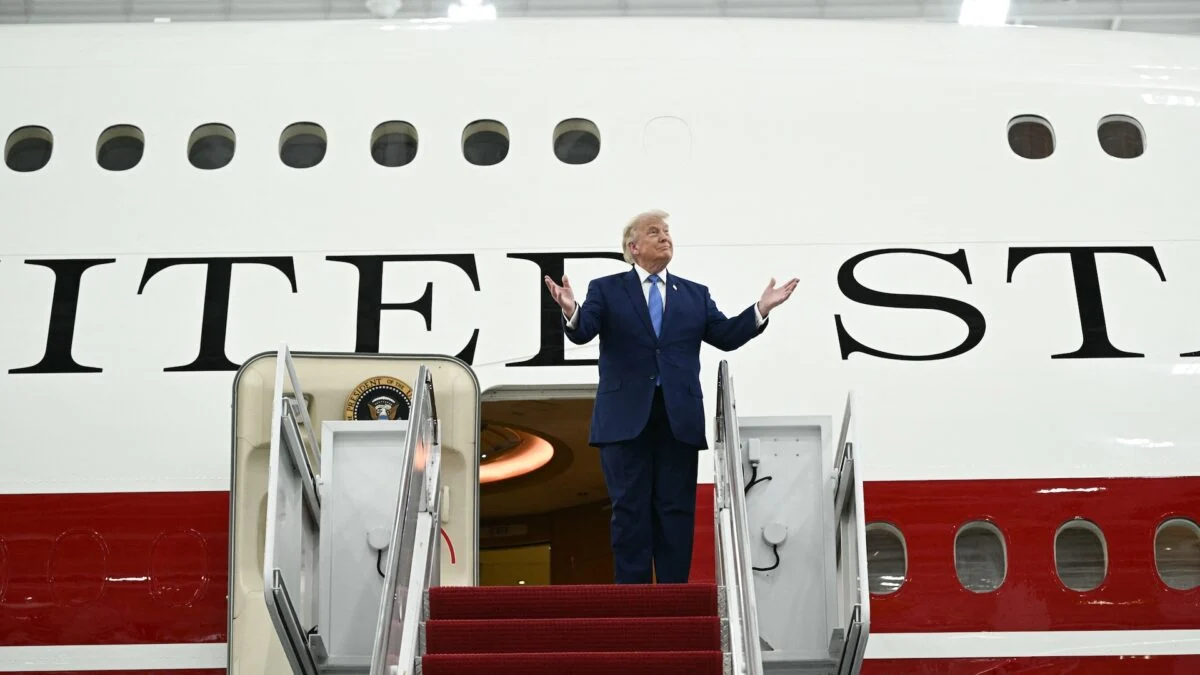
They rolled the blue-and-gold jet onto the apron and cameras flared. I stood there thinking: this is supposed to be the new symbol of American continuity, but something about it felt improvised. By the time the president flies it over the Mall, you’ll know which parts are upgrades—and which are borrowed theater.
I’ve followed aircraft politics for years, and I’ll speak plainly so you can judge for yourself. You and I both want to know whether this Qatar-gifted Boeing 747-8i is truly an upgrade or a stopgap dressed up as a triumph. Read with the suspicion you reserve for press releases; I’ll point to the reporting and the pilots so you don’t have to guess.
This plane is controversial, and the political photograph tells part of the story
On the tarmac, officials posed beside the jet as if every handshake erased the questions around it.
The biggest row isn’t about legroom. Legal experts flagged the transfer as a potential violation of the Constitution’s emoluments language, and outlets from Poynter to PolitiFact laid out why courts might see it that way. Reporting from CNN suggests the handoff was more solicitation than spontaneous gift. The White House argument is procedural: the Pentagon accepted the aircraft, not the president personally. Most analysts expect the claim will fizzle rather than produce penalties, but optics matter—and optics are what you remember when the plane flies over a holiday crowd.
Is it legal for a foreign government to give a plane to the U.S. President?
Is it legal for a foreign government to give a plane to the U.S. President?
Short answer: the transfer raises legal eyebrows. Longer answer: scholars say the form of acceptance, who negotiated it, and whether the president personally benefited are the factors that would determine legality—and those details are murky enough that litigation looks unlikely, even if questions remain.
The Boeing delays explain why a borrowed jet became the headline
I remember early mockups of the VC-25B floating around aviation blogs during the Obama years.
The VC-25B program—Boeing’s military version of the 747-8i—has been slowed by delays and cost increases for years. Trump complained publicly as early as 2016; he renegotiated a deal in 2018 with a price tag cited around $3.9 billion (€3.6 billion) and a delivery timeline that slipped into the late 2020s. With the VC-25Bs not expected until about 2028, the Air Force argued an interim capability was necessary. Qatar happened to have a modified 747-8i available. The result: a political expedient that doubles as an operational stopgap.
Pilots notice one obvious capability is missing
When I asked pilots about the old VC-25A, they described midair refueling as an unpleasant but strategic option.
The retiring VC-25As can receive fuel midflight—a feature meant to keep the commander in chief aloft indefinitely if the worst happens. The Qatar-gifted 747-8i does not have that capability, and the Air Force has said the lack of aerial refueling was already baked into program decisions back in 2017. Aviation analyst Luke Diaz and outlets like Simple Flying have explained why midair refueling is rare for presidential trips: it’s difficult, uncomfortable for crews, and logistically complex. Still, losing that capability narrows contingency options in extreme scenarios.
Can the new Air Force One be refueled midair?
No—the Qatar-sourced aircraft lacks that system, and the formal VC-25B design that Boeing is delivering also sacrificed the capability years ago.
Defense analysts saw a test-flight photograph and raised a red flag
I compared recent test-flight images frame by frame and noticed an absence: no visible DIRCM pods or under-fuselage modular units.
Air Force One’s defensive suite includes classified systems, but visible countermeasures—jammers, missile-warning sensors, and modular pods—are part of what you can infer from photos. Defense sites such as The War Zone found little public evidence that the Qatar jet had been fitted with the usual external countermeasure packages. Simple Flying and other analysts are similarly skeptical about EMP shielding and missile countermeasures being fully installed. In plain terms, the aircraft may be less hardened out of the box than the VC-25As it will temporarily replace—an operational gap the Air Force says will be addressed through classified modifications where needed.
Is the Qatar-gifted Air Force One protected against missiles?
Visible defenses appear limited. Some modular systems can be added later, but photographic analysis so far shows no clear signs of the external hardware you’d expect on a fully hardened presidential transport.
The interior kept its royal leather and some practical changes
Photographs circulated online show plush leather seating and modern art that would be at home in a VIP terminal.
Reports from AeroTime and The Wall Street Journal indicate the Qatari luxury fittings largely remain. The Air Force and officials such as General Dale White say the cabin’s look is largely unchanged. What was added, according to reporting, were targeted, secure communications racks and antennas necessary for a flying command center—installed carefully so as not to rip out the plane’s décor. The result feels like a tuxedo tailored for a different guest: the outward impression is high-gloss, while some internal systems are quietly reworked to handle classified traffic.
Paint, politics, and perception matter more than you might expect
From the ground, the new livery reads as a political statement: more red, touches of gold, a slightly altered silhouette against the skyline.
Changing the exterior color scheme is cheap political theater compared with structural mods, but it’s effective. A presidential flyover is as much about symbolism as logistics. The aircraft will serve as an interim presidential stage for roughly two years while the VC-25Bs are finalized—making how it looks and what it can do a live political argument above the National Mall.
There are two ways to think about this plane: as a pragmatic bridge bought from the nearest available supplier, or as a politically convenient prop wrapped in a national celebration. I’ll leave the verdict to you—are we watching sensible expedience, or a gap you can feel beneath your feet when the cameras cut to the tarmac?