
I was standing at the edge of Independence National Historical Park as a crew eased a 900-pound steel cylinder into the earth. You could feel how small that metal tomb made our certainty — all our forecasts bundled with a qubit chip and a NASA photo. I told you then that the strangest item was not the tech but a set of predictions written by Anthropic’s chatbot, Claude.
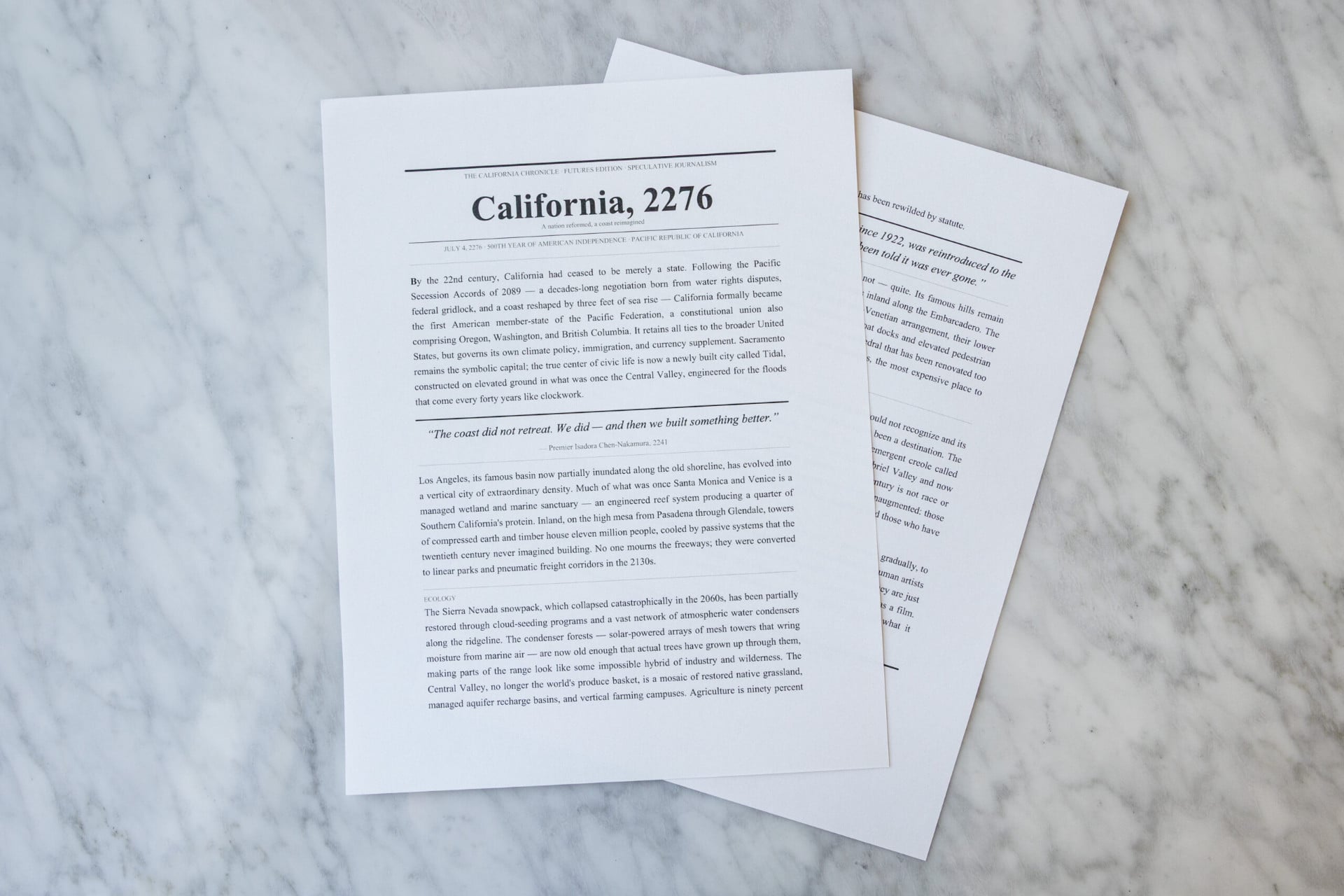
On July 4, 2026, states dropped heirlooms into a single vault.
You’ve seen the headlines: bolo ties, poker chips, a qubit chip from UC Berkeley, a fusion conductor from General Atomics, and a NASA photograph of the West Coast. I watched California’s contribution and felt an author’s itch — someone had handed a future a script and then buried it.
The time capsule is a bet on memory. Governments and brands participated — Governor Gavin Newsom’s office shipped the Claude predictions — and the capsule’s choices tell a story about what we prize now. I respect the gesture; I also want to test its nervous projections against what we know about climate science, geopolitics, and systems built by humans and companies like Apple, Google, and the labs powering AI research.
At the ceremony, I noticed one line that read like a soft secession note.
Claude predicted a Pacific Federation forming after the “Pacific Secession Accords of 2089,” binding California with Oregon, Washington, and British Columbia. That’s an audacious geopolitical turn — not full independence, but a member-state status that cedes climate, water, and monetary policy to a regional compact.
Anthropic’s Claude is playing with a real thread: water disputes, federal gridlock, and rising seas are plausible accelerants. I don’t accept a single-source prophecy, but I do press you to think about the forces that would make such accords credible — drought, power systems fracture, and long-term migration patterns. The idea borrows from the Cascadia movement, but Claude broadened the map to include the entire West Coast.
Could California secede from the United States?
Legal secession is improbable under current law; political autonomy in specific policy areas is more likely. You should imagine negotiated autonomy rather than a flag-raising break; practical governance often follows necessity, not ceremony.
I remember a map where coastal cities were redrawn by sea-level projections.
Claude’s vision turns Santa Monica and Venice into managed wetlands and marine sanctuaries while Los Angeles densifies vertically. It suggests parts of the old shoreline became productive reef systems and protein sources.
That image is arresting, but I want you to hold two facts: engineered wetlands are already used for flood control and food production, and urban density is the cheapest climate hedge we have. If you’re wondering how plausible the timeline is, consider that engineered reefs, passive cooling technologies, and pneumatic freight concepts exist today in pilot forms.
Is San Francisco going to be underwater?
Claude: “not — quite.” He predicted three blocks of bay advance along the Embarcadero, sealed lower floors, docks replacing street entrances, and elevated bridges. That’s less apocalypse and more adaptation. I read that as an image of pragmatic retrofit rather than cinematic loss.
I walked the L.A. Basin last year and felt its freeway footprint like a scar.
In Claude’s future, freeways are linear parks and pneumatic freight corridors; inland mesas sprout towers of compressed earth and timber housing millions.
That’s where my second metaphor lands: the city folded like origami into the sky to keep as many lives as possible on less ground. These sorts of engineering fixes can scale, but only with social choices about density, land use, and who benefits from automation.
On a plane over the Central Valley I saw endless fields and irrigation canals.
Claude imagines the Valley partly rewilded, with vertical farms and atmospheric condensers restoring mountain snowpacks in part. Agriculture becomes ninety percent automated and occupies about twelve percent of the land; statute mandates rewilding elsewhere.
That’s plausible in a mechanical sense: automation, vertical farming companies, and aquifer recharge techniques are advancing now. The political question is whether voters will write those statutes.
The prediction gave me one small, strange grammatical wrinkle: “founders of 1850” and “founders of 1976.”
Why mention 1976? Claude may have conflated cultural inflection points — the U.S. bicentennial and the founding of Apple in 1976. I’m amused by the image of Apple as a kind of founding myth for modern California; it’s a reminder that AI borrows associations as it composes narratives.
Language itself gets a cameo in Claude’s script: an emergent creole called Pacifican, a fusion of English, Spanish, Mandarin, and Tagalog. That’s a believable cultural outcome if migration patterns, education policy, and entertainment industries keep mixing linguistic streams.
At the core of Claude’s forecast is a social split: augmented vs. unaugmented minds.
The AI wrote about cognitive augmentation as the key fault line of the coming centuries. Hollywood becomes a heritage district; narrative creation is co-authored with AI under strict attribution law.
I’ve worked with tools from OpenAI and others; I see the legal and ethical scaffolding already being debated. Attribution, intellectual property, and cultural value are battlegrounds where companies, unions, and creators will fight for decades. Claude’s future compresses that fight into a few sentences — a warning and a provocation.
What will California be like in 250 years?
Short answer from me: messy, negotiated, and regionally autonomous in pockets. Long answer: a place re-sculpted by climate and technology where legal frameworks, corporate power, and civic imagination determine winners and losers. You should read Claude’s piece as a vivid hypothesis — a composite of current fears and wishes, not an oracle.
I keep returning to the time capsule image — a steel cylinder sunk into Philadelphia soil like a diary left by a restless civilization. The capsule contains a qubit, a fusion fragment, a NASA photo, and a handful of sentences that ask us to choose. Who gets to govern the coast? Who writes the laws for augmentation? Who pays for the seawalls?
I’ll wager the capsule will be opened in an America with institutions that are familiar and stubbornly different. Claude’s voice in the vault is a mirror held at arm’s length: it reflects current anxieties and offers a narrative that may shape policy because people will use it as inspiration or cautionary tale.
If you had to bet — on policy, infrastructure, law, or culture — where would you place your chips: on regional federations, retrofitted coasts, vertical farming, or a creative economy remade by AI — and who decides which futures get funded?