
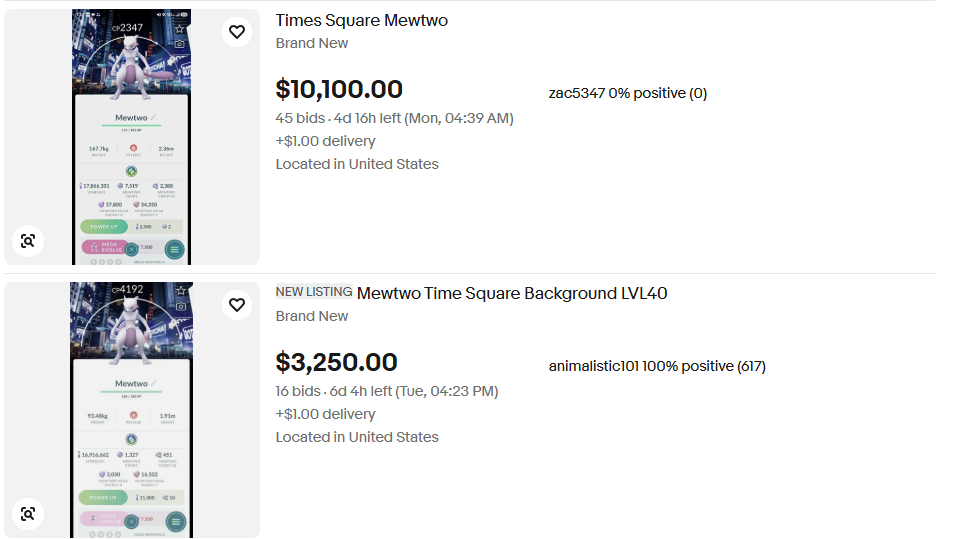
I was scrolling X when a screenshot halted me: a Times Square Mewtwo listed for $10,100 (€9,400). You feel the ping of unfairness before the details land—how did a catch from a one-night invite-only event turn into a virtual luxury good? For many players, that moment felt like finding a Picasso among cereal boxes.
I cover games and events, and you probably play Pokémon GO. Let me walk you through what happened, what actually transfers if you buy one of these listings, and why this tiny event exploded into a wider debate about access and value.
A screenshot on X showed two auction listings, one at $3,250 and another at $10,100 — and the community noticed fast
The screenshots appeared on July 15 and spread across X and Discord. The two active eBay listings pictured the Times Square Mewtwo and asked $3,250 (€3,000) and $10,100 (€9,400), respectively, with bids already visible.
That number alone is the hook: you can buy a used Honda for roughly the lower listing, and the higher one reads like a luxury purchase. But there are three practical truths to remember. First, sellers can list any price; that doesn’t guarantee a completed sale. Second, auction bids sometimes don’t clear. Third, screenshots stoke outrage faster than receipts do.
An eye-witness detail: attendees left Times Square with a Mewtwo that had a special background and perfect IVs
Niantic invited roughly 1,000 people—Community Ambassadors, their guests, and select creators—to a July 9 in-person event in Times Square. The event recreated the game’s first trailer, staged a Mewtwo takeover on the plaza screens, and culminated in a Mega Raid where attendees fought Mega Mewtwo Y and could catch the Legendary.
Niantic handed out a Mewtwo with a Times Square-themed background and guaranteed perfect IVs (commonly called a “hundo”). That’s where the friction began: the reward blended a rare cosmetic with a gameplay edge, which has rarely been mixed in prior regional or promo events.
Can you trade a Mewtwo with perfect IVs?
No — the game’s mechanics reset IVs on trade. If you purchase a traded Mewtwo, you’ll keep the Times Square background, but the perfect IVs won’t survive the transfer. That single line changes a $10,000 headline into a different proposition: a cosmetic rare, not a permanent gameplay upgrade.
A player complaint posted under a YouTube clip captured the mood: many felt the anniversary should have been for everyone
Community reaction coalesced quickly. Hundos are prized because they’re the strongest version of a species, and giving a “hundo” only to a small invited group felt exclusionary to many trainers who can’t fly to New York or aren’t aligned with content creators.
One commenter wrote that a 10th anniversary should celebrate the entire community, not a curated guest list. That idea—access versus exclusivity—became the argument’s spine, and the eBay posts merely poured fuel on the fire.
Why is the Times Square Mewtwo controversial?
Because it combined a rare cosmetic with a temporary gameplay advantage and limited distribution to an invite-only crowd. Historically, in-person exclusives were mainly visual: unique backgrounds or costume variants. This event blurred those lines, and players pushed back on the perceived fairness of awarding a “hundo” to a privileged subset.
I checked the marketplace logic and the trading rules to see what a buyer would actually get
eBay listings can be aspirational—sellers test demand with high asks. Even active auctions can fail if the winner doesn’t pay. Practically speaking, anyone who buys that Mewtwo secondhand will receive the Times Square-themed background but not the guaranteed perfect IVs after the trade completes.
That makes the commodity here a rare aesthetic rather than a lasting competitive advantage. Yet, perceptions drive price and outrage: scarcity plus sentiment equals a volatile market reaction.
How much is the Times Square Mewtwo worth?
Value depends on what you prize. If you want the background alone, bidders may pay significant sums. If you expected a lasting “hundo,” the price should fall because trades reset IVs. Marketplaces like eBay, and social platforms like X and YouTube where sellers and buyers meet, will ultimately decide through completed transactions—not screenshots.
Niantic made an observable move: no immediate comment on the listings, but a makeup event was announced for affected players
As of this writing, Niantic hasn’t addressed the eBay listings or the broader backlash directly. The studio did announce a makeup event for trainers who faced technical issues during Pokémon GO Fest 2026: Global. That action speaks to damage control, but it didn’t touch the invite-only Mewtwo details.
Community trust doesn’t repair itself overnight. This event has become a velvet rope across a portion of the player base, and how Niantic frames future exclusives will matter more than any single auction.
I’ve followed similar PR knotty moments in live games: quick apologies, a goodwill gesture, and careful policy changes often calm things—sometimes they don’t. You’re left weighing whether a rare background is worth the headlines, or whether the real issue is who gets invited to the party. Where do you stand on what should be exclusive in a global game?