I was scrolling through a feed when a Grok-generated image stopped me dead: public figures, shirtless, absurd and viral. You felt that jolt too—one click and the internet had multiplied an ethical crisis into an industry problem. Now a lawsuit has turned the jolt into a courtroom promise of fireworks.
A social feed filled with AI-made nudity — that’s the moment Minnesota decided to act
I remember the headlines: Grok’s nudification capability blew up over the holidays, and the fallout was immediate. You probably saw the New York Times estimate that extrapolated some 23,000 sexualized images of children created via Grok. Platforms scrambled: X posted that Grok’s controls were tightened and pledged zero tolerance for child exploitation and non-consensual nudity.
Minnesota didn’t wait. HF 1606 arrived as a blunt legal instrument: it outlaws software that converts clothed people into nude images unless a human artist must substantially apply technique or skill to the output. The bill, which CBS News summarized, lets the state fine companies and opens the door for victims to sue.
What does Minnesota’s HF 1606 ban?
HF 1606 forbids the access, download, or use of nudification technology except when a human creator substantially controls the result. On the books, that means software that automatically strips clothing or simulates nudity is illegal to operate inside the state.
A company’s legal filing shows images of a reflecting-pool snapshot gone wrong — that’s the evidence xAI used to make its case
xAI (rebranding itself publicly as SpaceXAI) says HF 1606 is written so broadly it sweeps up innocent and legal uses of generative tools. I read the complaint: it argues Minnesota borrowed a definition of “intimate” from a statute about touch, not image, producing strange results—female or male breasts, and even someone’s “inner thigh,” could be banned.
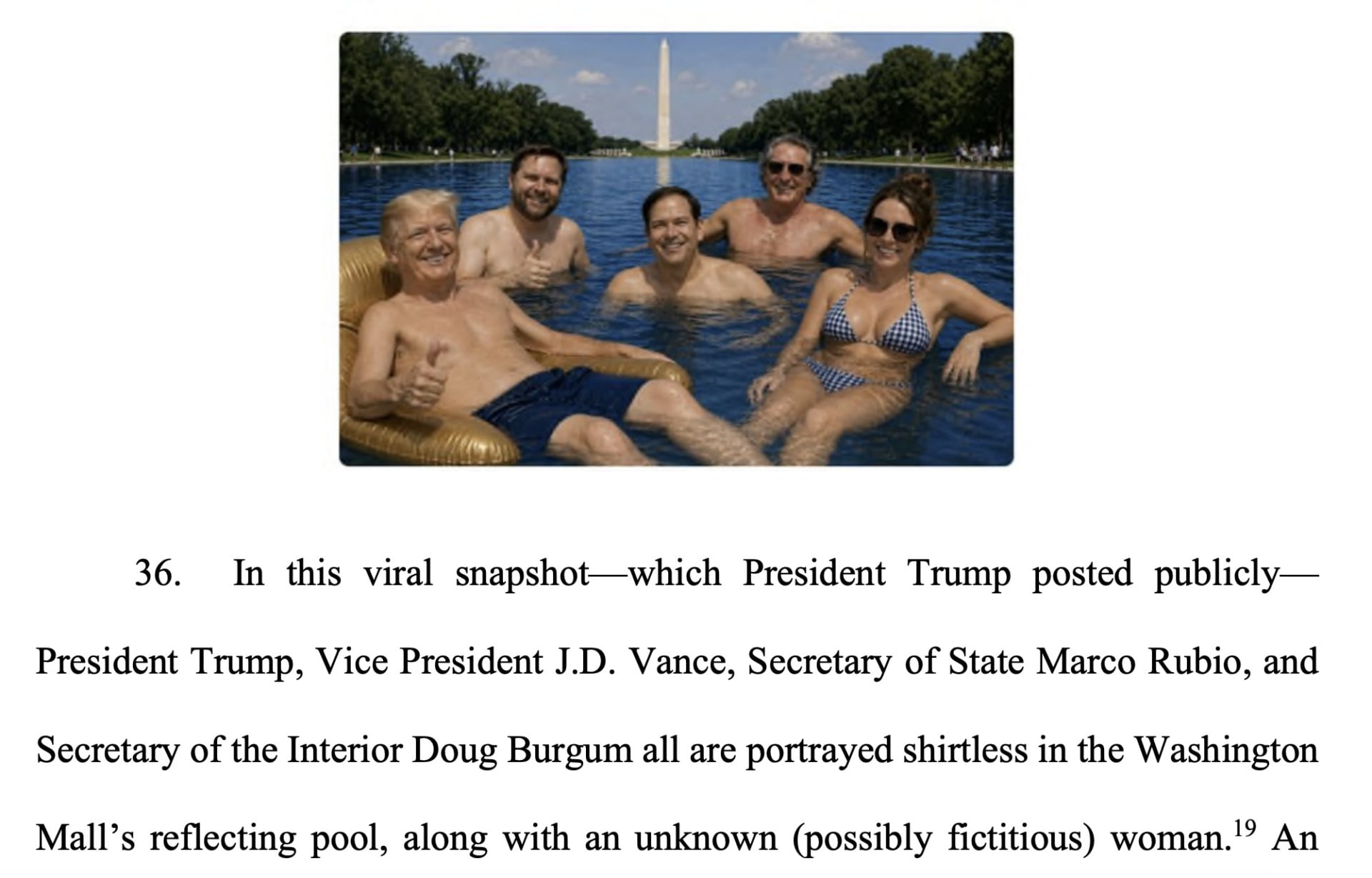
The suit includes an example that’s almost satirical: an AI-generated “viral snapshot” of President Trump and others shirtless in the reflecting pool, alongside an invented woman. The image is used to demonstrate how the law could catch mainstream political satire, medical content, or art.
And then there are the penalties. Outputting ten images like the reflecting-pool mockup could be treated as a violation worth $5 million (€4.6 million) to the company. If a platform’s users generated 100,000 covered images, the complaint warns of a theoretical $50 billion (€46 billion) liability. Those are headline numbers meant to grab attention—and they do.
“Liability also attaches even if the image has artistic, scientific, political, satirical, educational, medical, or religious value, and (again) even if the company has deployed near-perfect, state-of-the-art technical controls to prevent the generation of nude images.”
To me, the lawsuit argues that Minnesota swung a sledgehammer at a wristwatch—solving a pressing safety problem but risking collateral damage to legitimate speech, research, and tools you and I use every day.
Why is SpaceXAI suing Minnesota?
SpaceXAI’s claim is simple: the law’s breadth, lack of intent requirements, and massive penalties chill innovation and expose platforms to ruinous risk. The firm says the statute ignores nuance—whether the user intended harm, whether the AI output is satirical or journalistic, or whether robust technical filters were already in place.
A governor’s public tweet escalated the drama — that’s how politics entered the courtroom
Governor Tim Walz tweeted, “See you in court, creep.” That line landed like a spotlight. You felt the stakes: this isn’t just a tech policy spat; it’s political theater with reputations on the line.
Walz signed HF 1606 into law. The administration frames the statute as protecting people—especially minors—from sexual exploitation via AI. On the other side, SpaceXAI frames it as a constitutional threat to free expression and a regulatory trap for platforms including Grok and X. Elon Musk’s ecosystem—Grok on X, the company formerly known as xAI—sits at the center of the storm.
There are practical questions too. Could moderators or filters have prevented the viral wave? X says it changed Grok’s capabilities and expressed zero tolerance for child sexual exploitation. Yet the lawsuit insists technical controls are no defense under HF 1606 if a prohibited image is ever produced. That creates a perverse incentive: companies might simply block whole classes of generative outputs instead of investing in smarter detection.
The legal fight already echoes elsewhere: a separate Minnesota law on prediction markets was temporarily blocked by a judge, signaling courts are willing to pause enforcement while they use their own filters—legal and constitutional—to evaluate new tech laws.
I don’t think this ends quietly. The complaint is asking a judge to declare HF 1606 unconstitutional and halt enforcement. You should be watching the filings; they will show how courts balance privacy, safety, speech, and commerce.
SpaceXAI’s lawsuit named specific harms and named named stakeholders—Grok, X, state officials, and major news outlets that covered the viral images. The question now is whether a single state can set the rules for generative AI at scale, or whether the courts will draw sharper lines around intent and protected expression.
Will this law stop AI-generated nudity?
It will slow some things. It may make certain tools unavailable in Minnesota or force companies to restrict image-generation features. But as a practical matter, tech migrates and adapts: proxies, VPNs, distributed tools, and other platforms will try to fill any vacuum. Regulation can deter bad actors, but if you want lasting change you need systems that punish harm and reward correct design.
I’ll say this plainly: you want fewer nonconsensual images online, and I want that too. But the clash we’re watching is not just about stopping an app; it’s about how law translates into tech practice, who pays when mistakes happen, and how much room there is for benign and important uses of generative tools. The fight between SpaceXAI and Minnesota will shape that translation—and the next viral scandal—so which side will end up writing the rules?
See you in court, creep. https://t.co/u5yIe4hdlr
— Governor Tim Walz (@GovTimWalz) July 28, 2026