
You pull into a restaurant lot because the DoorDash app pinged you with a short job. I watched a Dasher lift a takeout bag, open a robot, snap photos, and slide the order into its compartment. Five minutes later the robot rolled away and the Dasher pocketed about $5 (≈ €4.60).
A Dasher in Mesa drove two miles, picked up an order, and loaded a Dot.
Dot is DoorDash’s purpose-built autonomous delivery robot: lidar, radar, and cameras tucked into a stroller-shaped chassis that can move up to 20 mph. The machine moves itself; it cannot tuck food into its own trunk. That gap—sensors and software vs. simple hands—has created a tiny, paid task for human drivers.
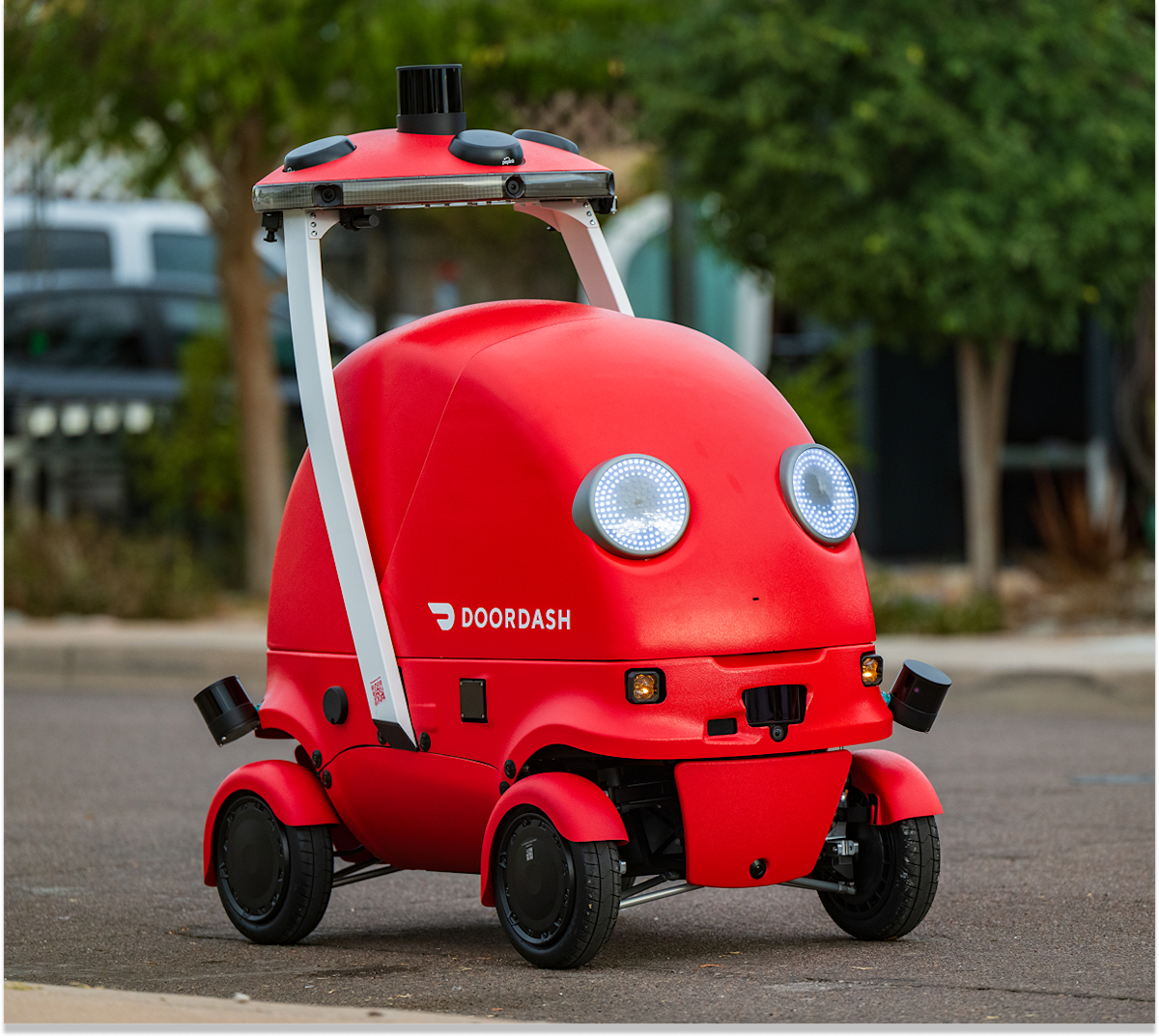
Drivers in forums and on Business Insider described a five-minute job: pick up, load, document, and go.
Devena Bybee, a Mesa Dasher, told Business Insider the app offered an assignment to “load a robot.” She drove about two miles, handed the order into a waiting Dot, photographed each step, and tapped complete. Other Dashers shared screenshots and posts in a Facebook group confirming similar $5 offers.
How much do Dashers get paid to load Dot robots?
Reports and screenshots suggest these tasks pay about $5 (≈ €4.60) and take roughly five minutes. For some Dashers it’s an extra, predictable five minutes; for restaurants it’s a tiny workflow someone else can perform.
DoorDash frames the program as a limited pilot to support busy merchants and create earning opportunities.
The company told Business Insider this is a short pilot to help merchants during peak times and to add options for Dashers. At the same time, DoorDash has moved aggressively elsewhere in autonomy: DoorDash Labs is building Dot and a drone program called DoorDash Air, which recently won FAA commercial approval.
Why is DoorDash paying drivers to load robots?
Short answer: the hardware is ready; the handoff logistics are not. DoorDash’s own statement points to the harder work on the ground—inventory reconciliation, universal handoff systems for drive-throughs and back doors—that makes autonomous delivery practical for restaurants. Robert Bruno, a labor professor at the University of Illinois Urbana-Champaign, told reporters some merchants might prefer paying Dashers to handle loading rather than reorganize their kitchens or hire new staff.
Small tasks are becoming the seams between machines and humans.
The Dot moves on its sensors; people fill a practical hole by placing meals and documenting each handoff. To Dashers this is a quick earn; to merchants it’s a plug-in labor option; to the company it is a field test for real-world integration. I call Dot a mechanical stroller—strictly functional, not yet independent—and that distinction matters for how rollout will feel on the street.
Will robots replace Dashers?
DoorDash insists Dashers will continue to complete the majority of deliveries as autonomy scales. The company points to pilots and limited use cases rather than wholesale substitution. Still, labor experts warn that outsourcing simple tasks to independent contractors can shift costs and responsibilities away from merchants and employers, a trend worth watching.
I watched a screenshot tell the rest of the story: the app asked drivers to “Find the Dot Robot.”
That screenshot, shared in driver groups and reported by Gizmodo and Business Insider, showed the robot’s light bar as the identifier and required photos during loading. The DoorDash app becomes a backstage clipboard for small, repeatable tasks—another tool in a logistics stack that includes DoorDash Labs, drones, and third-party platforms.
Waymo has already leaned on humans for small closures—DoorDash drivers and tow operators have been asked to close doors left open on robotaxis—which shows this is not unique to one company. The practical takeaway: autonomy creates new micro-jobs as much as it removes old ones.
You can see the efficiency case and the labor risk at once—so which side do you bet on when “help the robot” becomes part of the gig economy’s daily checklist?