
I froze on a single frame from a 2024 documentary: a woman at a table, a printer humming, a heavy battery on the floor. The pieces snapped together—this is the “human printer” everyone jokes about. I had to know what she was hauling and why it looked like overkill.
I’ve traced gear for politicians before. You and I both know proximity work with a president is organized chaos: speed matters, but so does redundancy. Here’s what I found about Natalie Harp’s setup, how it squares with the job, and where it’s plainly excessive.
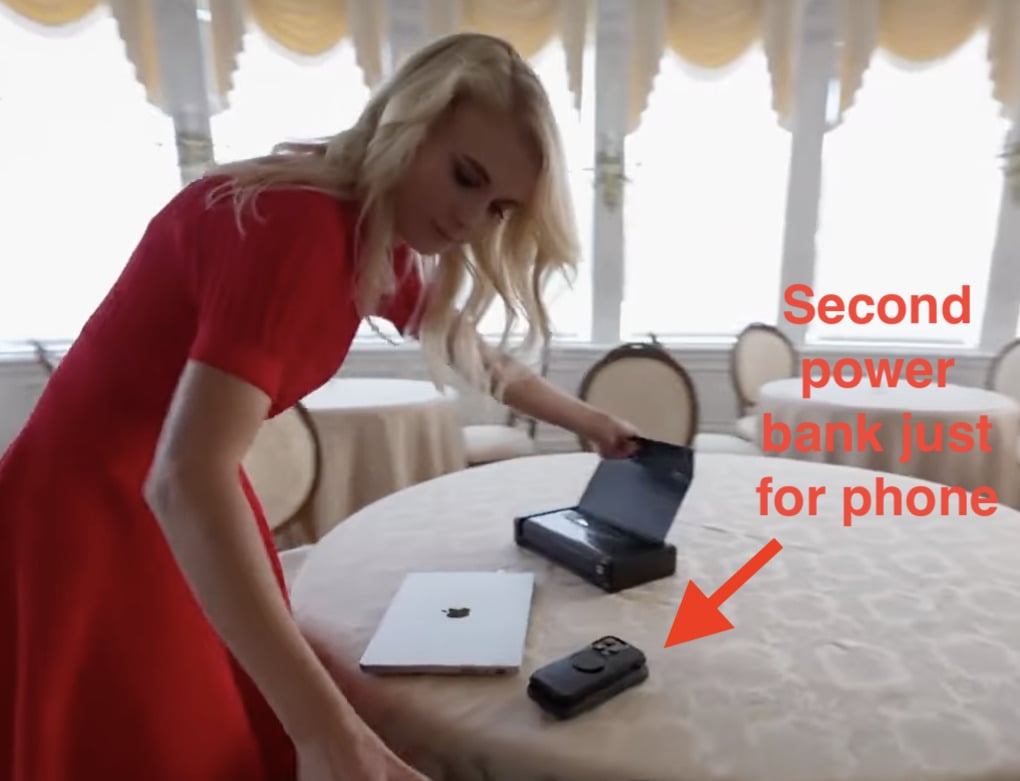
At a documentary table I spotted an Epson WF-110 and a third-party power brick — what that tells us
The New York Times called Harp the “human printer” after reporting she carries a printer and battery pack to keep the president supplied with printouts. In footage from The Art of the Surge, the machine is unmistakable: an Epson WorkForce WF-110 paired with a MARBERO portable power supply and a separate phone bank. That combination reads as redundancy by design.
What printer does Natalie Harp use?
The visible unit matches the Epson WorkForce WF-110, a true mobile inkjet with a built-in battery and Bluetooth. PCMag lists its speeds at about 6.7 ppm in black-and-white and 3.5 ppm in color — fine for small jobs, sluggish if you expect a stream of urgent printouts. Epson even sells an extended battery you can snap onto the WF-110 so it becomes a single, neater unit.
On Getty Images frames her tote looked like a small supply depot — why that matters
Pool photos show a colossal Osprey tote. Inside, you’d expect paper, ink, maybe a laptop. Instead, the footage shows a separate MARBERO power supply (roughly 2 lb 5 oz) plus a smaller phone bank and the printer itself. That mass adds up fast when your job is to sprint to a president’s side at a moment’s notice.
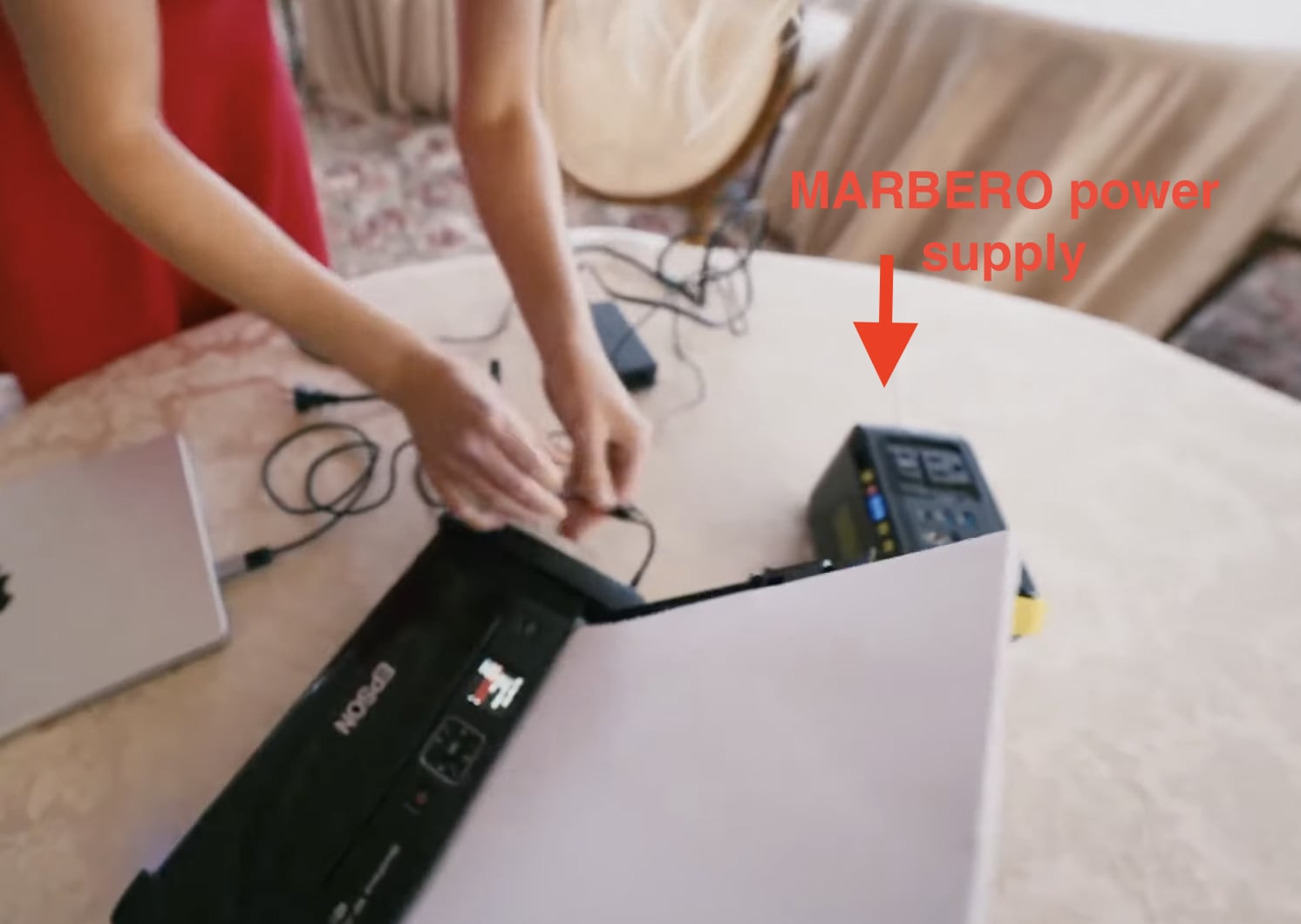
I watched cord spaghetti on a Mar-a-Lago conference-table shot — and it felt unnecessary
The WF-110 supports Bluetooth and USB charging, yet footage shows multiple cables and a separate AC-style power brick taking up floor space. That cord cluster looks like a beehive of redundancy: one device that can self-power, plus a large external supply and a dedicated phone bank. It solves a problem that the WF-110’s design already addresses.
Is the Epson WF-110 practical for field use?
Yes, in many cases. The WF-110 is compact, prints full color, and has an internal battery. But PCMag’s speed figures and Amazon weight listings (the assembled kit creeping toward ~4.6 lb) make it clear this isn’t featherlight. For a role that Vanity Fair describes as “on-call and sleeping near the president,” lighter and simpler often wins.
I compared product specs and a colleague pointed me to alternatives — here’s the analysis
I dug into specs and asked a consumer tech colleague, Kyle Barr, for a recommendation. He suggested the Brother PJ-883, a thermal mobile printer that trades ink for speed and lower carry weight. Thermal devices remove cartridges and reduce failure points; they print fast and require fewer consumables on the move.
Why would someone carry a backup battery for a portable printer?
Redundancy and signal insurance. If you’re responsible for immediate, physical printouts for a public figure, you hedge against dead batteries and spotty connectivity. The oddity here is scale: the WF-110 can attach an extended battery to become a single package. Bringing a separate 2+ lb power station plus a phone bank looks like guarding against a problem the primary unit already fixes.
You could argue this kit is a small traveling hardware shrine built around certainty; that shrine works, but it’s heavy and slow. The cord cluster and duplicate batteries increase points of failure as much as they reduce them.
I reached out to the White House with device IDs and a question about upgrades; I didn’t get a reply. Public coverage from The Washington Post, The Hill, and Getty Images helped map the narrative; Vanity Fair and the New York Times had earlier profiles that established her reputation as the “human printer.” Between those sources and footage in the documentary, the gear picture is granular.
If you were advising someone who literally has to sprint across a golf course to hand the president a printout, I’d push one change: consolidate power and ditch separate heavy bricks unless you can’t avoid them. Thermal Brother units, an Epson WF-110 with Epson’s snap-on extended battery, or simply printing from a phone to a smaller thermal device would cut weight and failure modes.
Natalie Harp’s setup does the job. It just carries too much ballast for what the job actually asks. When seconds and steps matter, will bulky redundancy be comfort or a millstone?