I was scrolling through headlines when a stray stat stopped me mid-scroll: Americans have binge-watched Spider-Man for longer than most civilizations have existed. You shrug, I did too—until Nielsen laid out the minutes and it stopped feeling like fandom and started looking like a cultural megastorm. The scale hit like a tidal wave of playtime.
The scale is obvious on your screen right now.
I keep a habit of checking Nielsen when pop culture goes loud, and this one is loud. Between January 1, 2023 and July 4, 2026, Americans streamed over 121 billion minutes of Spider-Man content—movies, TV shows, everything. Nielsen translates that into more than 230,000 years of web-slinging. That stat isn’t trivia; it’s a ledger of attention.
How many minutes of Spider-Man have been watched?
Nielsen’s headline number is the start. When you break it down, Shameik Moore’s Miles Morales leads with 12.3 billion minutes, Tom Holland’s Peter Parker follows at 10.6 billion, Tobey Maguire clocks 8.6 billion, and Andrew Garfield sits at 6.7 billion. Those figures only count what Nielsen tags under the Spider-Man umbrella—so Holland’s Avengers cameos aren’t in that specific tally.
I noticed which films people kept returning to this summer.
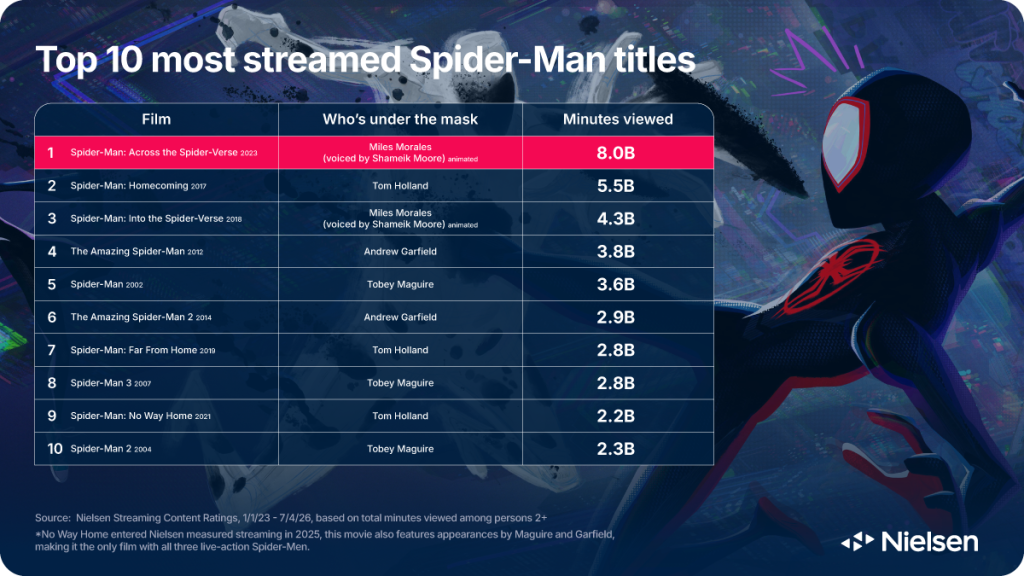
Film by film, the animated entries dominate. Across the Spider-Verse tops the list at about 8 billion minutes, then Homecoming with 5.5 billion, and Into the Spider-Verse at 4.3 billion. Nielsen even reports nearly 2 billion minutes of views for Across in 2026 alone—and that only counts through early July. There’s also the noise around the recent Beyond the Spider-Verse leak; how much more attention that added is still an open question.
The TV landscape tells a different, quieter story.
Look at the data and you see a kid-focused show quietly hogging the “minutes” column. Spidey & His Amazing Friends, a preschool series, accounts for 73.7 million minutes, while films collectively sit at roughly 38.2 billion minutes. Other TV entries like Your Friendly Neighborhood Spider-Man and Spider-Noir register 1.2 billion and 2.6 billion minutes respectively. Part of that advantage for Spidey is episode volume: as of May it had 103 episodes across four seasons, which naturally piles up playtime for younger viewers.
Who is the most-viewed Spider-Man?
Short answer: Miles Morales. The animated Spider-Verse movies have been a viewing engine—Shameik Moore’s voice performance and Sony’s marketing pushed Miles over Tom Holland’s live-action lead. If you track discovery on platforms like Netflix, Amazon, or Sony’s own distribution, the animated pairings keep getting recirculated.
I watched the ripple into gaming and it was immediate.
When Insomniac added the Brand New Day suit to Marvel’s Spider-Man 2, players didn’t just click; they came back. According to Gamespot reporting, the update drove an extra 316,000 copies sold across PlayStation 5 and PC, netting roughly $11 million (about €10 million) in additional revenue. That’s the commerce side of cultural buzz: a costume drop equals sales and a burst of re-engagement.
Did Spider-Man boost video game sales?
The short answer is yes. The cross-pollination between films and games is now a marketing tool and a product strategy. Insomniac’s free update acted as both a fan service and a sales catalyst—players wanted the suit in game, and that nudged purchases and micro-engagement like photos and streaming sessions.
I still keep my eye on what the numbers hide behind their shine.
Metrics tell a story of repetition and discovery. The Spider-Verse pairings, Holland’s Home trilogy, legacy trilogies—they all pull different crowds at different times. Some viewers consume Spider-Man like a mixtape stuck on repeat; others revisit because a new entry surfaces in algorithms or a costume shows up in a game.
So here’s what I take from this: Spider-Man isn’t just a hit—it’s an infrastructure of attention spanning kids’ TV, animated features, live-action blockbusters, and games. Nielsen, Gamespot, Insomniac, PlayStation, Sony—these names are the poles holding up that infrastructure. If Beyond the Spider-Verse lands on June 18, 2027 as scheduled, the next chapter won’t be a whisper. Will Miles claim the next year outright, or will the web keep tangling everyone together?
Want more io9 news? Check out when to expect the latest Marvel, Star Wars, and Star Trek releases, what’s next for the DC Universe on film and TV, and everything you need to know about the future of Doctor Who.