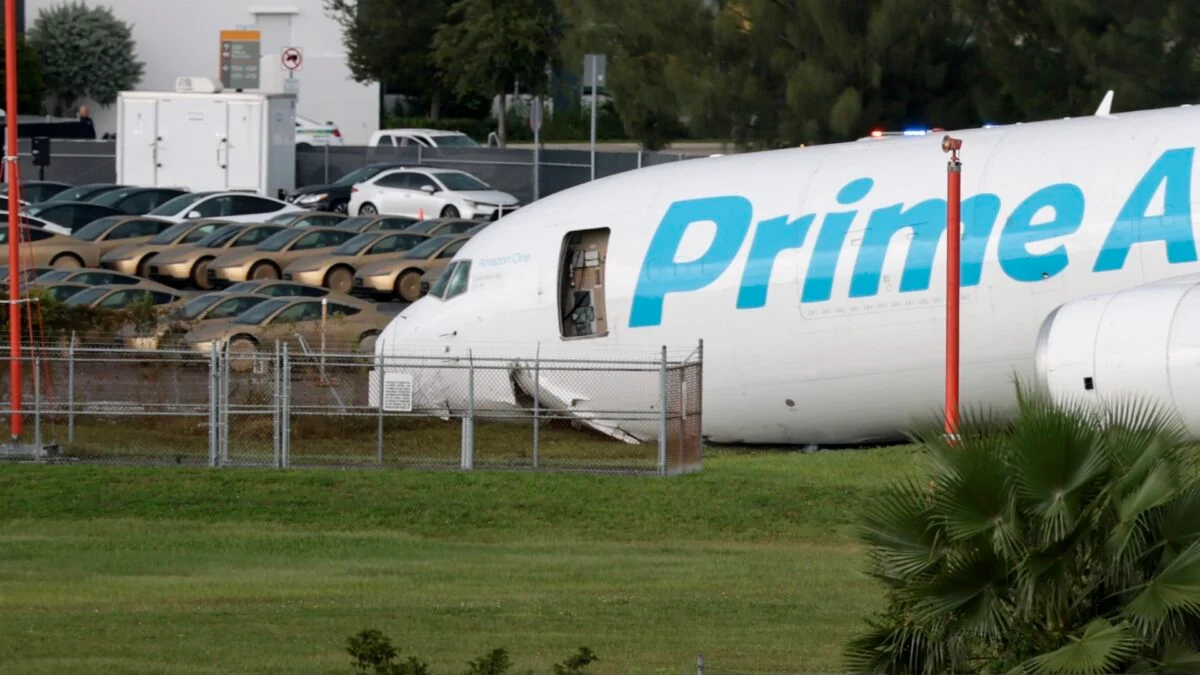
The Boeing 767 skidded off the runway and stopped a breath away from a fenced lot full of gold vehicles. I replayed the footage and felt the same flinch you did when you first saw the clips. Elon Musk called it “Weird.”
I follow this stuff for a living, and I want you to see why that near-miss matters beyond the headline. This isn’t just an aviation accident or a quirky fleet photo — it’s a window into how quickly hardware can accumulate, how regulation chases innovation, and how a single fluke can illuminate planning gaps at Tesla, Amazon, and regulators.
The plane came to rest just short of a rental trailer lot — Why the parked Cybercabs turned a crash site into a curiosity
FlightRadar24 and FAA coordinates place the wrecked Prime Air plane within yards of a truck-trailer rental lot. Social observers and EV trackers, including Sawyer Merritt, had posted footage the day before showing dozens of Tesla Cybercabs in that very lot.
Those Cybercabs — gold, wheel-less, rated for Tesla’s robotaxi service — were parked with no clear assignment. They sat like a stack of gold coins in a silent vault, visible but unused. The image of a cargo jet missing that lot by inches made the vehicles look less like a coming mobility revolution and more like inventory waiting for a call.
La FAA annonce la fermeture jusqu’à nouvel ordre de l’aéroport de Miami suite à la violente sortie de piste du Boeing 767 de Prime Air.
Les services d’urgence de l’aéroport signalent plusieurs victimes après l’accident. pic.twitter.com/bQrNaNw97l
— air plus news (@airplusnews) September 6, 2026
Are Tesla Cybercabs safe?
Short answer: regulators are asking questions. The National Highway Traffic Safety Administration has opened an inquiry into how Tesla certified the Cybercab against federal standards. The probe will examine whether Tesla’s internal logic exempted the vehicle from requirements other vehicles must meet.
That matters for you because certification affects what can legally operate on streets, who insures it, and how much risk residents accept when a new vehicle type arrives in a city.
I found parked Cybercabs in Miami even though commercial service is limited — How Tesla’s rollout and social media created the confusion
Tesla lists Robotaxi service in Miami on its site, but it specifies that the Cybercab variant is currently only in Austin. Yet reports and social posts show Cybercabs in Miami lots, Las Vegas, Pittsburgh, and elsewhere — often with Texas plates or steering wheels reinstalled.
Tesla began manufacturing Cybercabs at its Texas Gigafactory in April and claims a theoretical capacity of 125,000 units per year. The company has argued individuals could buy Cybercabs and put them into a Tesla ride-hailing pool for passive income — Musk has suggested a private price below $30,000 (€27,600). That promise fuels social chatter and explains why vehicles turn up far from their advertised service areas.
Why were Cybercabs in Miami?
There’s no single public answer. Possible explanations include transport logistics (moving stock between lots), off-network testing, lease or dealer storage, or private owners parking vehicles ahead of activation. I asked Tesla for comment; they hadn’t replied by publication.
There were five fatalities in the crash — What regulators and operators are watching now
Miami International Airport emergency reports and news outlets confirm five people died after the Prime Air plane overshot the runway and struck ground vehicles near the terminal. The FAA has closed parts of the field while investigators probe the anomaly that happened just before touchdown.
Amazon Prime Air’s branded jet creates a second axis of scrutiny. Aviation investigators will parse mechanical telemetry and pilot action. On the ground, the NHTSA will continue to examine Tesla’s Cybercab certification logic, and state vehicle regulators will watch for cross-jurisdictional testing that happened without clear permits.
Will Cybercabs be sold to the public?
Elon Musk has publicly said private Cybercabs would be available and affordable. Production is underway at Tesla’s Texas factory and small commercial deployments exist in Austin. But public sales hinge on certification, insurance frameworks, and whether the NHTSA demands modifications for compliance.
The optics matter: Tesla’s Model Y Robotaxis, the ones actually operating in Miami today, still have steering wheels and pedals. Cybercabs are a different beast — no wheel, no pedal — and that technical gap is why regulators are looking more closely at Tesla’s paperwork than they ever did with ordinary EV launches.
Social media amplifies this uncertainty. Tracker accounts, Instagram posts, X threads, and Reddit sightings create a sense of immediate scale. Sometimes the result is hype; sometimes it’s a logistical trail showing where these machines sit, waiting. The lot near Miami looked like dominoes waiting to fall — orderly but tense.
If you’re watching this as a citizen, a city planner, or a potential buyer, the questions track across safety, legal frameworks, and how quickly manufacturers can move from pilot fleet to mass market. Amazon and Tesla made headlines for different reasons this week, but both stories intersect where public space, private inventory, and regulatory authority meet.
I’ve followed launches, recalls, and rollouts for years. You should expect more messy overlaps — test fleets in public, pilot services in one city, inventory in another — until rules catch up and companies align operations with permits and public safety expectations. Do we want more innovation at the speed of Tesla’s production line, or do we want public-facing deployments to wait until oversight is ready to match them?
The plane almost hitting that lot was a coincidence with teeth. What does it tell you about where responsibility lies, and who gets to decide when a vehicle type goes from prototype to everyday presence on your street?