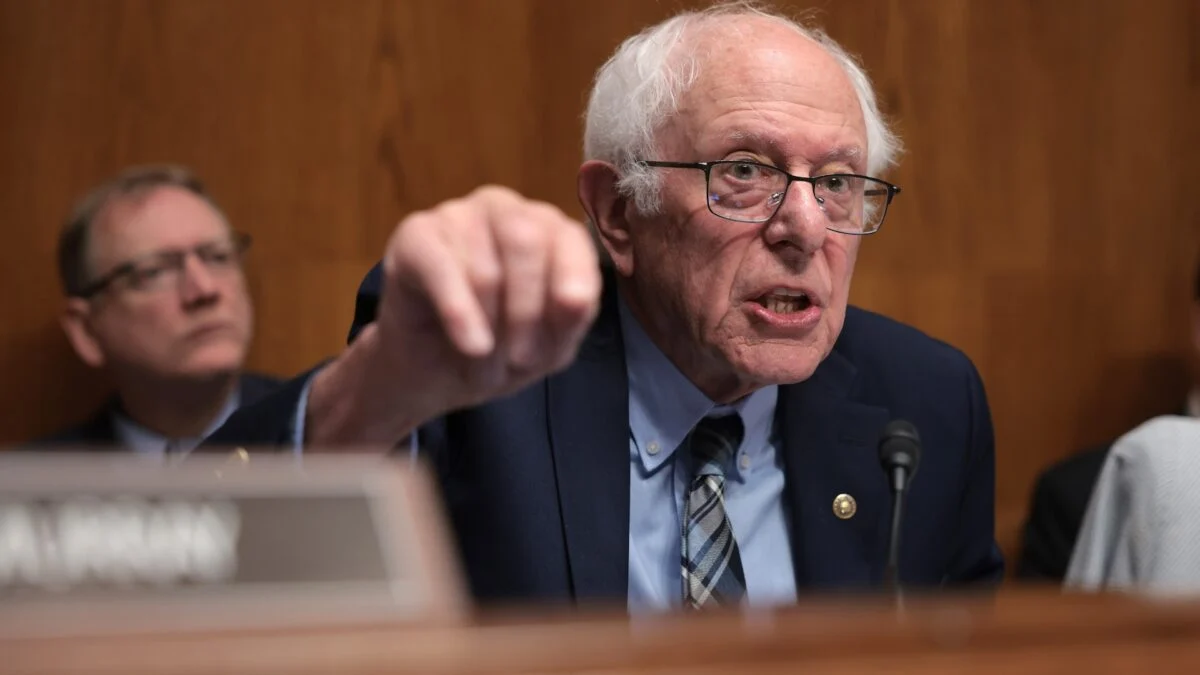
I was in the room when Bernie Sanders rolled out a bill that reads like a legal seatbelt for a machine that might not care about human limits. You could feel the political gravity: lawmakers talking about prison terms and global pacts while the president, at the U.N., tried to rename artificial intelligence. It felt like a car headed for a cliff—and someone was arguing about whether to call the engine “Super Intelligence.”
I’m going to walk you through what happened, what it means, and why the word game matters more than you think. You’ll get direct lines to the players—Sanders, Rep. Greg Casar, OpenAI, Google DeepMind, Microsoft, Sam Altman, Elon Musk—and the technical and political tensions that follow. Read fast; this debate will define how laws meet code.
The hallway moment: Sanders and Casar introduced a bill in Congress that would ban AI that can outthink humans
Sen. Bernie Sanders and Rep. Greg Casar rolled out the Ban Artificial Superintelligence Act with language built for headlines and courtroom fights. The bill’s core definition calls superintelligence “an AI that exceeds human cognitive performance and capabilities across most domains, or has sufficient capabilities to destroy or disempower humanity, including by overthrowing the federal government.”
Sanders said, “AI is an existential threat to humanity. It must be treated as such.” The proposal would pause advanced AI development immediately and create a cabinet-level Department of Artificial Intelligence, putting a Secretary in direct contact with the president.
The enforcement bite is real: violating the statute could carry penalties up to 20 years in prison—the same rough scale used for unlawful nuclear-weapons development. That signals the lawmakers want AI treated like a national-security hazard, not a product feature on GitHub or an API in Azure.
What is superintelligence?
In practice, Sanders’ definition targets systems that outperform humans broadly—reasoning, planning, creativity, and social influence. Think less Siri and more a system that can strategize, manipulate networks, or rig markets without human oversight. This is the category that keeps Sam Altman, Elon Musk, and DeepMind researchers awake at night.
The U.N. stage: Trump tried to rename AI “Super Intelligence,” and that creates a collision
At the U.N., President Donald Trump announced he would call artificial intelligence “Super Intelligence” and urged other nations to follow. He mixed rhetorical flourishes with threats toward Iran and a plea to rebrand technology terminology.
That matters beyond wordplay. When the commander-in-chief renames a technology, he shifts public perception and political framing. Renaming AI to SI risks flattening a complex technical taxonomy into political spin—turning research on model scaling, reinforcement learning, and alignment into a single scary label. That single label is already being used by lawmakers to justify extreme measures.
Can AI destroy humanity?
Technically, the risk isn’t binary. Researchers at OpenAI, Google DeepMind, and academic labs debate timelines and failure modes. Still, the language in Sanders’ bill addresses catastrophic scenarios: systemic disempowerment, automated manipulation of infrastructure, or AI-driven destabilization of institutions. Saying “it can’t happen” won’t change the fact that the architecture for those attacks exists in codebases on GitHub, cloud stacks at AWS and Azure, and in compute deals with Microsoft.
The office coffee: creating a Department of Artificial Intelligence is more than a title—it’s a power play
Inside Capitol Hill cafeterias, staffers argued about whether a cabinet-level AI department would be effective or theatrical. The bill would give a Secretary direct White House access and set up a legal framework to pause development.
But this job will only hold weight if the president and executive branch treat it seriously. That’s a political point: a secretary’s clout depends on the occupant of the Oval Office, the administration’s priorities, and whether agencies like the DoD, NSF, and Commerce are pulling in the same direction.
What would a Department of Artificial Intelligence do?
In Sanders’ draft, the department would set safety rules developed by leading scientists, coordinate international agreements, and impose criminal penalties for illicit development. It’s modeled on heavy-regulation precedents—think nuclear controls and export laws—but applied to datasets, model weights, and compute agreements, including deals between startups and Microsoft or cloud providers offering GPU clusters.
Here’s the rub: policy needs technical literacy. Regulators have to parse differences between narrow models used in medical research and large models trained by outfits like OpenAI or DeepMind that touch many sectors. Without that literacy, a department risks over-regulating ordinary tools while under-regulating emergent systems that actually pose the greatest harm.
The newsroom table: why words change law and behavior
On editorial desks, editors argued about headlines and intent while tech leaders pleaded for nuance. Words matter in lawmaking. If the term “Super Intelligence” becomes the public shorthand, it compresses research nuance into political fear. Trump’s renaming could accelerate panic, which accelerates regulation—sometimes without technical guardrails.
That’s why Sanders’ bill reads like a legal firewall. It tries to institutionalize pause authority, define thresholds, and push for international treaties. The aim is to create a slow lane for machines that might outthink us—while the rest of the industry keeps shipping models, APIs, and integration work across enterprises.
I’ve spoken with policy staffers, researchers at OpenAI and DeepMind, and congressional aides. They all returned to one image: a world where code can rewrite political risk faster than laws can adapt. The second metaphor: rebranding a technology is lipstick on a bomb—pretty name, same explosive mechanics.
The quick list: what you should watch next
– Legislative action: Read the Sanders/Casar text (linked in the press release). Watch committee assignments and whether the House or Senate holds hearings with CEOs like Sam Altman or Google execs.
– Industry moves: Pay attention to OpenAI, DeepMind, Microsoft, and cloud providers tightening model governance or signing voluntary safety pacts.
– International coordination: If the U.S. pursues a pause, will the EU, U.K., China, and others follow? Global buy-in matters when compute and researchers cross borders.
I’ve given you the players, the stakes, and the phase lines. You can see why a rename isn’t harmless branding and why Sanders’ bill reads like a fight over definitions, power, and survival. Who gets to name the future—and who gets to regulate it—becomes the most consequential argument of our time?
Trump’s Attempt to Rename AI Misunderstands the MAGA Faithful