
I was scrolling Truth Social when a post stopped me cold. “Anyone that uses the term ‘Artificial Intelligence’… THE ENEMY!” the message declared in all caps. For a second I had to check the feed — did I land on satire or a country that suddenly rewrote its threat matrix?
I’ve watched political language get weaponized before. You and I both know labels change how people feel, and feelings change how power is used. Let me walk you through what that Truth Social outburst means, who’s already ceding the new language, and why you should care if a president is rebranding technology as an enemy.
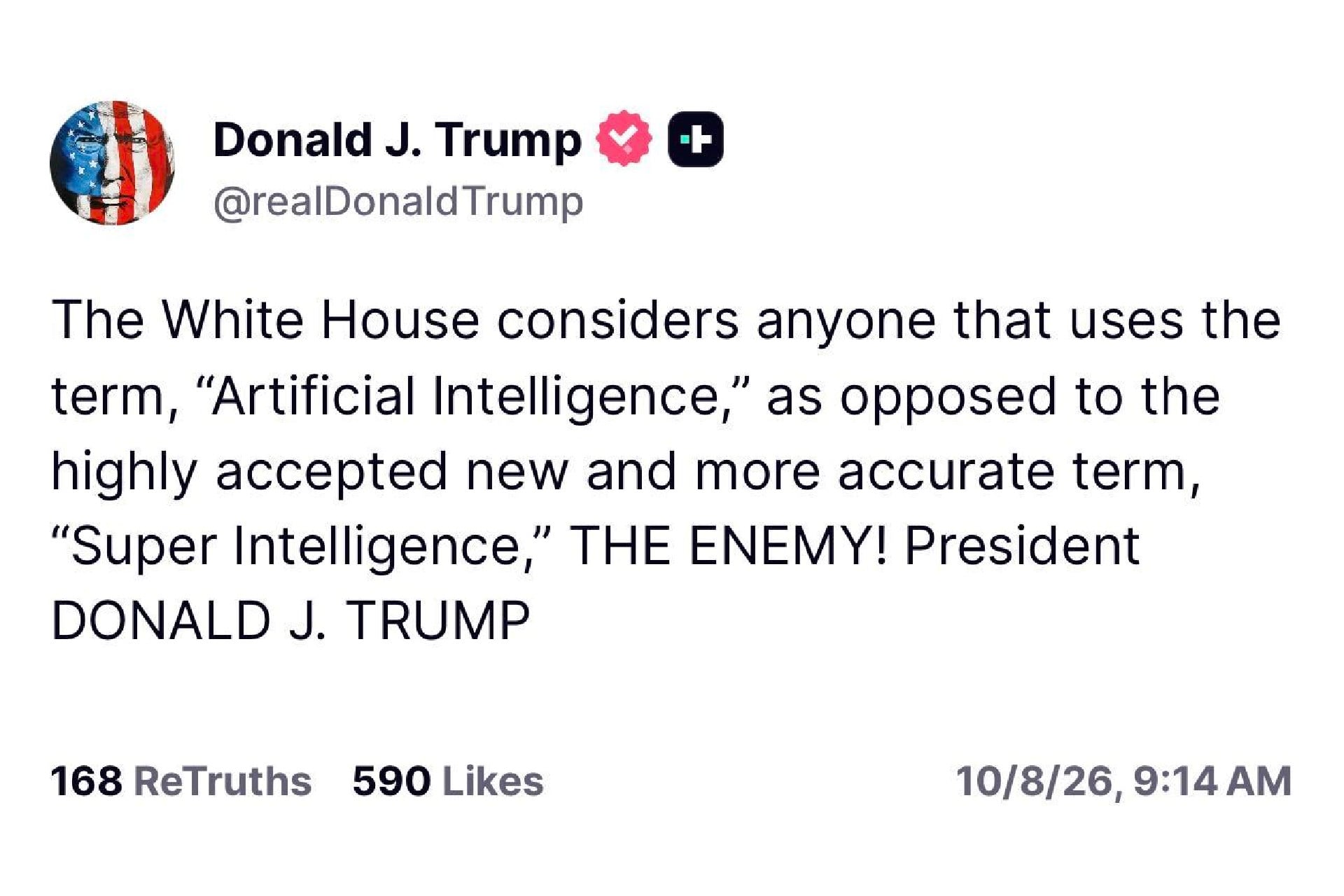
On my feed yesterday I saw the word ‘enemy’ used like it was a brand; here’s what that meant
The post wasn’t a stray rant. It came from the top and it named a target: anyone who says “artificial intelligence” instead of “super intelligence.” You and I can parse the silliness — but words from a president are press releases with teeth. When a leader declares an entire phrase forbidden, institutions start rearranging themselves around that new language.
Why is Trump calling AI ‘the enemy’?
He’s weaponizing nomenclature. Calling the technology “super intelligence” casts it as something beyond ordinary control — worthy of fear and therefore control. That framing makes it easier to justify broad regulatory moves, audits, or even punitive actions toward researchers, companies, or platforms that resist the rhetoric.
I watched executives change their language in public this week; here’s what happened next
At a handful of interviews and earnings calls, CEOs swapped words like actors changing costumes. Jensen Huang at Nvidia, Mark Zuckerberg at Meta, and Elon Musk (now nudging SpaceXAI toward a new name, SpaceXSI) have all started using “super intelligence.”
Jeff Bezos told Bret Baier he prefers “SI” because “artificial” sounds unflattering — think “artificial sweetener.” That line landed on Fox and then reverberated. When the house brands shift, the rest of the industry absorbs the cue like paint on a fresh wall — a brand repaint that resets what feels respectable.
Is ‘super intelligence’ different from artificial intelligence?
Historically, “superintelligence” meant systems that outperform humans across many domains. Today the change is rhetorical: the phrase is being popularized to carry heft and menace. Functionally, the underlying technologies are the same models and chips you read about — Nvidia GPUs, Meta research stacks, and the attention of investors — but the label bends perception.
BAIER: The president says ‘SI.’ Are you into SI or AI?
BEZOS: I do like SI, because ‘artificial’ is not a very flattering thing. Like, nobody wants an artificial sweetener, artificial flavoring.
— Aaron Rupar (@atrupar.com) October 7, 2026 at 3:26 PM
I checked government sites and found a mismatch; these are the facts
The Democratic Party’s X account flagged ai.gov as still live while si.gov remains dormant. Later, someone swapped a graphic at ai.gov to read “SI,” but the domain si.gov hasn’t been claimed. You can see how messy this is: the rhetoric races ahead of the bureaucracy, and that gap is where power grabs happen.
I listened to the larger political rhythm and the pattern looked familiar; here’s why it matters
Designating something as an enemy makes it legally and administratively easier to target. Trump has called journalists, Democrats, and even Canada “enemies” before. Now a technology term sits where a political faction used to, and that shift could let policy act like a scalpel and a hammer at the same time — a Trojan horse for sweeping authority.
Short-term theater and long-term consequences collide: the man who posted the Truth Social message also suggested a possible bombing against Iran then promised no attacks before the midterms. He pivoted instead to promises of $5,000 (€4,600) checks to voters and teased “big surprises” from Russ Vought and Project 2025. Those are not small signals; they’re noise intended to change attention and compress debate.
I watched the industry compliance unfold like a small coup; here’s what you should watch next
Nvidia, Meta, SpaceXAI, and CEOs like Bezos and Musk are linguistic signalers. When they adopt a label, regulators and media follow. Platforms — Truth Social, X, and mainstream outlets — will decide which term has purchase. You should watch which platforms enforce language, which agencies update guidance, and whether ai.gov becomes si.gov on the server level as a symbol of policy capture.
There’s another danger: when language is weaponized, researchers and smaller companies get squeezed. Grant reviewers, procurement officers, and compliance teams take cues from the top. If “super intelligence” becomes a loaded term tied to national security, funding and freedom of inquiry could shrink without public debate.
I’m telling you this because labels shape policy. You may roll your eyes at the idea of renaming technology, but when a president points a rhetorical gun, institutions duck. Will our institutions defend neutral terminology, or will they follow the new script and hand power to those who named the enemy?