
I was scrolling an astronomy subreddit when a string of timestamps stopped me. They promised either a new world or a spectacular false alarm. You know that small, thrilling doubt — did an amateur and a few lines of code really find a planet?
On a laptop in Spain, a 28-year-old product manager fed TESS light curves to several AI agents
I met Pavel Rabtsevich’s thread the way you meet most internet flame-outs: skeptical, curious, ready to move on. He wasn’t an astronomer and he didn’t own a telescope. What he did have was TESS public data, subscriptions to Anthropic’s Claude Code, OpenAI’s Codex, and a collaborator he calls Jev at TypeSafe — and he pushed those models through iteration after iteration.
Rabtsevich ran an automated sweep across a narrow slice of TESS observations — about 126,000 stars captured between November and January — then focused resources where the models flagged repeating dimming. He didn’t accept first answers. He asked the agents to test themselves, to falsify hypotheses, and he judged the results.
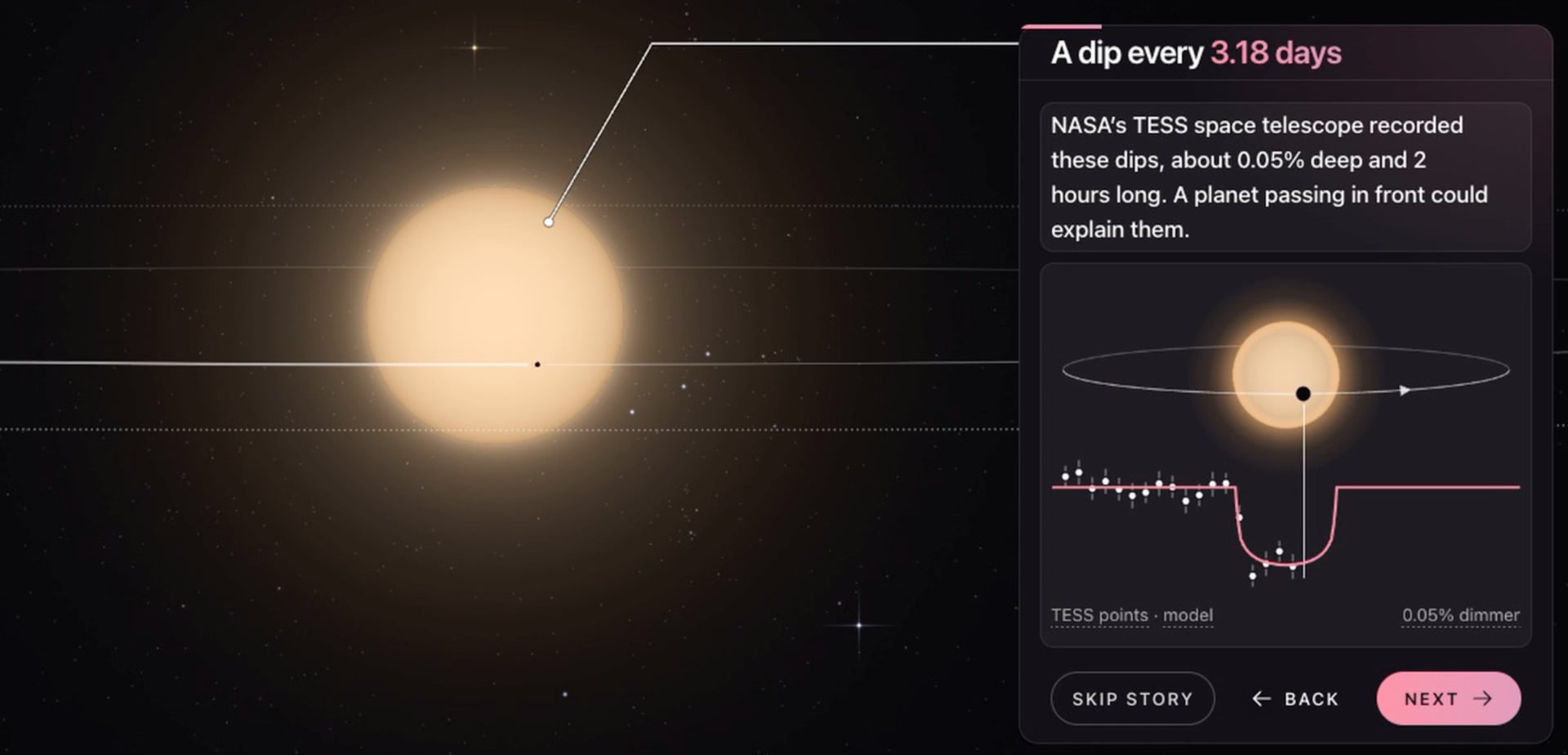
On the TESS light curves, a pattern kept repeating every 3.18 days
I went back through Pavel’s notes and the archived TESS sectors from 2018 and 2020. The same tiny dip — faint, but periodic — showed up at the same cadence. The candidate star, TIC 4206066, sits about 116 light‑years away and is slightly smaller than the Sun.
Rabtsevich’s math puts the transiting object at roughly 1.4 times Earth’s radius, circling so close its “year” would be about 3.18 Earth days and its surface temperature might reach roughly 1,000°F — hot enough to melt lead. He also found a weaker signal every 11.13 days that could be a second planet, but he describes that one as less convincing.
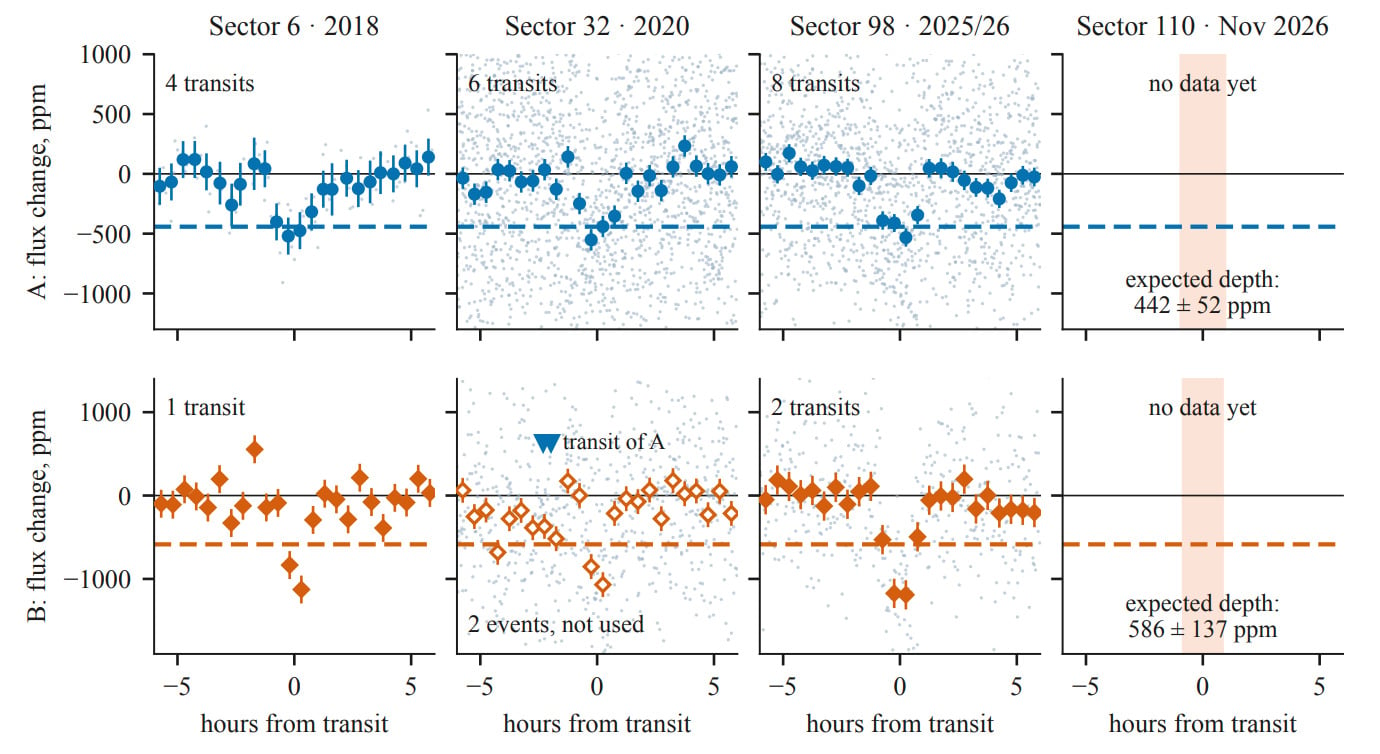
On his laptop, Pavel forced Claude Code to try and disprove the signal
You can be excited by a pattern and still act like a scientist: Pavel ran seventy‑four targeted tests against Claude Code to break the hypothesis. In one trial he trained the model on two sectors and asked it to predict the third; the agent returned correct timing for the dimming events every time.
That’s the difference between a hobbyist finding an oddity and reporting a candidate: he pushed for falsification. Then he filed a request with MIT to schedule TESS observations of TIC 4206066; it was accepted. From October 31 to November 26, TESS will collect two‑minute cadence photometry for that sector — a real, high‑quality follow-up.
Did Claude help discover a planet?
Short answer: Claude assisted the search, but it didn’t sign the discovery certificate. AI here acted as an amplifier for human choices. Pavel chose the tests, judged thresholds, cross‑checked outputs, and decided which signals deserved telescope time.
On a public forum, the community reaction split between awe and caution
I watched the thread move from incredulity to organized scrutiny. People praised the approach and warned about false positives: binary stars, instrumental noise, and faint background objects can mimic transits.
Kevin Hardegree‑Ullman at the NASA Exoplanet Science Institute reminds us why confirmation is hard: so many candidates, limited telescope time, and targets that are too faint for follow-up. Even with AI pruning the list, professional resources still have to do the heavy lifting.
Can AI find exoplanets?
Yes — and it already has. NASA’s own deep‑learning pipeline mined TESS data and flagged roughly 7,000 candidates. Tools like Claude Code and Codex make that workflow accessible to more people, lowering the barrier to run searches and basic vetting.
On a modest budget and a few subscriptions, an amateur can move the needle
If you’ve spent nights on tedious spreadsheets, you’ll appreciate what Pavel described: AI turned hours of grind into weeks of targeted exploration. He says he couldn’t have processed 126,000 stars without these tools. I see it as a new kind of telescope: software that scans mountains of numbers faster than any human could.
This work isn’t a replacement for observatories. It’s a sieve that catches promising grains and hands them to the pros. It’s also a risk: if enthusiasts flood the pipeline with poorly vetted signals, professionals may face extra sorting work.
How can amateurs request TESS follow-up?
The process Pavel used is public: analyze TESS Sector archives, build a convincing case for periodicity and false‑positive checks, then file a request with the TESS team (run by MIT and NASA partners) to observe a sector during scheduled campaigns. If accepted, TESS can collect targeted two‑minute photometry for that window.
On the wider stage, this raises questions about trust and credit
I’ve been reporting on AI in science long enough to know this pattern: a tool lowers costs, more people use it, discoveries multiply, and institutions must adapt. Who gets credit when an AI‑assisted amateur points a professional telescope? Who verifies the claim? How do we prevent noise from drowning the signal?
Rabtsevich has been careful publicly: he says the November TESS run will be decisive. If the star dims on schedule, the case strengthens. If not, he’ll post that too. Either way, this episode reframes a simple fact: AI can amplify curiosity into a path that reaches a real instrument.
For me, the most interesting detail isn’t whether Claude “found” a planet but how quickly a few accessible models can transform raw curiosity into testable science. That changes the social geometry of discovery — professionals and amateurs now meet in the same dataset.
Is the future one where a hobbyist on a laptop, aided by public AI tools and disciplined skepticism, discovers a planet before a telescope team does — and how will the community handle the fallout?