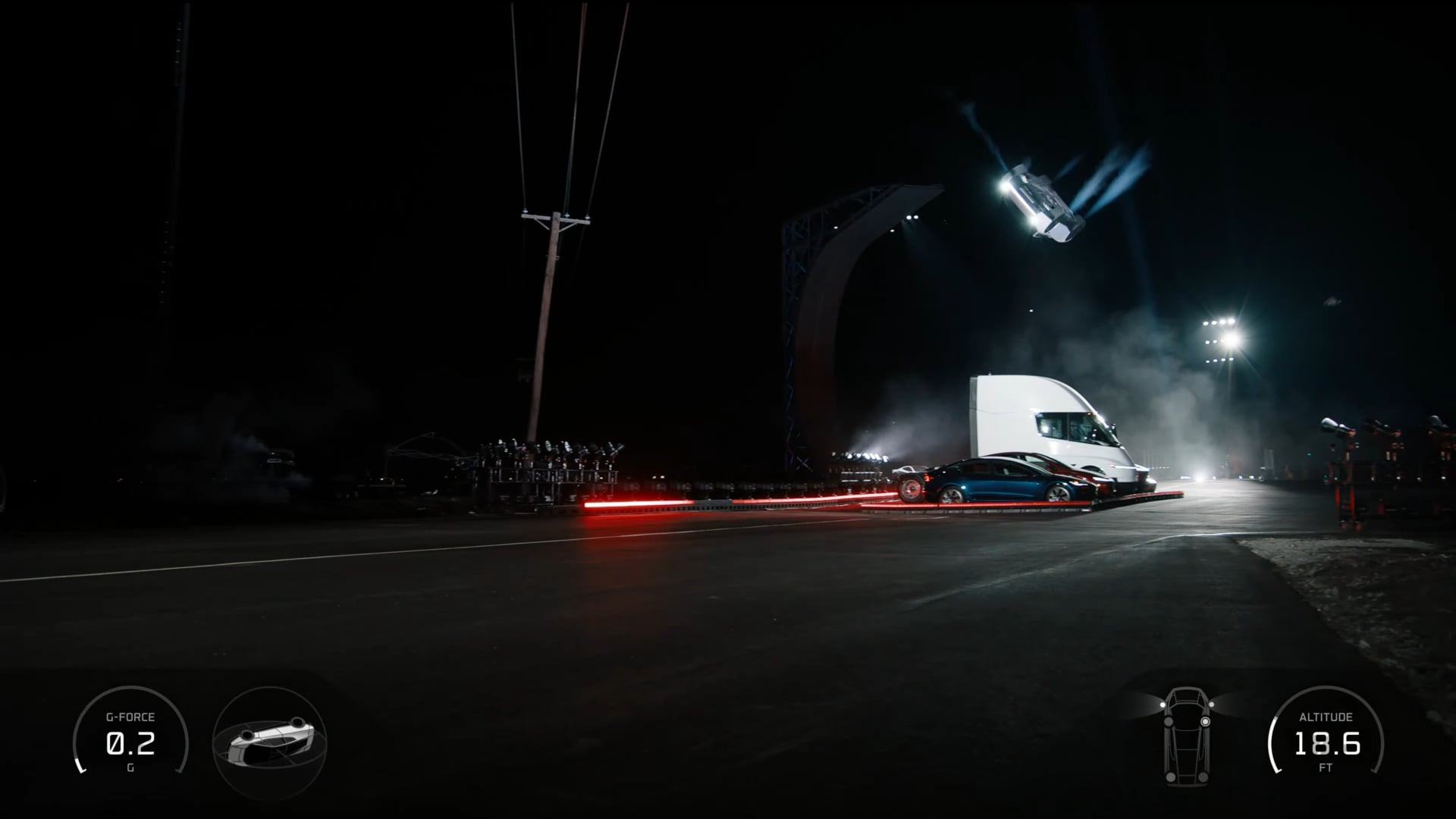
You are watching a livestream from a dusty SpaceX test site in McGregor, Texas. I remember flinching when the red Roadster lifted off the half-circle ramp and rolled upside down through the night sky. For a handful of seconds applause and nervous silence traded places.
I’ve covered Tesla, SpaceX, and Elon Musk enough to know spectacle when I see it—and to sniff out the engineering trade-offs behind it. You want the truth without the hype, so I’ll walk you through what I saw, what Musk claimed, and what regulators and safety engineers are likely to worry about.
A crowd at the test site heard the thrusters before they saw the vehicle
The demo opened with a warning: the cold-gas thrusters are deafening, and Musk only fired them briefly near the audience. What followed was not a virtual teaser or CGI trick; Tesla and SpaceX showed a prototype Roadster launching, turning upside down, and threading a corkscrew over a parade of parked Teslas.
The prototype mixes Tesla chassis work with SpaceX hardware: an advanced ultra-high pressure air tank that feeds cold-gas thrusters. Musk claimed 80 kilonewtons of thrust and compressed air feed—no liquid fuel required. The effect on camera was immediate: acceleration bursts, corkscrews, and a jump that would have made a monster-truck promoter grin.
Can the Tesla Roadster actually fly?
Short answer: the demo showed it can lift off and maneuver in controlled conditions. The FAA’s phrasing—any vehicle that rises “Any Inch Off the Ground” can be an aircraft—already framed this as an aviation question, not just an automotive one. If you trigger those thrusters on public roads, you’re almost certainly stepping into regulated airspace.
An on-stage silence followed every ignition because safety was being bargained for attention
Musk said, “Success is not guaranteed,” and positioned the audience at a safe distance. That line served two purposes: it minimized legal risk and bulleted the drama. The crowd saw a Roadster do a full roll and then clear a line of Teslas with a corkscrew—a stunt that wouldn’t be street-legal in any sensible jurisdiction.
Those suction fans that enable upside-down cornering reportedly generate more than 2 Gs of cornering grip, Musk said. The prototype hit 0–60 mph in 0.81 seconds in a live test—an eye-watering figure the team backed with a demo clip. If you funded the original pre-order deposit—historically cited at $50,000 (≈ €46,000)—you’ve been waiting nearly a decade for that moment.
How fast is the new Tesla Roadster?
Musk repeated old promises: blistering acceleration and record-crushing lap times. The 0.81-second run was the headline, but the demo also demonstrated thrust-assisted vertical movement, which only the Rocket configuration will include. Tesla says production will begin in 2028; Musk insisted that’s a real timeline, not a placeholder.
A camera angle caught the Roadster flying over its own driveway of stock vehicles
That shot made for viral fodder: a red Roadster arcing over a fleet of Teslas in full corkscrew fashion. For brand theater, it’s perfection. For practical buyers, it raises questions: noise, back-blast of compressed air, passenger safety, and the cabin’s ability to protect a human body under extreme Gs. Musk joked about retinal detachment; the audience laughed, then thought about liability.
The prototype’s capabilities will be split across configurations: Performance, Thrust, and Rocket. Only Rocket offers vertical-axis movement. That means most buyers won’t get full aerial theatrics—unless Tesla decides to sell the full package to a small, eager cohort.
An FAA flight restriction had been in place around McGregor before the event
The company had airspace restrictions for a reason: if you rise any measurable distance off the ground the FAA’s rules kick in, and usage becomes restricted to pre-approved areas. Tesla has tangled with regulators before—remember the Cybertruck glass demo and NHTSA probes—and this moves the debate into a different agency’s court.
If you’re an engineer or a regulator, there are clear technical fault lines: thrust metrics reported in kilonewtons, compressed-air logistics, and human tolerance for short-duration, extreme acceleration. If you’re a buyer, the math is about practicality: where can you legally and safely use these features?
A live-streamed ignition is one thing; reliable consumer safety is another
You can be dazzled by a stunt and still insist on data. Tesla delivered spectacle and some numbers, but no spec sheet, no pricing, and no full safety brief beyond stage assurances. The company promised production by 2028, but left open questions that matter for insurance, licensing, and resale value.
For suppliers, partners, and performance tuners—think Bosch, Continental, Sony infotainment partners, or even software platforms like YouTube and X where Tesla’s marketing thrives—this is a product that will invite integration and litigation in equal measure.
A manufacturer’s history colors how the reveal was received
Tesla’s past gestures—Starman launched on a Falcon Heavy, Cybertruck’s failed glass demo, and ongoing NHTSA probes into Autopilot-era citations—mean every triumph is weighed against previous missteps. Investors, journalists, and safety bodies are not only watching how the Roadster performs; they are watching how Tesla explains it.
The prototype behaved during the demo, and that’s a relief. But spectacle doesn’t equal vetting. You want numbers, test cycles, and independent validation before saying a car that performs corkscrews in the air is ready for owners’ garages.
The prototype itself felt like a circus cannon and a Swiss Army knife of velocity rolled into one—one draws applause, the other demands scrutiny.
If you were in charge at the FAA, NHTSA, or Tesla’s legal department, how would you write the rulebook for a car that can climb, flip, and accelerate harder than many rockets?