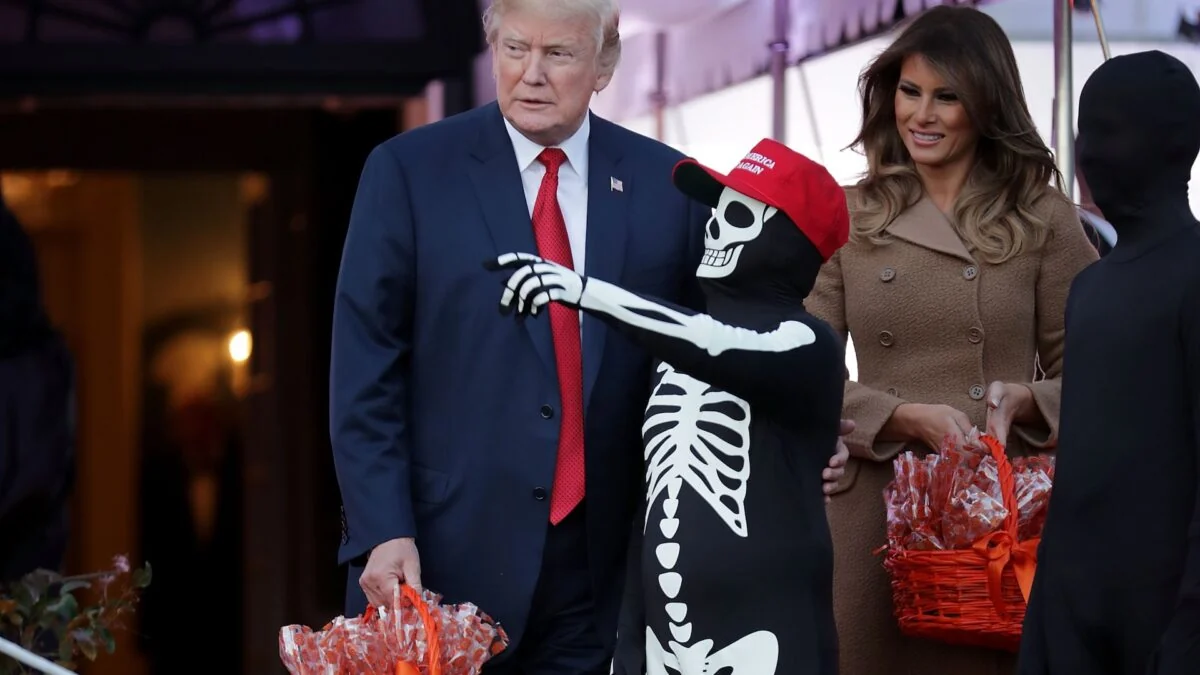
I stood on the news feed when the notice landed: a planned rally in Salina, Kansas, wiped from the calendar the day before Halloween. Guests were instead expected at Mar-a-Lago for a private gala as the campaign announced a string of 20 “telerallies.” I followed the threads—videos, poll numbers, and a handful of blunt exchanges—to see what the swap really meant.
A campaign map still showed a Kansas stop, and then it didn’t.
You saw the same update I did: NewsNation’s White House correspondent Kellie Meyer reported that President Trump canceled the in-person Salina rally set for Oct. 31 and will conduct more than 20 virtual telerallies before Election Day. The White House framed it as an effort to “connect directly with Americans nationwide.”
That explanation lands oddly when you add one fact: the Palm Beach Post reported a Halloween party at Mar-a-Lago that same night. I don’t pretend to read motives; I read signals. When a president replaces a physical stage with a livestream while a private fundraiser proceeds at his club, you weigh optics and outcomes the way an editor weighs lead paragraphs.
A private club had a gala on the books, and reporters flagged the timing.
If you’ve followed Mar-a-Lago coverage, you know the club sells an image as much as a meal. Trump has joked that his promised $5,000 payment to every American (if Republicans win) wouldn’t stretch far at the club—$5,000 (€4,600) “might buy a hamburger,” he quipped. That line landed in social feeds and clips from Aaron Rupar and Bluesky embeds.
Trump’s affordability message: “You could even come to Mar-a-Lago. You’ll be my guest. The problem is that for $5,000 the most you’ll be able to buy is a hamburger and maybe a small dessert. I’m not even sure you could buy that! No, don’t go there. It’s not a good place if you’re price conscious.”
I’ll be frank: for many voters the signal is not just the party itself but the contrast. You have Americans facing higher costs at the pump and on grocery bills while a president celebrates in a club whose menu he brags about. That tension is a political accelerant.
An operational note sat in the public record: flights restricted, state events shifting.
Reporters at the Miami Herald and Des Moines Register tracked travel restrictions and last-minute schedule changes. By late Friday, flight restrictions around Mar-a-Lago were reported; by Thursday a Reuters interviewer asked Trump whether he’d skipped Kansas because he was “sick of travel.” The president responded by belittling the reporter on camera—an exchange that played on CSPAN and X.
Q: “You not going to Kansas has nothing to do with you being sick of travel?”
President Trump: “You’re sick to ask that question. You are sick…I don’t feel I have to go to Kansas…I feel perfect. You are disgusting. Put yourself in shape. You look like hell!” pic.twitter.com/8jfPolxExW
— CSPAN (@cspan) October 29, 2026
The campaign announced “virtual rallies,” and that changes the mechanics of persuasion.
Virtual events are a different animal. I’ve watched administrations try streaming platforms and low-energy feeds—Trump TV, for example, has struggled to draw audiences—so the complaint isn’t theoretical: a live crowd feeds a candidate momentum; a screen flattens the chemistry. The campaign says telerallies expand reach; critics call them a dodge when in-person appearances vanish.
Did Trump cancel the Kansas rally to attend the Mar-a-Lago Halloween party?
Short answer: Reports show the Kansas in-person rally was canceled and Mar-a-Lago hosted a Halloween event the same night. NewsNation’s Kellie Meyer relayed the White House line about 20 telerallies; the Palm Beach Post flagged the gala. You can connect the dots—timing, travel notices, and event listings—but direct proof that one caused the other rests on internal scheduling decisions the White House hasn’t fully disclosed.
Is he still holding rallies elsewhere?
Yes and no. The campaign initially planned a Florida rally on Friday and an Iowa stop on Sunday; by later updates the Iowa event was canceled and replaced with a virtual event, according to the Des Moines Register. That patchwork of in-person and virtual appearances has reporters and digital teams scrambling to keep timelines accurate on platforms like X, Bluesky, and traditional outlets such as CNN and Reuters.
Will skipping in-person events hurt down-ballot Republicans?
There’s a plausible case it could. Trump’s presence can lift fundraising and turnout, and he’s still using rallies to headline races. But his approval sits near 34% in CNN’s poll-of-polls, historically low for a president heading into midterms—comparable to Harry Truman’s 33% in 1946. When a candidate with that approval rate pulls back from a local appearance, the net effect depends on the candidate’s name recognition, local campaign strength, and how well virtual outreach substitutes for a live crowd.
A gas pump readout showed real pressure on voters, and that pressure shapes politics.
You feel price pain at the pump and in the grocery aisle. AAA reports the national average for a gallon of gas is $4.22 (€4), up from $2.98 (€3) before the conflict in Iran. Diesel sits near $6.33 (€6) a gallon, pushing shipping and food costs higher. That cost-of-living fury is the single bipartisan issue that could decide close seats.
I track these metrics because campaigns do—they feed messaging, ad buys, and debate lines. When voters name pocketbook issues, you can bet both sides adjust ad spend on platforms like Meta and X to reach them.
A live rally can be a weather system for a campaign, and the forecast has been rocky.
If you’ve watched Trump onstage recently, you’ve seen moments that reporters call off-script: slurred lines, unusual riffs, and claims that drew fact-checks. At a Rock Hill event he argued pollsters were lying and then offered a math trick that would make his approval exceed 100%. The moment was clipped, amplified, and used by opponents across social channels.
Trump on his approval rating: “42%?! You mean times 2, and add 20.”
The campaign trail has become a high-wire act. If the president’s team believes virtual events limit risk while keeping reach, that’s a defensive choice. If voters see the move as avoidance of scrutiny, it becomes an attack line for Democrats.
At the tactical level, virtual events change media coverage: producers clip shorter bites for platforms, algorithms reward engagement over nuance, and local races lose the viral, attention-grabbing moments that can flip a tight contest. At the human level, nothing replaces the roar of a live crowd for a candidate who built his brand on rallies.
Two images stick with me: the Mar-a-Lago ballroom filling with costumed guests, and a quiet gym in Salina with chairs stacked and lights off. One is a fundraiser in a private club; the other would have been a finishing line for a local campaign. Both are real. Both matter.
I try not to editorialize beyond the facts, but I do watch patterns. The president’s approval, the timing of private events, last-minute flight notices, and the pivot to virtual appearances all create a narrative thread you can follow across coverage from NewsNation, CNN, the Palm Beach Post, the Miami Herald, Reuters, and local outlets like the Des Moines Register. You can pull the raw clips from X and Bluesky, and the polling snapshots from CNN’s poll-of-polls and AAA’s gas tracker.
So tell me: when an in-person stop is replaced by a livestream while a private gala goes ahead, do you see a savvy tactical shift or a political calculation that risks alienating voters?