You circle a downtown block while the meter ticks and your phone shows an ETA for a ride you won’t take. I remember when Uber promised cars would fade from city streets— that promise hovered over planners and investors like a dare. Now the company is selling you a reserved spot for the very car it once said you wouldn’t need.
I’ve tracked Uber for years. You should know two things upfront: this is practical, and it’s clever. It’s also an admission that the future CEO headlines sketched has arrived on a timetable more flexible than definitive.
Drivers hunting for spaces while the morning rush swallows curbside spots
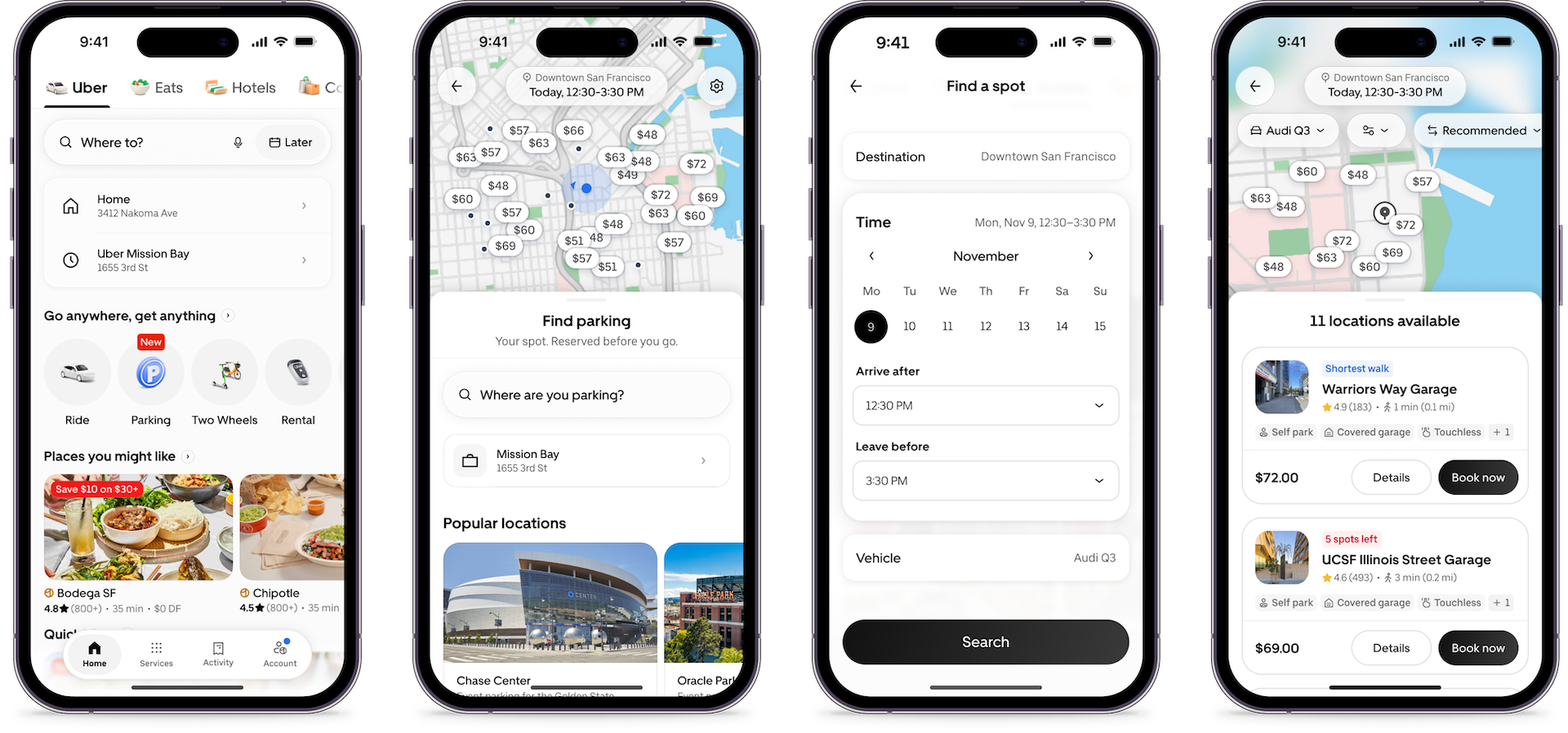
You’ve waited in that line at a garage and watched the price tick up on your screen. Uber Parking launches as a direct answer to that irritation: an in-app icon, a search field, dates and times, and an interactive map showing prices and filters for self-park, valet, garages, and open lots.
To reserve a slot you enter your vehicle make, model, and license plate. Entry is handled by QR code or license-plate recognition depending on the facility. Uber says the feature is available in 15 U.S. cities—Atlanta, Austin, Boston, Chicago, Los Angeles, Miami, New York City, Philadelphia, San Francisco, Washington, D.C., and others—with plans to expand.
How does Uber Parking work?
Open the Uber app, tap the new Parking icon, enter where and when you’ll need a spot, and choose from available locations on a map. Prices and filters appear up front. The reservation links to your plate or a QR code so entry and exit move faster. It’s the same sort of friction-reduction SpotHero offered before Uber bought the app and its network of 13,000 garages, lots, and valet services across more than 400 cities in North America.
Commuters grabbing a monthly pass while apps try to own the workday
I’ve watched commuters build rituals—an Uber to the train, then a rented spot for the day. Uber’s pitch is to fold those rituals into one wallet and one app. Amit Fulay, Uber’s vice president of product, called it a way to make getting where you’re going seamless whether you ride or drive.
On the company earnings call, CEO Dara Khosrowshahi framed commuters as a core customer: an Uber to work, a pass to avoid surge, and parking when you drive. That’s not just convenience; it’s product bundling aimed at holding daily habits inside Uber’s ecosystem.
Is Uber Parking available in my city?
Not yet everywhere. The initial roll-out is limited to select U.S. markets, with Uber saying it will expand. If SpotHero’s footprint is any guide, growth could be rapid—SpotHero already covered hundreds of cities before the acquisition—so expect your market to appear on demand rather than on a fixed schedule.
Executives predicting no cars while selling you a space for yours
You’ve heard the speeches: Dara Khosrowshahi predicted fully autonomous fleets in the decades ahead, Andrew Macdonald said ownership will decline in 15 to 20 years. Those are authority cues that shaped investor expectations and product roadmaps.
And yet today Uber is monetizing the present: a parking reservation turns every car into potential revenue. The company bought SpotHero months ago and says SpotHero will continue as a separate app even while its inventory feeds Uber’s offering. Uber already partners with more than 30 autonomous-vehicle players—names such as Waymo and Zoox sit on that list—so it’s playing both sides of the street.
Will Uber stop personal car ownership?
I don’t have a crystal ball. The truth is messier: ownership will decline in some corridors and for some demographics, and persist or even rise in others. Uber’s strategy is pragmatic—sell parking today, stage facilities for autonomous fleets tomorrow. The company talks about using parking lots as staging and waiting areas for self-driving vehicles; in my reporting that reads as a way to reduce deadheading, congestion, and wear on AVs while keeping real estate in its ecosystem.
Parking inventory becomes a staging ground while cities wrestle with congestion
Near several downtown garages I visited, drivers already use apps to reserve spots for concerts or errands. Uber’s addition makes that behavior part of the daily commute.
By folding SpotHero’s inventory into Uber’s interface, the app gives commuters an all-in-one choice: ride, ride-subscription, and a place to leave your car. For Uber it’s a revenue line that survives whether autonomous fleets arrive next year or 20 years from now. For you, it’s another decision in the calculus of owning a car versus paying per trip and per space.
Think of the move as turning parking into a backstage where cars wait their cue—ready to appear when demand calls. You can follow the company’s investor briefings, podcasts such as 20VC where Andrew Macdonald has spoken, and press releases about acquisitions to watch how this strategy unfolds; I’ll keep tracking what those signals mean for prices, access, and city streets.
So which future will win—the one that sells you a spot today or the one that sells you a ride tomorrow?