
Planes sat silent on the taxiways as controllers traded terse messages. I watched status boards blink from busy to blank; you felt the country tilt for a moment. The FAA lifted a nationwide ground stop late Friday, but the calm didn’t erase the alarm.
Secretary of Transportation Sean Duffy and Department of Homeland Security head Markwayne Mullin told reporters at 8:30 p.m. ET that the halt stemmed from a failure in aging FAA telecommunications equipment while crews were installing upgrades. Duffy said the blanket ground stop was lifted at 8:15 p.m. ET to allow critical traffic to move, though most flights remained grounded and chaos continued at major airports.
“Everybody is safe”
An air-traffic control room went from routine to frozen, then back to motion—controllers landed every plane without injury.
I heard Mullin flatly rule out a cyberattack or AI as the trigger, and he explicitly disconnected the incident from Thursday’s Microsoft outage. Duffy, in a sharper tone, blamed decades of underfunding and warned this would happen again unless Congress acted.
Duffy described an “analog telecom” crash that could not be restored on the fly, matching reporting that outages hit several Air Route Traffic Control Centers—facilities that manage high-altitude routing separate from airport towers. Wired and industry sources point to the FAA Telecommunications Infrastructure (FTI), an aging communications network the agency has been converting to fiber optic for years.
“Our switches, our routers actually got overloaded with data,” Duffy said. “They started to give us inconsistency in the data from those routers, and because of that we shut the system down.” He later added the failure caused intermittent communications and radar, which made continued flight operations too risky.
Sean Duffy: “I want $50 billion”
Mullin suggested the immediate trigger was the new equipment overwhelming legacy components during a patching process. He echoed Duffy’s refrain that piecemeal fixes won’t hold: the patchwork doesn’t work. Duffy emphasized that the newer digital IP switches and fiber upgrades did not crash, and he publicly asked Congress for more funding—he even invoked a $50 billion (≈€46 billion) request as a remedy.
I should note Duffy also denied the outage involved SMART, the FAA’s new AI-powered re-routing system that was accelerated into service; he insisted SMART could not have interacted with the failed systems.
What caused the FAA ground stop?
Short answer: hardware and legacy software strain during upgrades, according to officials. The longer answer: the FAA’s FTI network and older analog telecom gear appear to have been overwhelmed as IP-based equipment and patches were introduced, creating inconsistent router data and intermittent radar and communications.
FAA technicians are investigating the issue
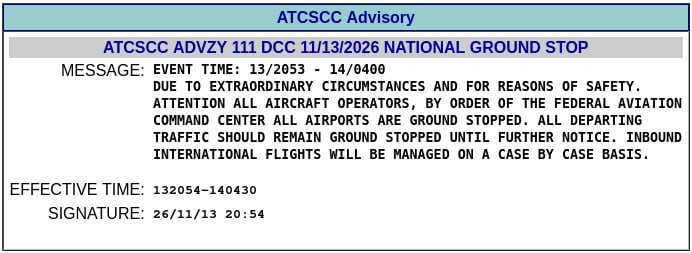
At 3:54 p.m. ET the Air Traffic Control System Command Center posted the first ground stop; airport departure boards snapped from “on time” to “canceled.”
Airlines told passengers to stay home because no one could say when departures would resume. Delta reportedly canceled all outbound flights from LaGuardia; airport operations and crew-hour rules turned an hours-long stop into a cascade of delays. Amtrak’s support feeds flooded as stranded travelers searched for any seat on anything moving.
Industry outlets such as The Air Current warned the ripple effects would last: planes stacked in terminals, crew duty limits forcing cancellations, and a tangle of reroutes across complex airspace. The Associated Press flagged a collateral toll on weekend sports travel—teams were stranded or scrambling for bus legs.
Is the outage a cyberattack or linked to Microsoft’s outage?
Mullin said investigators are keeping an open mind, but there is no firm evidence tying this to a cyber operation or Thursday’s Microsoft failure. Multiple officials and the FAA have pointed at hardware strain during upgrade activity as the proximate cause, and Microsoft services were not implicated in FAA system logs shared so far.
National Weather Service not facing problems
A local NWS forecast office confirmed its radar feeds were live while national headlines suggested otherwise.
Reports of a nationwide NWS outage were traced to an outdated Anchorage-specific page archived in the Wayback Machine. Baltimore/Washington NWS staff told reporters they were receiving radar updates and saw no IT disruption; the agency posted on X (formerly Twitter) that radars and radar.weather.gov were fully operational.
Reuters and others flagged NWS issues, then the office-level checks pushed back: the apparent outage was an old notice, not a current system failure.
Where’s the president?
President Trump posted twice on Truth Social during the ground stop—about tax incentives for Hollywood and a Coast Guard rescue—but did not address the national air emergency.
You could read silence as a choice. For a crisis that snarled airports and frayed travelers, the public statements from the administration centered on infrastructure funding and technical fixes, while attention on platforms such as Truth Social, X, and BlueSky tracked fragments and official denials.
Will flights resume quickly after a lift of a ground stop?
Resuming is gradual. Airspace reopenings prioritize safety and sequencing; you don’t simply flip a switch. Controllers must re-sync traffic, crews hit duty limits, and terminals that filled with aircraft need time to recover—so expect staggered restoration, follow airline alerts, and plan for extended delays.
The incident exposed a brittle patchwork in a system that still depends on old gear while new tech is layered in, like a fuse blown in a fireworks factory. The FTI’s fragility was already a known risk; the mix of legacy analog systems and rushed patches can leave the whole network as precarious as a house of cards. Do you trust the process that let that happen, and will Congress finally provide the budget to stop it from happening again?
In case you heard otherwise, there is no radar outage and radar.weather.gov is fully operational! Outdated content from isolated webpages stating otherwise has been circulating, but NWS radars are operating normally.
— National Weather Service (@nws.noaa.gov) 2026-11-13T23:14:33.105Z