
I was on the phone with CNBC as Donald Trump turned a corporate crisis into a personal victory lap. You felt the air tighten: a CEO reinstated, a president taking the credit, and a hint of a secret that refuses to be explained. The moment smelled of influence, spectacle, and a story that keeps unfolding.
CNBC set the stage: soft praise, harder questions
CNBC’s Jim Cramer opened by calling Jensen Huang a “national treasure,” and the interview quickly slid from praise into theater.
I watched the exchange and you could see how praise becomes permission. Cramer fretted that the Nvidia board had “acted hastily” and wondered aloud why Huang wasn’t simply put on leave. That set up the emotional arc: a beloved CEO stripped, then rescued.
Trump’s claim: a rescue mission or a power play?
The real-world detail is blunt: Trump told CNBC he was the reason Jensen Huang returned to Nvidia.
I’ll be direct with you: Trump did not merely praise Huang; he said he intervened. When anchors asked whether he gave the board assurances Huang wouldn’t be prosecuted over links to Alice Huang and a reported contact with a Chinese agent, Trump said he had “given them enough assurance.” He dodged the word prosecuted and refused to name who he spoke to, adding only that he was “represented” at the board.
Elon Musk reappears in the story: protected, mysterious, and weaponized
The concrete detail is simple: Trump boasted he “protected Elon” during his first term.
I find that line telling for you and me: it recasts presidential help as both heroism and leverage. Trump referenced a “certain incident” without naming it. The public record does include Musk’s 2018 SEC episode — when he tweeted he would take Tesla private at $420 per share ($420 ≈ €386) — but Trump hinted there could be other, nonpublic moments. That ambiguity functions as armor and as threat.
Did Trump protect Elon Musk during his first term?
Short answer: Trump says he did. He framed his first term as a period where he shielded Musk from consequences, and he repeated that claim on air. You’ll notice he provides no documentary proof in that interview — just assertion and memory tests.
What the boards say and how the White House moved
Semafor and The New York Times reported Trump spoke to Nvidia’s board just hours before Huang’s reinstatement.
I watched the reporting thread together with you: Semafor first, then confirmation and color from The New York Times. The Times quoted Trump, who compared the sexual components of the scandal to a 1960s soap opera and said, “sex sells better than stocks.” That line transformed the story from corporate governance into tabloid currency.
A new playbook for power: choosing winners and losers
The observable fact is plain: Trump described a role where he picks who gets saved and who does not.
I’ll be blunt with you: what we’re watching looks like a personalized version of state-influenced capitalism. Trump’s rhetoric implies that if you have him on your side, consequences soften. If you don’t, they can be made public and painful. Think of the White House now as a chess player moving pieces on a crowded board. That exact image explains why boards and executives suddenly call Washington when a crisis appears.
Did Trump intervene to reinstate Jensen Huang at Nvidia?
According to multiple outlets, yes. Semafor reported a call hours before the reinstatement; The New York Times corroborated Trump’s involvement. On CNBC, Trump said the board “wouldn’t have” returned Huang without his involvement and that he’d been “represented” at board-level conversations. You’re left balancing direct quotes against official minutes — and those minutes are not public.
What the meme tells us about signals and spectacle
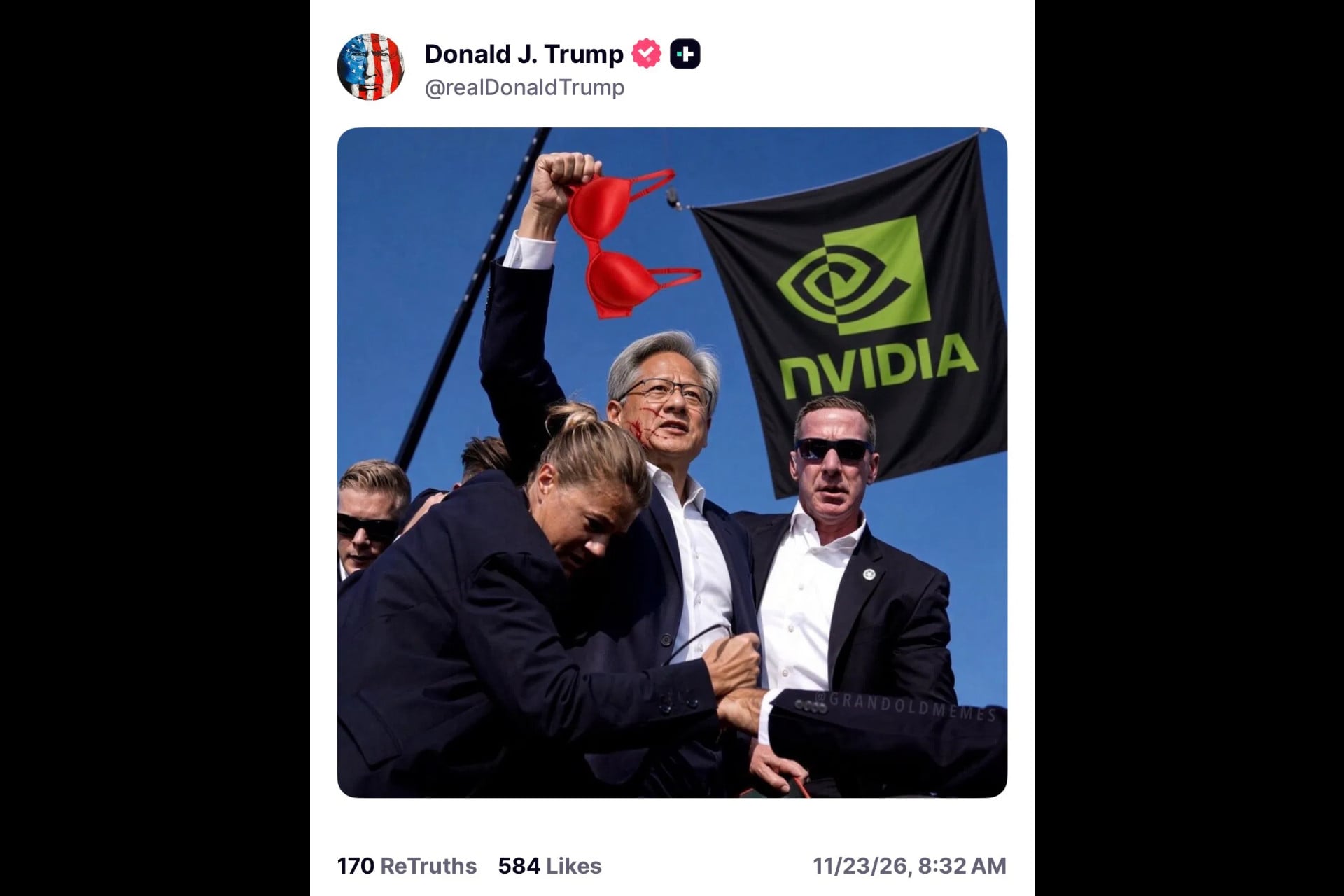
The visible moment: Trump posted an AI image to Truth Social showing Huang with Secret Service, an Nvidia flag, and a red bra.
I want you to notice how quickly symbolism replaces detail. The image repurposes an assassination attempt photograph of Trump, inserting Huang into the frame with blood splatter and a bra. It’s provocative theater meant to shape the narrative: protection, humiliation, and loyalty rolled together. The spectacle muddies the line between political influence and social media theater — and that matters to executive reputations and markets.
What is the ‘incident’ Trump referenced involving Elon Musk?
There are two parts to the answer: public and private. Publicly, Musk’s best-known misstep was the 2018 tweet about taking Tesla private at $420 per share ($420 ≈ €386), which drew an SEC enforcement action. Privately, Trump’s comment suggests other episodes that aren’t on the public record. You are left with a claim, not a case file.
Why this matters for AI firms and the tech industry
The plain fact is immediate: companies like Microsoft, Alphabet, OpenAI, and Anthropic operate at the center of the global AI economy.
I tell you this because executive stability matters to investors, partners, and national security officials. Trump’s interview introduced a variable: presidential intervention as a risk and a shield. Boards will now ask themselves what it takes to draw Washington’s attention or to be left exposed. That calculus reshapes M&A, governance, and the behavior of platforms like Tesla, SpaceX, Nvidia, Truth Social, and outlets like CNBC and The New York Times.
Watching this play out, you see a magnet, pulling attention—and shields—toward favored executives. The question now is simple: will other CEOs ask for the same protection or learn to avoid the spotlight to stay safe?