
I watched a Digital Foundry clip and felt the moment a frame stuttered—sudden, unmistakable. You can see the art and the engineering tugging at each other. I want to help you choose which side of that tug suits your setup.
I’ll walk you through what Pearl Abyss has shipped on PS5 and PS5 Pro, explain the trade-offs, and point out the exact places you should worry or breathe easy. Read fast or skim; I’ll keep the advice precise so you can decide before the download bar finishes.
Crimson Desert PS5 vs PS5 Pro Graphics Modes
I loaded the options screen and counted three modes on both consoles: Performance, Balanced, and Quality. Pearl Abyss published the specs and the split is straightforward — the consoles share modes by name, but not by output or raytracing settings.
Here are the confirmed graphics modes for both PlayStation versions as provided by Pearl Abyss:
| Console | Performance Mode (60 FPS) |
Balanced Mode (40 FPS) |
Quality Mode (30 FPS) |
|---|---|---|---|
| PS5 | 1080p Raytracing Low |
Upscaled 4K (from 1280p, FSR 3) Raytracing Low |
Upscaled 4K (from 1440p, FSR 3) Raytracing High |
| PS5 Pro | Upscaled 4K (from 1080p, Upgraded PSSR) Raytracing High |
Upscaled 4K (from 1440p, Upgraded PSSR) Raytracing High |
4K Raytracing Ultra |
Balanced Mode often looks like the reasonable middle ground: higher visual fidelity than Performance, with fewer frame dips than Quality. Balanced Mode is a tightrope — it rewards a monitor with VRR and a patient eye for the odd artifact from FSR 3.0.
Does Crimson Desert run at 4K on PS5?
Yes — the PS5 can present 4K output in Quality Mode, but on the base PS5 that image is upscaled from 1440p via FSR 3.0. The PS5 Pro can actually hit native 4K in its Quality Mode with Raytracing Ultra enabled.
Does Crimson Desert run at 60 FPS on PS5?
Yes — Performance Mode targets 60 FPS. On base PS5 that means 1080p with Raytracing Low. With a VRR-capable display you can see frame pacing improvements, and the PS5 Pro holds 60 FPS more consistently, though Digital Foundry recorded occasional dips into the 30s during heavy crowd or combat scenes.
Crimson Desert: What Advantages Does PS5 Pro Offer Over Base PS5?
In a hands-on session the Pro kept a steadier framerate across open-world vistas than the base unit. That steadiness comes from two things: raw GPU headroom and Sony’s upgraded PSSR (PSSR 2.0) implementation.
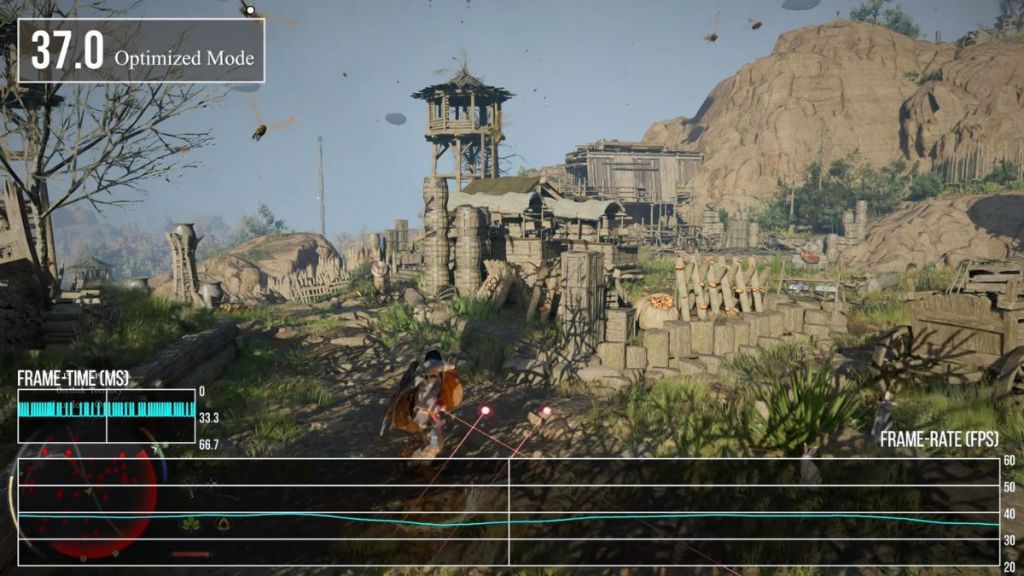
The PS5 Pro is a scalpel: it carves away the need for heavy upscaling in Quality Mode and offers dynamic raytraced global illumination and reflections across modes. That translates to cleaner reflections, more consistent shadowing, and fewer obvious upscaling artifacts when PSSR 2.0 is active.
Digital Foundry’s tests — run on an older build — showed generally positive framerates on the Pro, with 60 FPS in many scenarios and an understandable drop when dozens of enemies and effects taxed the CPU and GPU. DF’s footage is useful because it measures raw frame timing; combine that with community clips and you get a clearer picture than marketing copy alone.
If you’ve cared about Resident Evil Requiem’s use of Sony’s improved upscaler, you already have a reference point: PSSR 2.0 can raise perceived resolution without the traditional performance hit. Developers still need to tune it, and Pearl Abyss will have updates after launch that may change the balance.
The practical takeaway: the PS5 base gives you a capable experience with FSR 3.0 doing the heavy lifting, but the Pro brings native fidelity and fewer compromises when you demand full raytracing and steady framerate.
Which side are you leaning toward — pure fidelity on a Pro, or smarter upscaling on the standard PS5 with a VRR display and some tolerance for occasional dips?