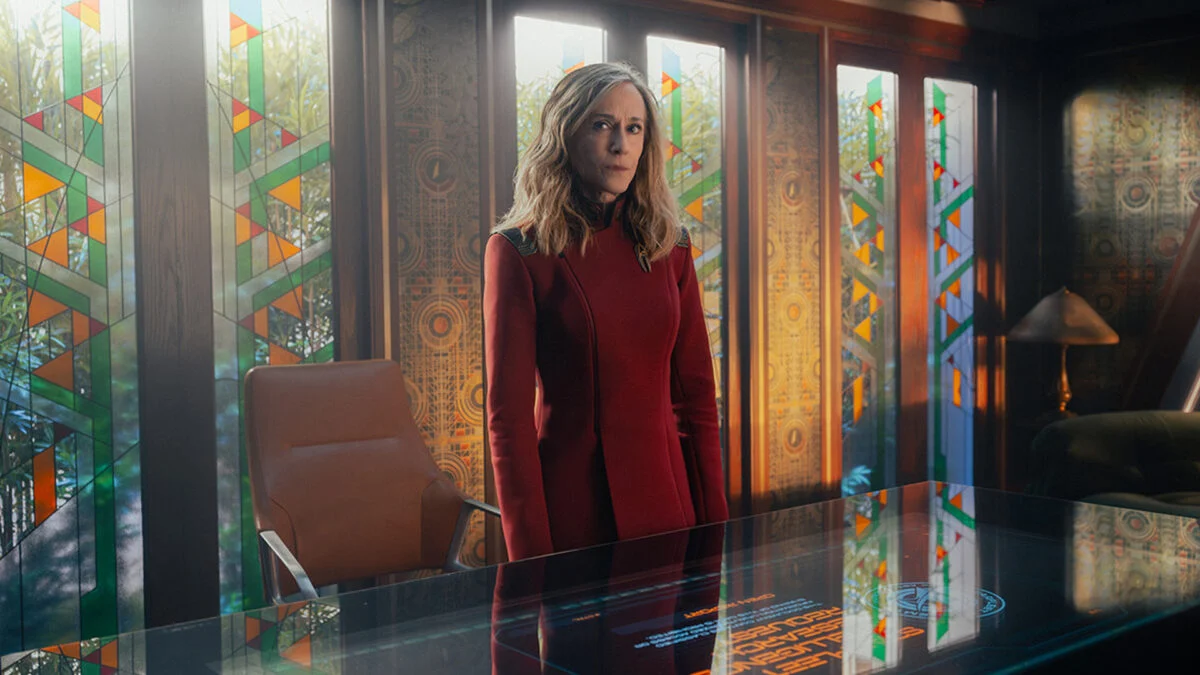
The transporter flickered, and as the shimmering subsided, the cadet realized with a jolt that the coordinates were off—way off. Instead of the bustling Academy courtyard, a desolate, alien landscape stretched before them, a stark reminder of how fragile their 32nd-century tech could be. This week, Star Trek boldly goes where it hasn’t gone before, into the 32nd century with Starfleet Academy, the furthest point in the timeline yet. If you need a refresher on the state of things, cadet, class is now in session.
Setting the Scene: The 32nd Century Beckons
Remember when phone booths vanished, replaced by sleek smartphones? The 32nd century Star Trek mirrors that evolution. Starfleet Academy occurs around 3190, aligning with Discovery‘s fourth season. You might recall that Starfleet Academy’s reopening was mentioned then. The USS Athena, serving as the Academy’s mobile HQ, frequently docks near the Presidio in San Francisco, signifying Earth’s restored role within the Federation after its century-long hiatus.
The narrative’s foundation rests upon “The Burn,” an event from 120 years prior. This cataclysm saw all active dilithium destabilize, crippling warp drive technology. Ships exploded, billions perished, and interstellar travel collapsed, impacting civilizations that relied on faster-than-light travel for almost a millennium. Dilithium became scarce, isolating worlds and stifling galactic connections.
Naturally, the Burn had major effects on the United Federation of Planets.

The Federation’s Fading Star: A Galactic Shift
Think about the European Union after Brexit—that’s the kind of upheaval the Federation faced. The third season of Discovery highlighted the Burn’s origins and the discovery of a new dilithium source in the Verubin Nebula. This discovery paved the way for the Federation’s resurgence after its influence waned post-Burn.
Before the Burn, the Federation boasted 350 member worlds. (The comic, Star Trek: The Last Starship, hinted at near-universal membership pre-Burn, with the Gorn as the final holdouts.) Afterward? Less than 40. Earth, Betazed, Trill, Andoria, and Ni’Var (formerly Vulcan and Romulus) seceded. Only Tellar Prime, among the founding members, remained. The Federation HQ relocated to the USS Federation, a mobile space station, while groups like the Emerald Chain (Orion-Andorian) and Nus Braka’s Venari Ral pirates rose amid the chaos.
How did the Federation rebuild after the Burn?
Following the resolution of the Burn mystery, the Federation initiated diplomatic efforts to reunite with former members. The reopening of Starfleet Academy, shut down after the Burn and Earth’s departure, symbolized this rebuilding phase, welcoming cadets from across the galaxy.
Tech of Tomorrow: 32nd-Century Innovations
Remember the upgrade from vinyl records to streaming music? The tech in Starfleet Academy experienced a similar leap. Set roughly a millennium after the era of The Next Generation, Deep Space Nine, and Voyager, the show showcases technological marvels that redefine Star Trek standards.
Transporters, for example, are now handheld and instantaneous. This advancement has reshaped starship design; while turbolifts still exist, transporters are now the primary mode of transit.
What is programmable matter in Star Trek?
Another game-changer is programmable matter, comprised of reactive nanomolecules. These can be reshaped on demand, either by user command or pre-programmed configurations. This tech revolutionized construction, especially in starship design. Separated nacelles, “floating” around the hull and reattaching as needed, enhance ship performance.
Most standard Starfleet tech has merged into the tricom, a universal device. This replaces the commbadge, personal transporter, and communicator. It also projects holographic PADDs or operates as a tricorder, even when disconnected from a ship’s systems. Physical tricorders still exist; the EMH, a Voyager alum teaching at the Academy, uses them in the premiere.

A Universe of Diversity: Species in the 32nd Century
Envision a modern university campus, a melting pot of cultures and backgrounds; Starfleet Academy is not so different. The student body includes Orions, Ferengi, Kelpiens, Vulcans, Romulans, Betazoids, and more. Among the main characters are Caleb Mir (Sandro Rosta), a human, and Darem Raymi (George Hawkin), a Khionian. Genesis Lythe (Bella Shepard) hails from Dar-Sha, while Sam (Kerrice Brooks) is a Kasq, a sentient hologram. Jay-Den Kraag (Karim Diané) is a rare Klingon. Though Klingons were mentioned in Discovery, their 32nd-century status remained largely unexplored.
What happened to the Klingons by the 32nd century?
Interestingly, Starfleet Academy features several characters with mixed species backgrounds. Chancellor Nahla Ake (Holly Hunter) is half-Lanthanite, while her first officer, Lura Thok (Gina Yashere), is half-Klingon, half-Jem’Hadar—a surprising combination, considering their Dominion War history. Nus Braka (Paul Giamatti) is half-Klingon, half-Tellarite. The prevalence of half-Klingons hints that the Klingon Empire may have suffered greatly after the Burn.
Given how technology has evolved, and how the make-up of the galaxy has shifted, is the Federation truly equipped to deal with new threats, or are they simply repeating old patterns?