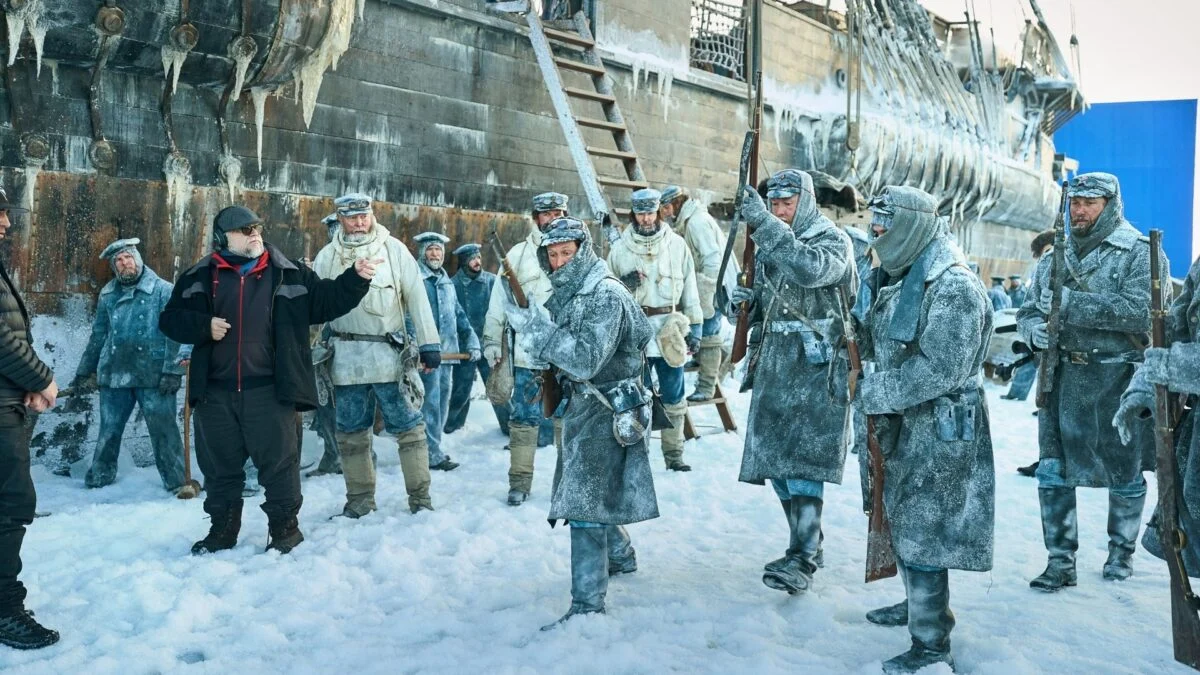
The biting wind whipped across the deck, and the salt spray stung their faces as the camera crew fought to keep their footing. It was madness: a full-scale 19th-century ship, creaking and groaning in a massive water tank, every detail perfect. “Are you sure this is necessary?” someone shouted to Guillermo del Toro, but the director just grinned, his eyes gleaming with feverish intensity.
There’s one thing everyone anticipated with Guillermo del Toro’s Frankenstein: breathtaking visuals. Del Toro has a gift for crafting immersive worlds. Every costume, every prop—down to the most minute detail—must resonate with authenticity. And that’s precisely what he delivered in Frankenstein, particularly when it came to one specific set.
A new behind-the-scenes video about the film’s production design has surfaced. In it, we get a glimpse into the movie’s aesthetic, the intricate props, and much more. Then comes the kicker: the team constructed the boat featured in the film at full scale. And it wasn’t just for show—it could actually move, a feat that required five months of labor. Take a gander.
Guillermo del Toro take us through the creation of the world of FRANKENSTEIN, alongside production designer Tamara Deverell and head of concept design Guy Davis. Critics Choice Awards Winner for Best Production Design. Watch now on Netflix. pic.twitter.com/u9SnptTyLc
— Frankenstein Film (@FrankensteinGDT) January 14, 2026
Certainly, big-budget productions such as Frankenstein often involve elaborate, real sets. These builds frequently span several months. Still, this particular endeavor feels exceptionally grand. When watching the movie, it never crossed my mind that del Toro would commit to erecting a fully functional boat for those scenes. I had assumed it was a partial set enhanced with green screen technology. (Which, to be clear, was also used extensively, given that they didn’t actually shoot on a frozen landscape.)
The sheer scale of constructing the entire boat, filming scenes on it, and circumventing the need to digitally recreate that element is remarkable. That singularity, that completeness, speaks volumes. Add to that the integration of mechanics to simulate the Creature’s movements, and the result is genuinely impressive. It’s a level of dedication that elevates the viewing experience.
Crafting Authenticity: The Heart of Del Toro’s Vision
Think of a master chef, insisting on the freshest ingredients for a dish, even if it means sourcing them from far-flung locales. That’s Del Toro. He doesn’t just want a film; he wants an experience, a tangible reality for the audience. The construction of the full-sized boat underscores his commitment to this philosophy.
The production design of Frankenstein, helmed by Tamara Deverell, clearly prioritizes immersion above all else. Every weathered plank, every rusted rivet, every frosty breath of the actors contributes to a sense of realism that transports viewers directly into the heart of the narrative. It’s world-building in its most literal sense.
What is production design in film?
In film, production design is the art and science of creating the visual appearance of a movie. It encompasses set design, costume design, prop selection, and overall aesthetic. A good production designer creates the world the story takes place in, working closely with the director and other crew to execute the vision.
Beyond the Green Screen: Embracing the Physical
Consider a painter meticulously layering brushstrokes to achieve the perfect texture. Del Toro applies the same level of care to his filmmaking, choosing tangible, physical elements over digital solutions whenever possible. This approach not only enhances the visual fidelity of the film but also provides the actors with a more realistic environment to inhabit, influencing their performances in subtle yet significant ways.
The decision to build a full-sized, functional boat wasn’t just about aesthetics; it was about creating a practical set that allowed for dynamic camera movements and authentic interactions between the actors and their surroundings. Imagine the difference in performance when an actor is actually battling against a swaying, icy deck versus pretending to do so in front of a green screen. The former brings an irreplaceable realism.
Who was the production designer for Frankenstein?
Tamara Deverell served as the production designer for Guillermo del Toro’s Frankenstein. Deverell has also worked on other notable projects, showcasing her expertise in crafting immersive and visually stunning worlds.
The Lingering Question: Where Does the Boat Live Now?
My biggest question, however, is where the boat is now. Does del Toro still own it? We know his penchant for movie props. Can we imagine it simply residing in his backyard? Sitting alongside other relics from his films, becoming a peculiar part of his private collection?
If you haven’t experienced Frankenstein yet, it’s available on Netflix. It’s a noteworthy return to form for the Oscar-winning director. Check it out on Netflix.
What other films has Guillermo del Toro directed?
Guillermo del Toro has directed a wide range of critically acclaimed films, including Pan’s Labyrinth, The Shape of Water, and Hellboy. His work is characterized by dark fantasy themes, intricate creature designs, and a strong emphasis on visual storytelling.
What becomes of these magnificent creations once the cameras stop rolling—do they find new life, or simply fade into obscurity?
Want more io9 news? Check out when to expect the latest Marvel, Star Wars, and Star Trek releases, what’s next for the DC Universe on film and TV, and everything you need to know about the future of Doctor Who.