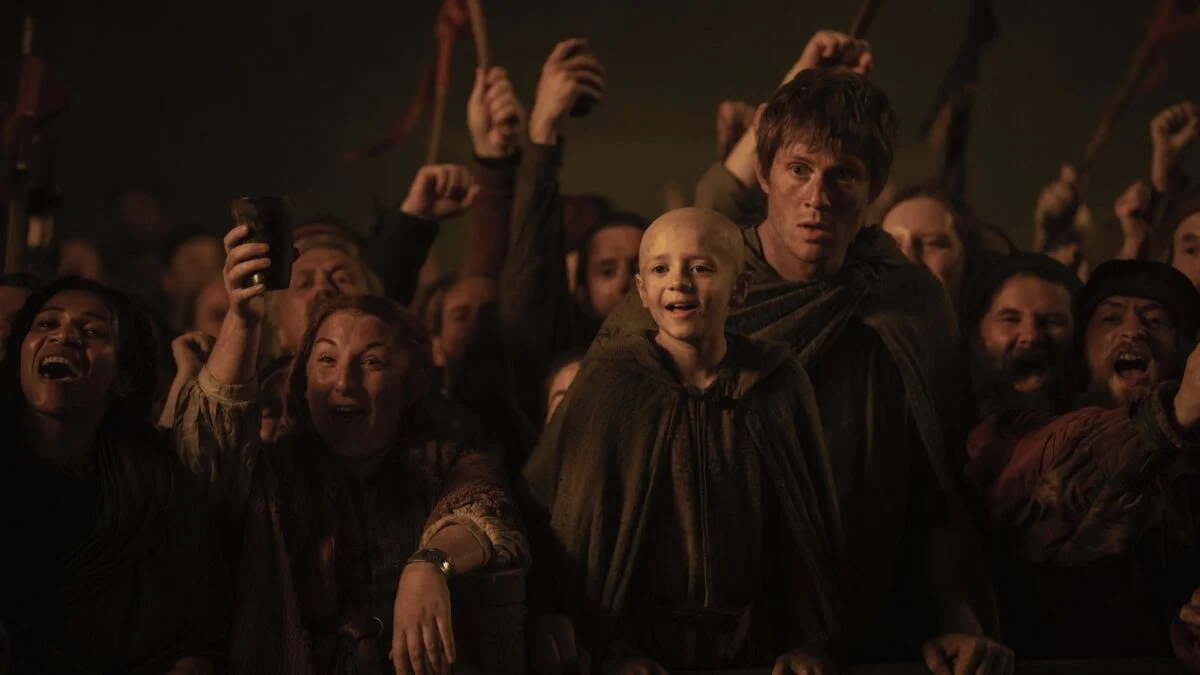
The roar of the crowd faded as the final jouster fell, his armor gleaming under the harsh sun; a hush fell over the arena. It felt like all eyes turned from the fallen knight to Dunk, the unlikely victor. Six-point-seven million viewers felt that similar tension recently, tuning in to see if HBO’s newest gamble, A Knight of the Seven Kingdoms, would stick its landing.
A Knight of the Seven Kingdoms’ ratings weren’t blockbuster—but they were quite solid, proving there’s still interest among Game of Thrones fans to revisit Westeros beyond the fire-breathing theatrics of House of the Dragon. Warner Bros. Discovery reports the premiere episode of HBO’s latest series based on George R.R. Martin‘s fantasy tales pulled in 6.7 million viewers across HBO and HBO Max during its first three days, according to Deadline.
In addition, those numbers make A Knight of the Seven Kingdoms “a top three series launch” in the history of the HBO Max streaming platform, though Deadline noted Warner Bros. Discovery did not share the other two titles.
The first Game of Thrones spinoff, the prequel House of the Dragon, attracted 7.8 million viewers for its season two premiere—impressive, but not as eye-popping as its season one opener back in 2022, which had nearly 10 million viewers and was touted as HBO’s most-watched series premiere at the time.
A Knight of the Seven Kingdoms is a scaled-down take on the Thrones formula, with just six episodes that run around 30-40 minutes each. That’s in keeping with the show’s narrative, which focuses on humble hedge knight Dunk (Peter Claffey) and his squire, Egg (Dexter Sol Ansell), as they navigate the chaotic environment at a local tournament.
By contrast, House of the Dragon had a 10-episode first season (season two and the upcoming season three went for eight), with many installments clocking in at over an hour each.
A Knight of the Seven Kingdoms drops new episodes Sundays on HBO and HBO Max. It has already been renewed for a second season, which is currently in production. Deadline writes that it will arrive next year.
Want more io9 news? Check out when to expect the latest Marvel, Star Wars, and Star Trek releases, what’s next for the DC Universe on film and TV, and everything you need to know about the future of Doctor Who.
Smaller Scale, Solid Impact: A Promising Start
Think about the last time you saw a street performer draw a crowd. It wasn’t pyrotechnics or elaborate costumes that captivated; it was genuine skill, and a story told with heart. A Knight of the Seven Kingdoms mirrors that appeal, trading sprawling battles for intimate character studies and managing to pull in solid viewership. Its debut numbers suggest a hunger for Westeros stories that aren’t solely reliant on spectacle.
The show garnered 6.7 million viewers across HBO and HBO Max in its first three days, according to Deadline. While shy of House of the Dragon‘s initial numbers, it still ranks as a “top three series launch” on HBO Max. This suggests that a more focused narrative, centered around Dunk and Egg, resonated with a significant portion of the Game of Thrones fanbase.
Is *A Knight of the Seven Kingdoms* better than *House of the Dragon*?
That’s the million euro (€920,000) question, isn’t it? Comparing the two directly is like comparing a sleek sports car to a reliable off-roader; both serve different purposes and appeal to different tastes. House of the Dragon delivers grand political intrigue and fiery dragon battles. A Knight of the Seven Kingdoms offers a more grounded, personal story, exploring themes of honor, loyalty, and the challenges of being a good person in a morally gray world.
The viewership numbers reflect that difference in approach. House of the Dragon’s season two premiere drew 7.8 million viewers, while its first season opener had nearly 10 million. A Knight of the Seven Kingdoms, with its 6.7 million viewers, demonstrates a solid, albeit smaller, dedicated audience keen on exploring Westeros through a different lens.
The Dunk & Egg Effect: Why Less Is Sometimes More
Remember that time you sat around a campfire listening to a captivating story? The simple setting amplified the power of the narrative. A Knight of the Seven Kingdoms, with its shorter episode lengths and more intimate storyline, aims for that kind of connection. Its format allows for a deeper exploration of its central characters, Dunk and Egg, and their journey through a less-explored corner of Westeros.
Unlike House of the Dragon, which features sprawling casts and complex political machinations across 8–10 episodes, A Knight of the Seven Kingdoms presents a streamlined narrative within just six episodes, each running around 30-40 minutes. This concentrated storytelling approach allows for a more immediate and engaging experience, focusing on character development and world-building through the eyes of its protagonists.
Will there be a season 2 of *A Knight of the Seven Kingdoms*?
Good news for those who enjoyed Dunk and Egg’s initial adventures: yes! Production is already underway for a second season, with a projected release next year. This renewal signals Warner Bros. Discovery’s confidence in the series’ potential and its ability to sustain audience interest beyond the initial six episodes.
The Future of Westeros: Beyond Dragons and Thrones
Consider the enduring appeal of Arthurian legends. They’re retold and reinterpreted across generations, with each iteration focusing on different aspects of the mythos. A Knight of the Seven Kingdoms represents a similar opportunity for the Game of Thrones universe: to expand beyond the familiar power struggles and explore the lives of ordinary people caught in extraordinary circumstances.
With a second season already greenlit and in production, the future appears bright for Dunk and Egg. The success of this initial season could pave the way for further spin-offs, exploring different eras and corners of George R.R. Martin’s rich fantasy world. The question remains: will HBO continue to invest in these smaller-scale stories, or will the lure of dragons and epic battles prove too strong to resist?