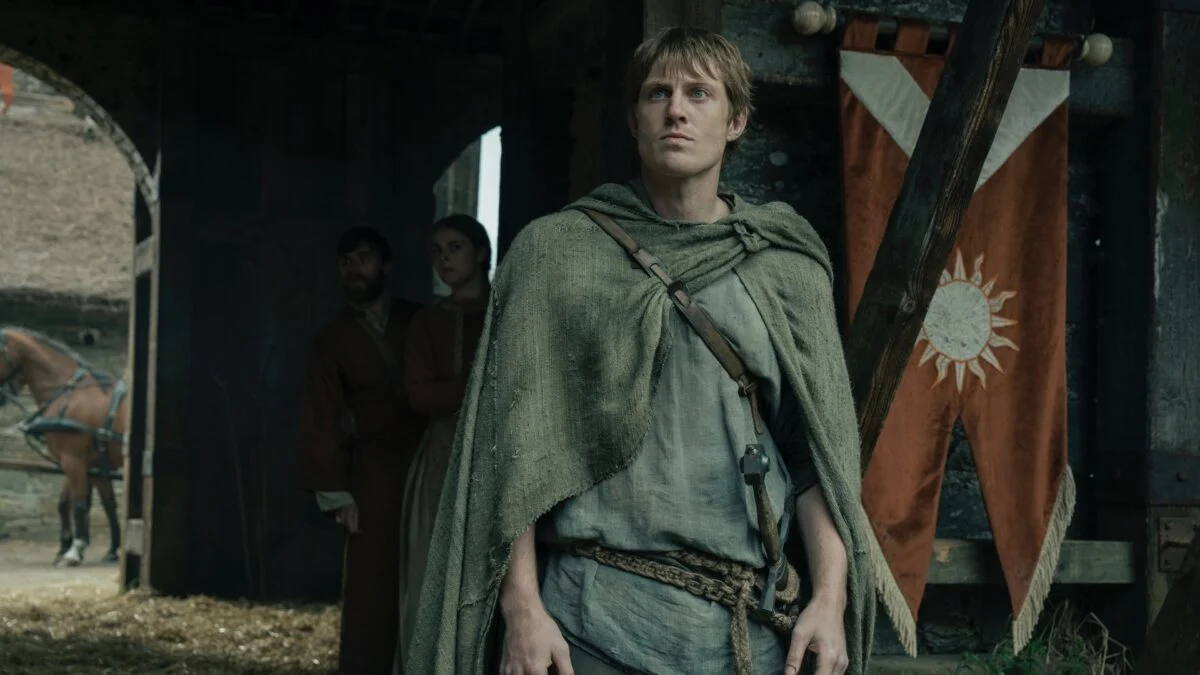
Imagine standing in the crowded stands, the roar of the crowd deafening as two knights charge towards each other, lances lowered. The impact reverberates through the ground, and you flinch, caught up in the raw energy of the moment. That’s the feeling Ira Parker, showrunner for A Knight of the Seven Kingdoms, wanted to capture: a visceral, immediate experience, tethered to the perspective of Dunk.
“Everything in this show … comes back to Dunk and his POV,” Parker said at a recent A Knight of the Seven Kingdoms press conference hosted by HBO and attended by io9. In contrast to Game of Thrones and House of the Dragon, the other shows adapted from Martin’s Westeros books, “We don’t have that roving epic scale of going from family to family and the dead coming to kill mankind and dragons. We have one guy and some horses and a few nice trees.”
Parker continued. “To feel intimate came very easily because we are just following one person’s story, and we’re seeing it through his eyes and trying to adhere pretty strictly to not going outside of that. We don’t have any drone shots in the series … because it’s not Dunk’s POV. It’s not that we would never use something like that, but for our visual language, we want the audience to feel everything that Duncan is feeling at that moment.”
“And so, when he is watching those knights riding each other down in the lists, we want him to feel scared. We want to see those knights looking as impressive as possible. When Dunk is lying down on the mud, we want to feel the grit under his fingernails. When he’s inside that helmet, we want to feel how heavy his breathing is, how hard his heart is beating. These are not comfortable moments. When he’s talking with Tanselle in the market, we want to feel all of his awkwardness.”
Parker also had high praise for Peter Claffey, whose performance brings Dunk vividly from the page to the screen. “There’s only so much you can do with visual language, really,” Parker said. “If it wasn’t for Mr. Peter Claffey just coming in every day and communicating so much with his body language and his eyes and his own sense of humor, we never would have been able to get out Dunk’s inner monologue, which is, of course, so important to this series. It is so important to this novella.”
New episodes of A Knight of the Seven Kingdoms arrive Sundays on HBO and HBO Max.
Want more io9 news? Check out when to expect the latest Marvel, Star Wars, and Star Trek releases, what’s next for the DC Universe on film and TV, and everything you need to know about the future of Doctor Who.
The Unfolding World of Dunk
Think about the last time you felt truly alone in a crowd. The sensation of being surrounded but utterly isolated is powerful, and that’s the core feeling Parker aimed to translate to the screen. The camera rarely strays from Dunk, making you a silent observer in his world.
In adapting George R.R. Martin’s Tales of Dunk and Egg, Parker recognized a singular characteristic: the novellas are intimate character studies. Unlike the sprawling narratives of Game of Thrones and House of the Dragon, Dunk’s story is self-contained. It’s a deliberate choice to ground the viewer in Dunk’s experience, creating a sense of immediacy and personal investment. His journey is the axis around which the story revolves.
How does this POV affect the storytelling in ‘A Knight of the Seven Kingdoms?’
By anchoring the narrative solely to Dunk’s perspective, the show gains an unprecedented level of intimacy. Parker described it as a conscious decision to avoid the “roving epic scale” of other Westeros adaptations. Instead, the focus narrows, magnifying Dunk’s struggles and triumphs. This approach isn’t just a stylistic choice; it’s a narrative contract with the audience, promising a deeply personal journey.
Experiencing Westeros Through Dunk’s Eyes
Remember the sting of grit under your fingernails after a day spent working outside? That’s the level of sensory detail Parker is aiming for. He wants you to feel the weight of Dunk’s helmet, the frantic beat of his heart during a joust, and the awkwardness of a budding romance in the marketplace. This isn’t passive viewing; it’s active participation in Dunk’s world.
The visual language of A Knight of the Seven Kingdoms is meticulously crafted to reinforce Dunk’s POV. Parker made it clear that elements like drone shots are avoided because they would break the immersion. The goal is to ensure the audience perceives the world as Dunk does—limited, immediate, and intensely personal. In essence, the screen becomes a mirror reflecting Dunk’s internal state.
Why is Dunk’s inner monologue so important to the series?
The showrunners understand that Dunk’s internal thoughts are essential. Parker emphasizes that they are vital to the story. Peter Claffey’s performance is key to conveying the depth of Dunk’s character. As a conduit, Claffey uses his body language, eyes, and humor to communicate what Dunk is thinking and feeling, giving depth to the story and connecting with the audience. Without this, the story would lack the layers that make it so engaging.
Peter Claffey: Bringing Dunk to Life
Consider how a single gesture can speak volumes. That’s what Parker found in Peter Claffey’s performance. He is the linchpin that makes the whole endeavor work. The actor becomes a vessel for Dunk’s inner world, communicating volumes with a glance or a stance. For Parker, Claffey’s ability to convey Dunk’s inner monologue is the magic ingredient that elevates the show beyond a simple adaptation.
Without Claffey, the whole concept would risk collapse. He embodies the character, conveying Dunk’s emotions and thoughts without needing constant exposition. His skill means viewers experience Dunk’s world. It’s not just about telling a story but making viewers live it.
What are the challenges of adapting a book with a strong first-person perspective?
Adapting a story so deeply rooted in a single character’s perspective presents unique hurdles. The challenge lies in translating internal thoughts and feelings into visual language that resonates with the audience. It is a gamble that demands careful planning and execution. The success of A Knight of the Seven Kingdoms hinges on how effectively it bridges the gap between Dunk’s inner world and the external world presented on screen. If successful, the series offers a new, intimate perspective within the vast landscape of Westeros.
Will this laser focus on Dunk’s point of view create a more engaging viewing experience, or will audiences miss the grand scale of other Westeros series?