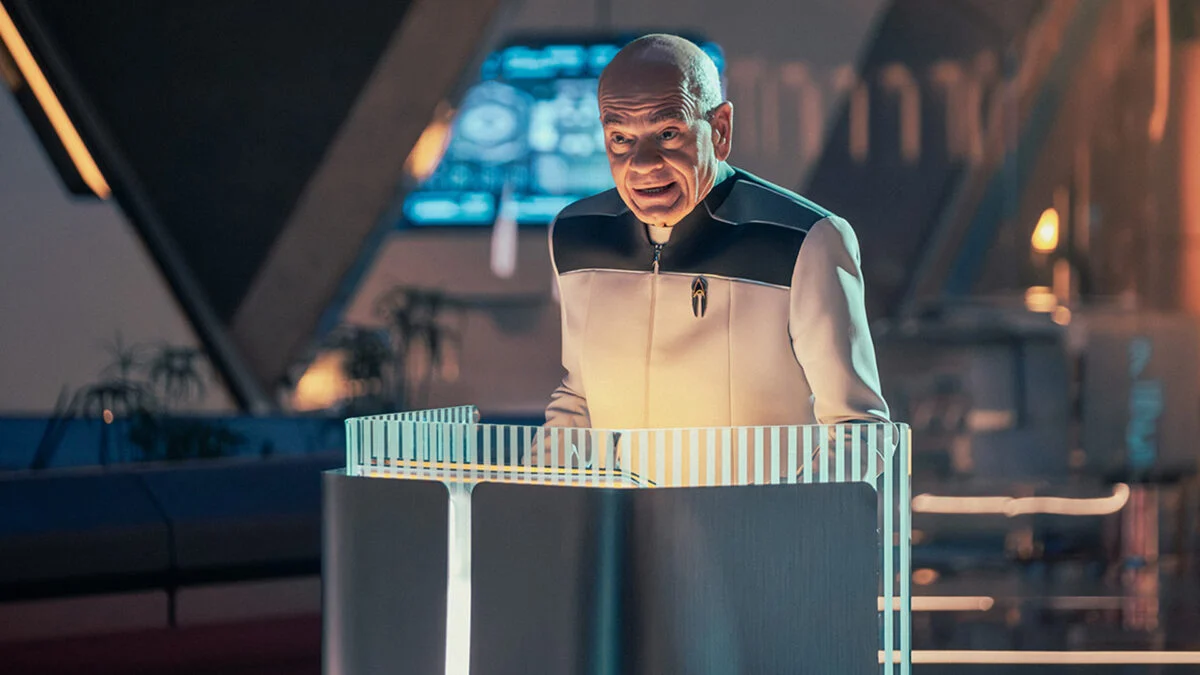
The holodeck flickered to life, and a younger, somewhat bewildered Ensign Kim found himself face-to-face with the Doctor. “Explain to me,” the Doctor began, his tone laced with exasperation, “why your report reads like a transmission from twenty-first century Earth?” It was a valid question that cut to the heart of Starfleet’s communication protocols, a problem that apparently still haunts the 32nd century, as seen in fan reactions to Starfleet Academy.
There are definitely a few things one could critique about the latest Star Trek show, Starfleet Academy, but it’s also hard to deny that the series has come under some incredibly picky scrutiny by some corners of social media, often for things perceived as not being aligned with the kind of supposed decorum that is expected of Star Trek characters. One thing that’s come up regularly after just three episodes, however, is that these gosh darn youths talk a lot like they’re from 2025 for kids from the 32nd century.
While Star Trek has long dabbled with trying to establish a futuristic culture away from contemporary trends and tones, it’s not always regularly adhered to that—but in general, it has tried to adopt a broadly neutral tone and style of talking for Starfleet officers over the years, so when Starfleet Academy comes along with a much more relaxed one, it’s not all that surprising that some Trek fans are a little irked.
But one of the show’s stars—Voyager alum Robert Picardo, who returns as the holographic Doctor for Starfleet Academy—has offered an interesting suggestion as to why that’s the case, beyond the series simply being written in our modern time: these kids are here to learn how to be Starfleet officers, and aren’t arriving at the academy fully formed in that mold yet, so they need someone to teach them how to. And this week’s episode, set around the Academy’s own debate club, will start teaching them that… with the Doctor himself leading the charge.
“My very first thought was that I was president of the debating club in high school, which I wasn’t a very good debater, but I cared a lot about it. That’s the first thing I thought. It was like, ‘Oh, it finally paid off,’” Picardo recently told Collider about the Doctor’s role in spearheading Starfleet Academy’s debate lessons. “But I do believe that, especially in our new show, the cadets talk like kids in the present-day world and in their own vernaculars, but it is important to note that it’s almost like old Star Trek meets new Star Trek. We used to speak in a different way in the old series, that mid-galactic speech, so I think it’s important that when you’re marshaling an argument in a diplomatic situation, that you can speak in well-thought-out and well-planned paragraphs, and not just, ‘Um, well, you know, kind of,’ and that kind of thing. So, I do think that the doctor was pretty demanding [as a teacher].”
Of course, the Doctor has a long history with debate, beyond his charmingly annoying ability to natter the ear off of half of Voyager‘s crew, including fostering his burgeoning passion for writing that ultimately led to him and Captain Janeway having to legally advocate for the creative rights of holographic beings in “Author, Author”. But Picardo is also definitely right that it makes a lot of sense that the Academy’s new generation of cadets needs to learn how to code-switch, and finding the difference between how they talk among themselves as peers and how to talk as Starfleet officers is another nice example of the show applying a Star Trek lesson through its academic setting.
The cadets probably won’t come out of this episode immediately taking in “mid-galactic,” as Picardo aptly put it, much to the chagrin of certain detractors, but it’s nevertheless an interesting way to consider the show’s distinctly contemporary voice in a suitably Star Trek light.
Want more io9 news? Check out when to expect the latest Marvel, Star Wars, and Star Trek releases, what’s next for the DC Universe on film and TV, and everything you need to know about the future of Doctor Who.
Real-World Vernacular vs. Starfleet Protocol
Think back to your first job. Remember stumbling over jargon, feeling like you were speaking a different language than your colleagues? That’s the learning curve Starfleet Academy is exploring, as Robert Picardo explains. The casual chatter of today’s youth clashes against the measured tones expected of Starfleet officers, creating a friction point the show intends to address.
Robert Picardo’s insight offers a different vantage point. The cadets’ contemporary speech isn’t a flaw, but a starting point. They’re not yet the polished diplomats of the Federation. They’re raw potential, and Picardo’s Doctor is there to shape them.
What is ‘Mid-galactic’ Speech?
Picardo jokingly refers to “mid-galactic” speech, but he’s pointing to a deliberate style used in earlier Star Trek series. Think of it as the King’s English of space, a formal and articulate mode of communication meant to convey authority and diplomacy. It’s about choosing words carefully, constructing well-reasoned arguments, and avoiding the verbal clutter of everyday conversation. The Doctor sees the need to instill this in the cadets.
The Doctor’s Prescription: Debate and Diplomacy
Picture the Doctor, holographic and slightly condescending, presiding over the Starfleet Academy debate club. It’s a scene ripe with comedic potential, but also one that underscores the importance of rhetoric in Starfleet. The debate club isn’t just an extracurricular activity; it’s a training ground for future leaders.
According to Picardo, learning to articulate arguments in a diplomatic setting is paramount. It’s the difference between saying “Um, well, you know” and presenting a well-structured, persuasive case. It’s clear why the Doctor would be demanding, his bedside manner leaves much to be desired.
Why is Code-Switching Important?
Code-switching is the ability to adjust one’s style of speech, appearance, behavior, and expression in ways that will optimize the comfort of others in exchange for fair treatment, quality service, and equal opportunity. In the context of Starfleet Academy, cadets need to be able to shift between casual conversation with their peers and formal communication with superiors or alien species. Mastering this skill is essential for navigating the complexities of interstellar relations and is a microcosm for societal fluency.
Contemporary Voice, Classic Values
The initial criticism of Starfleet Academy—that its cadets sound too much like modern kids—misses the point, perhaps. The show isn’t abandoning Star Trek‘s core values; it’s exploring how those values are learned and applied in a new generation. Robert Picardo’s perspective offers a valuable lens through which to view the show’s choices.
The cadets’ journey is, in some ways, a reflection of our own. We all start somewhere, speaking the language of our upbringing. But as we grow and learn, we adapt our communication styles to fit different contexts. Starfleet Academy is simply showing us the beginning of that process, a blank canvas ready to be formed. Is it working?